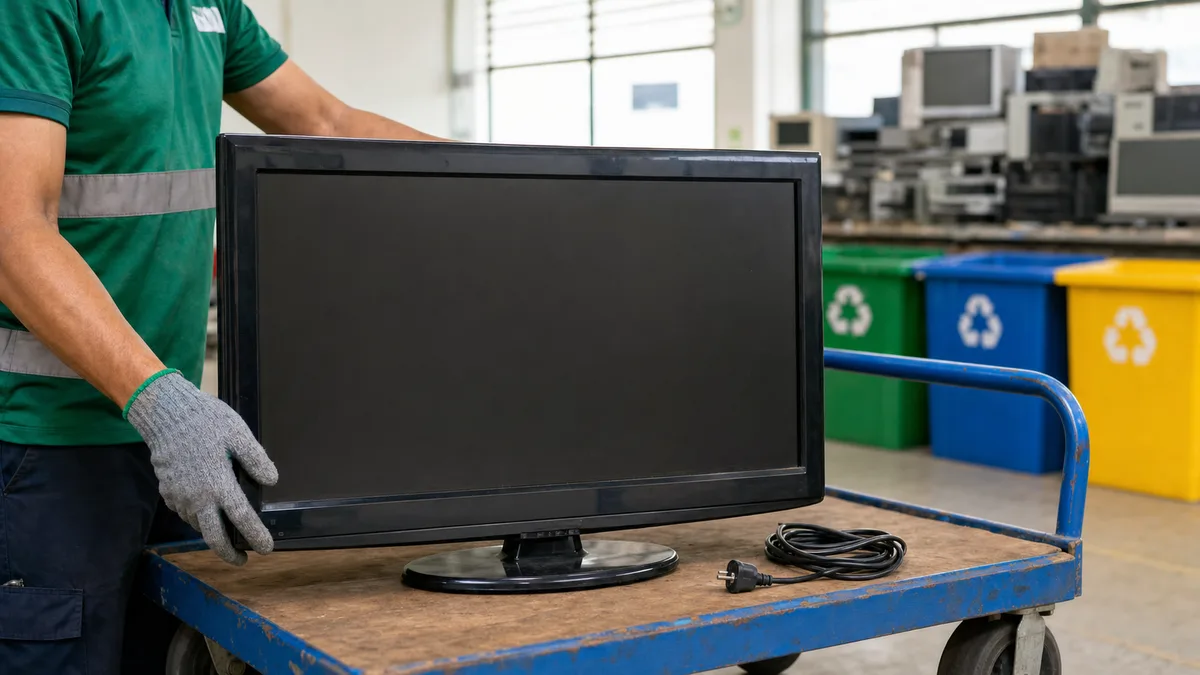
In Panama, the so-called “e-waste law” is not a single statute devoted exclusively to waste electrical and electronic equipment (WEEE). The current framework combines general waste laws, a commission focused on electrical and electronic equipment, and a circular-economy law enacted in 2025. To decide what to do with a computer, phone, or monitor, first distinguish equipment that can still be used from waste that requires differentiated management.
This guide was reviewed against official sources on August 10, 2026. It provides general information, not legal advice. A business dealing with hazardous waste, large volumes, or a specific compliance question should confirm the procedure with its municipality and the relevant environmental and health authorities.
Does Panama Have a Specific E-Waste Law?
In the official-source review completed on August 10, 2026, we found no standalone law governing the entire life cycle of WEEE by itself. Panama does have a framework that covers it:
- Law 33 of May 30, 2018 establishes the Zero Waste Policy. Its definition of hazardous waste expressly includes e-waste, old mobile phones, computers, and electronic devices no longer in use.
- Law 276 of December 30, 2021 regulates the integrated management of solid waste in Panama. It provides the general framework for generation, collection, transport, recovery, treatment, and final disposal.
- Executive Decree 23 of May 4, 2023 creates Panama’s Interinstitutional Commission on Waste Electrical and Electronic Equipment. Creating a specialized commission is not the same as enacting a separate comprehensive WEEE law.
- Law 502 of November 25, 2025 establishes rules for implementing the circular economy. It promotes reduction, reuse, repair, recycling, and extended producer responsibility, and creates the National Circular Economy Council. MiAMBIENTE reported on March 23, 2026 that it had begun interinstitutional work to analyze and draft implementing regulations, so do not infer that every implementation procedure has already been developed in regulation.
The short answer is therefore: Panama regulates e-waste, but the framework does not rest on one single “e-waste law.”
What the Zero Waste Law Requires
Law 33 contains the most concrete rules for a person or business holding electronics no longer in use:
- Article 10 requires public sanitation-service users to separate waste by type, handle it responsibly, present it separately for differentiated collection, and minimize the amount generated.
- Article 11 requires hazardous, potentially hazardous, or special-management waste to be separated within the premises for differentiated collection, recovery, disposal, or confinement as directed by the competent authority and current rules.
- Article 12 requires generators to adopt waste-minimization measures, subject to the competent authority and implementing regulations.
- Article 17 requires commercial and industrial generators to take responsibility for integrated waste management and keep a management program aligned with national and municipal plans. If waste is delivered to a manager, the generator must check that the manager is authorized for the relevant health and environmental handling.
Law 33 exempts household generators from preparing that formal program. This does not make household e-waste responsibility-free: separating it and choosing an appropriate destination remain prudent.
Is Every Unused Electronic Device Automatically Hazardous Waste?
Law 33 uses a broad hazardous-waste definition that mentions electronic equipment no longer in use. Even so, a working device kept, repaired, or transferred for continued use should not be handled like a swollen battery, broken monitor, or contaminated circuit board.
Ask three questions before choosing a route:
- Does it work safely? A device that powers on, charges, has no dangerous damage, and remains useful may be suitable for reuse or donation.
- Is it reasonably repairable? A storage, memory, keyboard, power-supply, or software fault may justify technical assessment before the entire device becomes waste.
- Is it dangerously damaged or no longer useful? Swollen batteries, burnt parts, broken glass, leaks, or contaminated components require isolation and guidance from an authorized waste manager or the competent authority.
Do not open, crush, puncture, or ship a damaged battery. Do not mix hazardous components with ordinary waste.
Donation, Reuse, Recycling, and Final Disposal Are Different
| Route | When it fits | Expected outcome |
|---|---|---|
| Reuse | The device works and another person or organization can use it | Extend useful life without transforming the product |
| Repair or refurbishment | There is a reasonable and safe possibility of restoring usefulness | Keep a repairable device from becoming waste prematurely |
| Donation | Working or repairable equipment may retain educational or technological value | Transfer it for assessment and a possible second life |
| Recycling or recovery | The device cannot be reused, but materials may be recoverable | Process materials under appropriate conditions |
| Final disposal | No safe reuse or recovery option remains | Manage the waste at an authorized facility |
Crezendo accepts requests to assess donations of reusable or repairable technology. It is not presented as a waste manager, certified recycler, or final-disposal operator. For more options by device condition, read this guide on where to donate electronics in Panama.
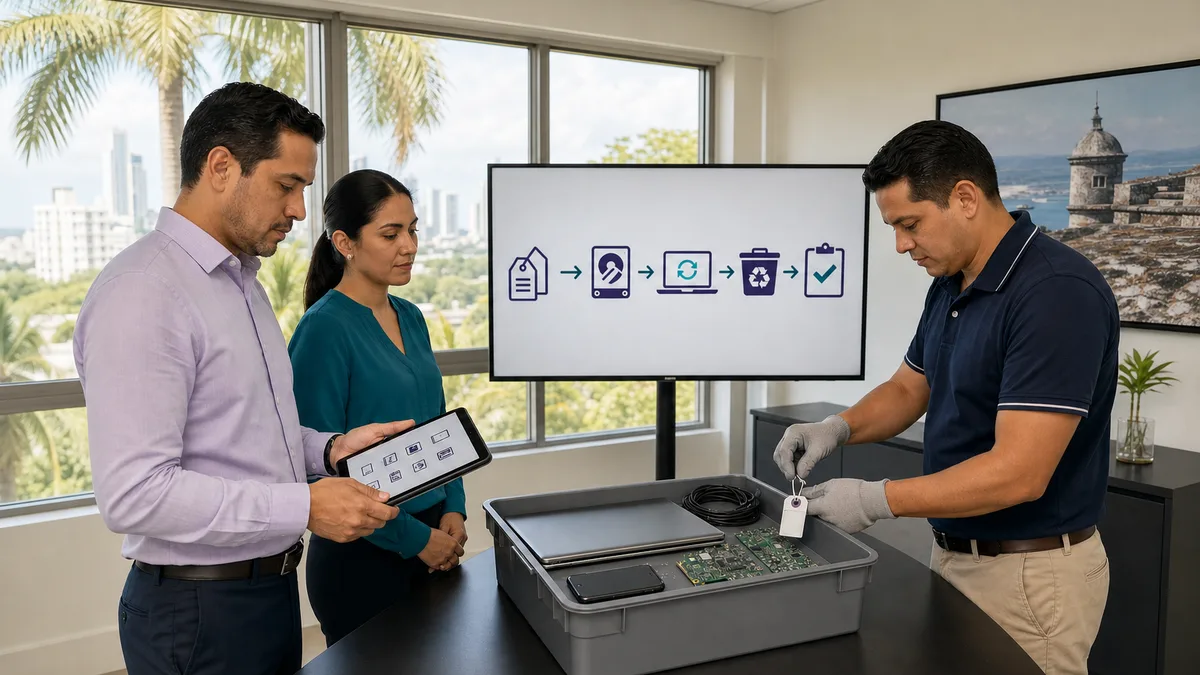
Decision Flow for Unused Electronic Equipment
1. Identify the Device and Its Owner
Record the brand, model, asset or serial number, accessories, physical condition, and internal custodian. In a business, also check accounting, contractual, warranty, and asset-retirement requirements.
2. Isolate Immediate Risks
Separate swollen batteries, wet devices, burnt components, broken screens, and anything leaking or contaminated. Do not present these as ordinary donations.
3. Protect the Data
Before transferring a computer, phone, server, or storage device:
- create an authorized backup;
- sign out and unlink accounts;
- remove SIM cards and external storage;
- use a deletion method appropriate to the sensitivity of the data and the organization’s policy;
- document who authorized and performed the process.
A factory reset is not always equivalent to verifiable erasure. If the medium is damaged or contains sensitive data, consult a specialist. This is a data-security control; it does not make Crezendo a certified data-erasure provider.
4. Choose Reuse, Repair, or Donation When Appropriate
Working or reasonably repairable hardware may retain value. Review what to do with an old laptop and learn how donated equipment can support technical education.
5. Use an Authorized Manager When the Equipment Is Waste
For irreparable, hazardous, or discarded equipment, ask the competent authority which route applies and verify that the manager is authorized for that material. When relevant, retain the quote, authorization, delivery record, weight or quantity, date, and proof of receipt.
Cables also deserve their own classification; this guide explains what to do with unused electronic cables. To understand why electronics should not be mixed or abandoned, read about the environmental impact of e-waste.
Checklist for Businesses
Before retiring equipment from inventory, confirm:
- An asset list records condition and responsibility.
- Reusable equipment is separated from hazardous or irreparable waste.
- Retirement and transfer were approved under internal policy.
- Data was backed up and deleted according to its sensitivity.
- Accounts, licenses, SIM cards, and removable media were removed.
- The integrated waste-management program is current if Article 17 of Law 33 applies.
- Any waste manager is authorized for the material it will receive.
- The handoff is supported by verifiable records.
- Donation is not being used as a substitute for hazardous-waste management.
Official Sources Reviewed
- Law 33 of 2018, Zero Waste Policy, from Legispan.
- Law 276 of 2021 in the Official Gazette.
- Executive Decree 23 of 2023 in the Official Gazette.
- Law 502 of 2025 on the circular economy.
- MiAMBIENTE: interinstitutional work to draft implementing regulations for Law 502, March 23, 2026.
Frequently Asked Questions
Which Law Regulates E-Waste in Panama?
There is no single exclusive law. Law 33 of 2018 expressly includes e-waste, Law 276 of 2021 provides the general solid-waste framework, Executive Decree 23 of 2023 creates the interinstitutional WEEE commission, and Law 502 of 2025 advances the circular economy.
Can a Business Throw Computers and Monitors in Ordinary Trash?
It should not. Law 33 requires hazardous or special-management waste to be separated and requires commercial and industrial generators to take responsibility for integrated management. The specific procedure should be confirmed with the authorities and the applicable municipal plan.
Is Donating a Device the Same as Recycling It?
No. Donation seeks to preserve usefulness through transfer, assessment, repair, or reuse. Recycling processes materials. Hazardous or irreparable waste does not become suitable for donation merely by relabeling it.
Should I Delete Data Before Donating?
Yes, as a security and privacy control. Back up authorized information, unlink accounts, remove external media, and use a deletion method appropriate to the risk. A business should document the process.
What Records Should a Business Keep?
As a control practice: the inventory, retirement approval, erasure record, transfer record, and—when a waste manager is involved—evidence of authorization and proof of receipt. The exact file depends on the device, the waste, and the business activity.
Do You Have Equipment That Can Still Be Useful?
If it works or appears reasonably repairable, do not turn it into waste prematurely. Describe its condition and ask Crezendo to assess it for donation. Dangerous, contaminated, or completely irreparable equipment should follow the route indicated by an authorized manager or the competent authority.