Looking for a basic electronics course in Panama should involve more than comparing topic lists or choosing the option with the fastest promises. For a beginner, the most important combination is clear concepts, measurable practice, and explicit safety boundaries.
A sound introduction does not need to promise a job, certification, or professional mastery within a few weeks. It should help you understand a simple circuit, use basic instruments without improvising, and explain why a measurement makes sense.
What a basic electronics course should help you achieve
By the end of a well-designed introduction, you should be able to:
- recognize common components and describe their purpose;
- interpret a simple diagram and relate it to a physical circuit;
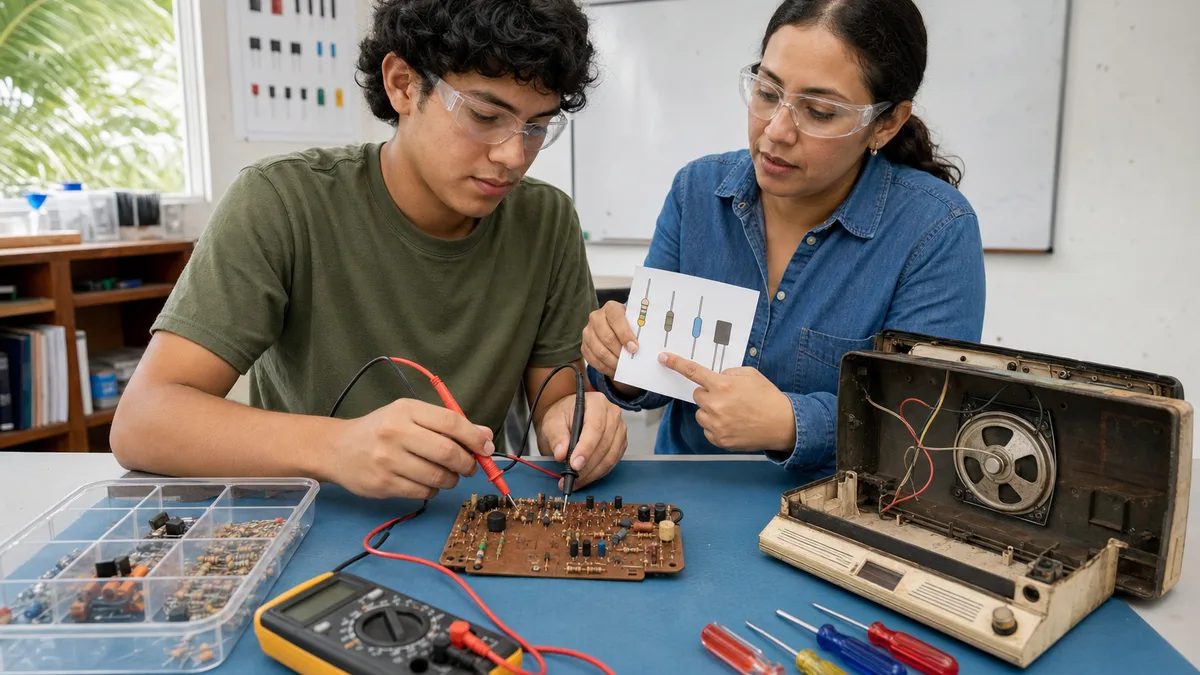
- measure voltage, resistance, and continuity with a multimeter in low-voltage exercises;
- assemble and check basic circuits without relying on blind trial and error;
- form a hypothesis when something does not work;
- record values, changes, and outcomes so a diagnosis can be repeated;
- identify situations beyond beginner scope and know when to stop.
The initial goal is not to memorize hundreds of symbols. It is to build a method: observe, understand, measure, compare, and document.
Minimum content for beginners
Electricity and fundamental quantities
The course should use practical examples to explain voltage, current, resistance, and power. Ohm's law becomes useful when it helps predict and verify a circuit, rather than appearing only as a formula to memorize.
It should also distinguish direct and alternating current, polarity, open circuits, short circuits, and series versus parallel connections.
Components and circuit reading
An introductory path commonly covers resistors, capacitors, diodes, LEDs, transistors, switches, connectors, and low-voltage power sources. Naming them is less important than learning how to:
- recognize orientation when it matters;
- read basic values and specifications;
- understand the role a component plays in a circuit;
- notice visible damage without assuming every failure can be seen.
Multimeter measurements
A multimeter is a central tool, but it must be taught in context. Students need to know which mode to select, where to place the probes, which value they expect, and what can go wrong if the instrument is connected incorrectly.
A useful exercise does not merely say “measure here.” It first establishes an expectation, then takes the measurement, and finally compares the result with the hypothesis.
Assembly, soldering, and diagnosis
Early exercises can use a breadboard and low-energy circuits. Soldering can be introduced after temperature, ventilation, tool handling, and board care have been explained.
Basic diagnosis should divide the problem into power, connections, components, signal, and output. Replacing parts at random may occasionally produce a repair, but it does not build technical judgment.
Diagrams, datasheets, and documentation
Even at an introductory level, students benefit from following a simple schematic, finding a component pinout, and recording measurements. Documentation allows someone else to understand what was tested and prevents unnecessary repetition.
Safe practice and laboratory equipment
Safety should not be a decorative chapter placed at the end of the course. It must be part of every exercise.
Beginner practice should focus on de-energized or low-voltage circuits, with limits established by the instructor. It is not appropriate to improvise work on household mains, microwave ovens, CRT televisions, energized power supplies, deformed batteries, or equipment affected by heat or liquid.
Before enrolling, ask whether the program defines:
- conditions that require an exercise to stop;
- maximum voltage and current for practical work;
- correct use of the multimeter and bench power supply;
- eye protection, ventilation, and orderly workspaces;
- handling of electrostatic-discharge-sensitive components;
- supervision during soldering and diagnosis;
- procedures for odor, heat, smoke, damaged batteries, or broken glass.
Equipment availability also matters. Watching one demonstration in a large group is not equivalent to measuring, assembling, making safe mistakes, and correcting them with feedback.
How to evaluate the instructor, format, and materials
A serious program should answer these questions precisely:
- Who is it designed for? A first course with no prerequisites is different from training for technicians who already repair equipment.
- What will participants actually do? Ask for examples of circuits, measurements, or diagnostic tasks rather than module names alone.
- Which tools will each participant use? Confirm access to a multimeter, power supply, breadboard, components, and soldering equipment when relevant.
- How is learning checked? Observable exercises, a lab notebook, or a simple project may be more informative than a conventional exam.
- What does the price include? Ask about materials, tools, replacements, manuals, and additional costs.
- What is outside the scope? An honest proposal states what will not be covered and which activities require a later level.
- Does the format fit the objective? Theory can work online, but manual skills require materials, adequate camera views, supervision, or well-organized in-person sessions.
Questions to ask before enrolling
Before paying or reserving a place, request concrete information about:
- total duration and hands-on hours;
- maximum group size;
- required previous experience;
- included projects or exercises;
- tools you must bring;
- who keeps the materials afterward;
- safety criteria;
- the exact type of attendance record or certificate that can be issued;
- make-up session policies;
- support available after the workshop;
- format, location, and accessibility.
Be cautious with claims such as “become a technician,” “guaranteed employment,” or “repair any device.” Introductory training can build useful foundations, but proficiency requires further practice, varied cases, and competent supervision.
Technical training you can ask Crezendo about
Crezendo maintains a catalog of workshops and training areas that includes technical capabilities such as computer repair and phone repair. Group availability, level, format, tools, and exact content must be confirmed for each request.
Review Crezendo's current workshops and training areas. When your interest is specifically basic electronics, describe your current level, learning objective, number of participants, and whether you need an individual option or an organizational proposal. Crezendo can explain what is currently available or whether a related scope can be designed.
Ask Crezendo about availability and scope
How donated equipment can support practice
Boards, power supplies, radios, computers, and other devices may provide material for observation, component identification, or diagnosis when their condition is safe and there is a specific educational need.
This does not mean every device is automatically accepted or should be delivered without coordination. Prepare a list with the model, condition, visible damage, accessories, and useful photos. Then use the page to ask about donating technology and wait for confirmation before transporting anything.
Donation can support hands-on learning, but it should not replace the main answer for a reader who came here looking for training.
Frequently asked questions
Do I need previous mathematics or electricity knowledge?
Not necessarily. An introductory course can start with fundamentals, but it should explain which calculations will be used and provide enough practice to connect them with real measurements.
Should a beginner course include soldering on the first day?
Not necessarily. It can begin with breadboards, component identification, and measurements. Soldering is appropriate after tool handling, temperature, ventilation, posture, and circuit care have been explained.
Which instruments should I learn to use?
At minimum, a multimeter in low-voltage exercises. Depending on scope, the course may also use a bench power supply, breadboard, and hand tools. An oscilloscope can be introduced later when the fundamentals justify it.
How can I tell whether the practical work is safe?
The instructor should state voltage limits, risks, protective measures, stop conditions, and supervision. A vague “nothing will happen” or encouragement to work on hazardous equipment without a protocol is not an adequate safety plan.
Does Crezendo currently offer a specific basic electronics course?
The technical portfolio can change according to demand, resources, and delivery format. Contact Crezendo to confirm whether a specific option, a related workshop, or an adaptable proposal is currently available. This guide is not an announcement of an open cohort.
Your next step
First define what you want to learn: circuit fundamentals, instrument use, soldering, diagnosis, or a broader technical path. That objective will help you compare real proposals and ask Crezendo for a concrete answer about availability, scope, and delivery format.