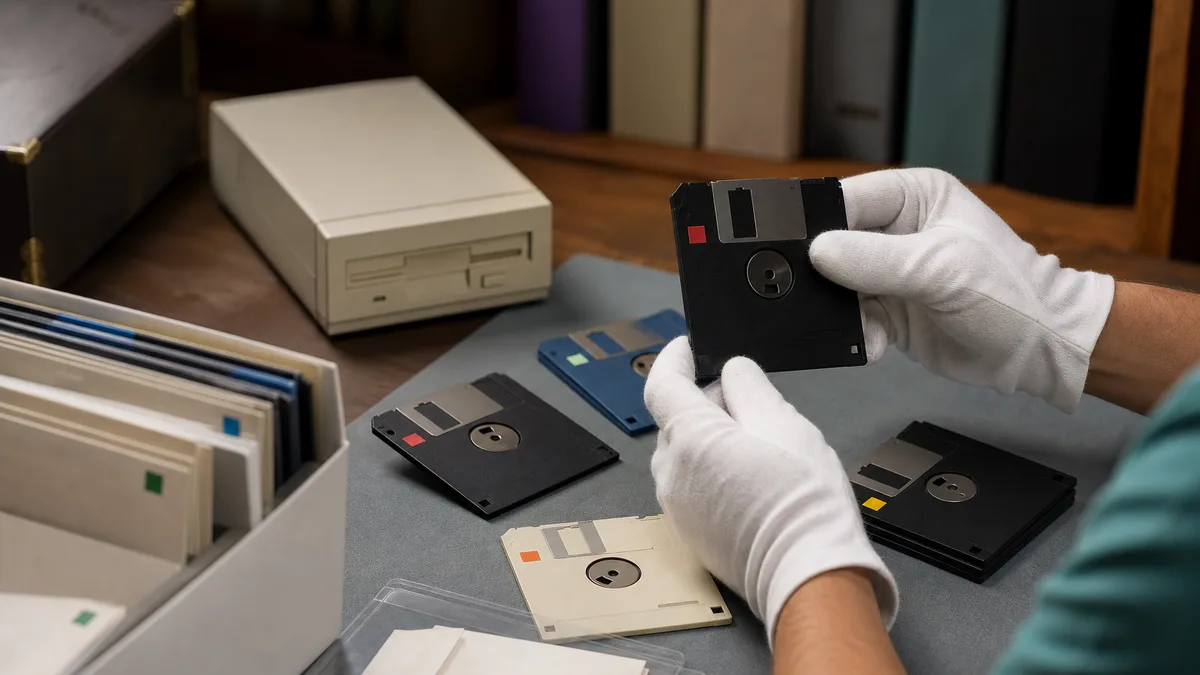
A 3.5-inch floppy disk may contain a commercial game, a backup copy, saved games, personal documents, or files nobody remembers. Its label does not prove what is actually stored, and the fact that a game is no longer sold does not automatically make it free software or public domain.
Before offering a box of disks in Panama, separate four tasks: inventory without alteration, identify physical risks, decide what to do with possible private data, and preserve information about provenance and licensing. Crezendo can assess a description of the collection, but it does not guarantee acceptance, reading, recovery, emulation, exhibition, permanent preservation, or educational use.
Do not test first: document first
Inserting every disk into an unknown drive may wear the medium, contaminate the reader, or change metadata. Begin on a clean, dry table away from food, liquids, magnets, and speakers.
For each group, record:
- label text and disk number;
- brand, apparent format, and quantity;
- game or program it supposedly belongs to;
- associated platform or computer, if known;
- box, manual, registration card, receipt, or license;
- owner or provenance, without publishing personal details;
- approximate date and last known use;
- signs of mold, corrosion, moisture, distortion, or loose pieces;
- whether it may hold saved games, documents, or other personal data.
Photograph front, back, label, and the complete group. Do not peel original labels or write on the shell with a marker. Put an identifier on a separate sleeve or bag.
If the collection includes optical media, see the guide to donating old CDs, DVDs, and games. If it belongs with a historical computer, the guide to preparing an Apple II and protecting privacy explains how to retain context between equipment and media.
Warning signs that require stopping
Do not insert a disk when you see:
- mold, diffuse spots, or particles inside the window;
- rust or corrosion on the metal shutter;
- a cracked, bent, or open shell;
- moisture, sticky residue, or flood damage;
- strong odor or contamination of unknown origin;
- displaced or wrinkled magnetic disk;
- a jammed shutter or loose pieces.
Do not open the shell, apply alcohol, use compressed air, or attempt to “clean” it in a drive. Isolate the item in a clean sleeve, record the issue in the inventory, and ask before moving it with healthy material. Mold and residue can contaminate other objects or the drive.
The Library of Congress explains that floppy-disk recovery requires specialized hardware, software, and techniques. Its preservation work may create images of magnetic flux and work from those representations to reduce wear on the original. This institutional capability should not be confused with a promise that every disk will be readable.
Privacy: a “game” label is not enough
Old games could write saves, player names, settings, or support files to the same disk. Someone may also have reused the disk for documents, accounting, or correspondence. Treat it as data-bearing media until shown otherwise.
Choose a path before handover:
- Exclude the disk: retain any item that may contain sensitive data.
- Offer only clearly identified commercial material: separate saves, homemade copies, and personal media.
- Authorize a limited assessment: define in writing whether directory reading or imaging is allowed and who may access it.
- Sanitize: choose a method suitable for the media and data sensitivity, recognizing that it may destroy preservation value.
- Destroy: for high-risk information, this may be the only acceptable decision under your policy.
NIST SP 800-88 Rev. 2 frames sanitization according to sensitivity and the effort required to make access infeasible. File deletion or formatting is not a universal guarantee. Old media also creates a genuine conflict: reading helps identify content but exposes data; overwriting may reduce privacy risk but destroys the content someone hoped to preserve.
Do not send passwords, documents, name lists, or screenshots of contents through the form. Crezendo does not provide forensic analysis, certified erasure, or custody of sensitive information by default. If you cannot make a safe decision, retain the medium.
Donating the object does not erase software rights
The physical disk and the game embodied in it are not the same property. WIPO Lex identifies Law 64 of 2012 as Panama's main law on copyright and neighboring rights. Exact conditions may depend on the license, origin, rights holder, and intended use.
As a cautious editorial rule:
- transferring the carrier does not automatically authorize publication of disk images online;
- a closed company or an “abandoned” game is not proof of public-domain status;
- an unauthorized copy does not become legitimate through age;
- preservation, research, exhibition, emulation, reproduction, and distribution are different acts;
- boxes, manuals, keys, certificates, and contracts may clarify applicable conditions;
- a backup copy may be subject to rules and terms linked to the original copy.
The U.S. law cited in the sources illustrates the distinction between ownership of a material object and copyright, but it does not replace Panamanian law. A project that intends to copy, publish, lend, or run software should review Law 64, the relevant license, and applicable legal advice.
Do not download another copy from the Internet to “complete” the set, and do not publish contents as part of the donation. The initial purpose is documentation and assessment, not an advance decision about lawful exploitation.
Preserve provenance and context
A collection's informational value may lie in relationships between its pieces. Keep together, while physically separating when needed:
- numbered disks from one program;
- manuals and maps;
- codes or cards, hiding personal information in public photographs;
- technical notes from the previous user;
- a floppy drive and compatible computer;
- adapters, cables, and drivers;
- original boxes and labels.
Do not mix disks found in different households or organizations. A simple note such as “family A, computer X, used around this period” may be more informative than cosmetic cleaning.
If the collection includes 5.25-inch floppy disks, apply the same inventory, provenance, privacy, and physical-handling principles and clearly identify the format in the inquiry. For PC collections on optical media, see how to offer old PC games.
Temporary storage and transport
Library of Congress guidance for magnetic media favors a clean, cool, relatively dry, stable environment with little light and distance from magnetic fields. In a home, this becomes a set of simple precautions:
- avoid attics, cars, balconies, and damp basements;
- keep disks upright and supported without compressing them;
- use clean sleeves and a correctly sized rigid box;
- separate items affected by mold or moisture;
- keep them away from speakers, motors, transformers, and vacuum cleaners;
- avoid direct sun, heat, dust, and rapid changes;
- do not place adhesive material over original labels;
- do not seal wet material in bags.
These measures reduce risk but do not guarantee preservation. Plastic and magnetic layers age, and compatible readers also become less available.
If reading or imaging is considered
A professional assessment first defines the purpose: identify format, recover files, document content, detect personal information, or preserve a representation. It then selects suitable hardware and workflow.
Questions to resolve first include:
- Who owns the medium and who authorizes access?
- Could it contain third-party information?
- What rights exist in the game or program?
- Will the original, an image, or selected files be preserved?
- Where will copies be stored and who can view them?
- What happens if sensitive data or malicious software appears?
- How will errors and modifications be documented?
Do not connect an old drive to your everyday computer without controls. Files may be incompatible or risky, and the reader itself may damage the medium. This article does not provide a forensic procedure or promise recovery.
How to request a Crezendo assessment
Prepare a summary with:
- number of disks and photographs;
- titles and apparent platform;
- availability of boxes, manuals, licenses, and hardware;
- general area in Panama;
- provenance you are able to share;
- possible personal data;
- damage, mold, moisture, or distortion;
- any access or use condition you want to retain.
Submit the inquiry through the donation page and wait for confirmation. Do not transport the collection until acceptance and logistics are agreed. Crezendo may request more information, accept a portion, or decline it; this article does not establish offices, hours, or pickup.
Frequently asked questions
Can I inquire when I do not know the contents?
Yes. Describe labels, provenance, and possible data. Do not test the disks merely to satisfy the form. State the uncertainty explicitly.
Should I erase saves or documents?
Decide based on sensitivity and purpose. Simple deletion may be insufficient, while overwriting may destroy information. For sensitive data, excluding the disk often preserves control while you seek advice.
Can I offer a game without its box or manual?
You may offer it while disclosing what is missing. That does not guarantee acceptance, readability, or permission to use it. Available documentation helps assess provenance and licensing.
Does donating the disk transfer the license?
Do not assume so. The carrier, license, and copyright are different questions. Review terms and applicable law before copying, distribution, or execution.
Does Crezendo guarantee game recovery?
No. Reading depends on condition, format, reader, and technique. The inquiry does not promise imaging, repair, emulation, or permanent preservation either.
Can I include the drive or computer?
Include them in the inventory and photographs without experimental power-on. Each component requires explicit acceptance.
What should I do about mold?
Isolate the item, keep it out of drives, and report the condition. Do not use chemicals or compressed air without a professional procedure.
Ask before delivery
After completing the inventory, separating media that may hold data, and retaining licensing documentation, use the page to inquire about donating floppy disks. Wait for confirmation of acceptance and logistics. A careful assessment protects the medium, privacy, and the rights of the people who created or used the software.
Primary sources reviewed
- Library of Congress: Preserving Collections on Floppy Disks
- Library of Congress: Care, Handling, and Storage of A/V Materials
- NIST SP 800-88 Rev. 2
- WIPO Lex: Panama legal profile
- U.S. Copyright Office: ownership of copyright and material objects
- U.S. Copyright Office: Copyright and Digital Files FAQ