Used Bluetooth headphones combine three issues that should be resolved before offering them for donation: they may remain linked to an account or location network, they contain lithium-ion batteries, and they have been in direct contact with skin and ears. Preparing them well does not mean testing them at any cost or applying one universal cleaning recipe.
Crezendo can assess a description of the equipment and confirm whether it accepts the offer. The inquiry does not guarantee pickup, repair, disinfection, reuse, spare-parts recovery, or an educational destination. Wait for a response before transporting the headphones.
Identify the set and its condition
Start without opening or charging the device. Gather and photograph:
- exact make and model;
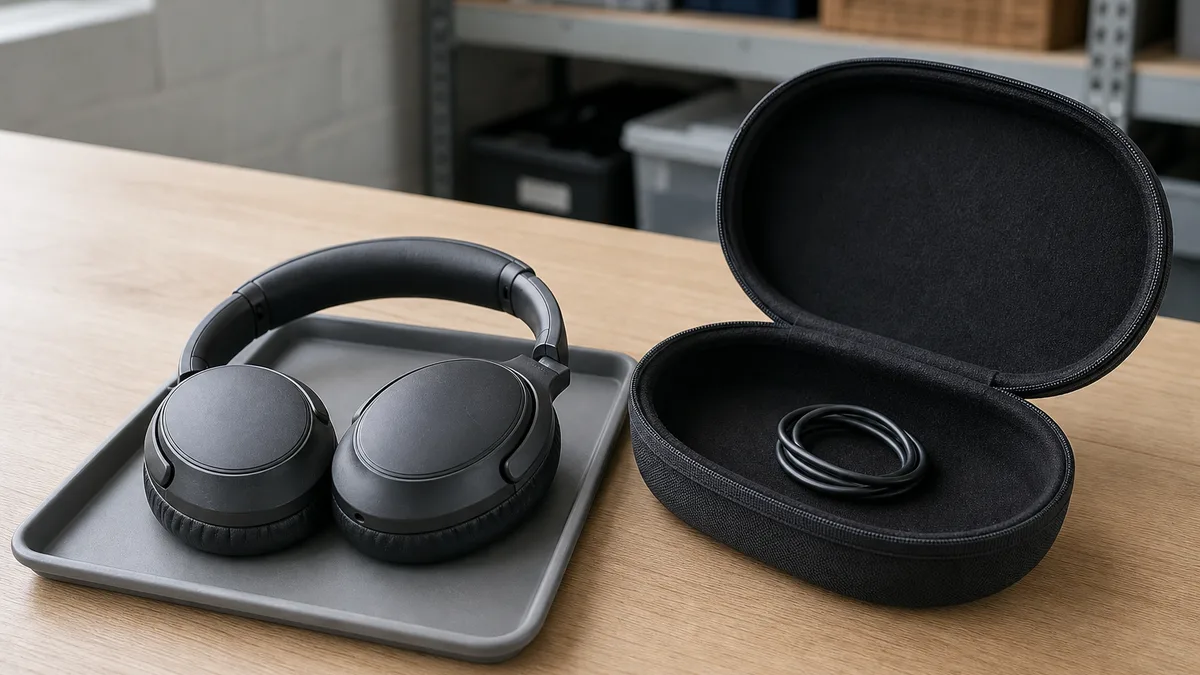
- headphones or the right and left earbuds;
- charging case, when applicable;
- cable and power adapter, identifying whether they are original or compatible;
- cushions, replaceable tips, and removable pieces;
- manual, box, or receipt after removing personal information;
- physical damage, corrosion, moisture, odor, or missing parts;
- approximate battery life only when known from recent use;
- observed faults: one side without audio, microphone, buttons, charging, or connection.
Do not publish complete serial numbers or screenshots of your account. You do not need to pair a forgotten product merely to complete the form; describe honestly what you know and what you did not test.
Stop if the battery appears damaged
Do not charge, power, open, press, or test headphones or cases that show:
- a bulging, separating, or distorted enclosure;
- abnormal heat at rest or during an earlier charge;
- leakage, corrosion, chemical odor, smoke, or hissing;
- impact, puncture, fire, or immersion damage;
- a burned port or cable with exposed conductors.
The EPA says a swollen lithium-ion battery is damaged and may represent a fire hazard. Keep the device away from combustible material, avoid unnecessary handling, and seek instructions from the manufacturer or a competent handler. If there is smoke, intense heat, or immediate danger, move away and call emergency services.
Do not extract an internal battery or ship it as an ordinary parcel. Transport and receiving rules may differ for damaged batteries. Disclose the condition to Crezendo, but do not assume it can accept the device. The guide on what to do with old Bluetooth headphones helps separate assessment, reuse, and disposition.
Remove links to your account
Forgetting a device on a phone and removing it from an account are not always the same action. Some models participate in location networks or associate with a manufacturer account.
Follow the official manual for the model and check these layers:
- Forget the headphones in Bluetooth settings on every phone, tablet, or computer you control.
- Remove them from the manufacturer account or app when that feature exists.
- Disable their participation in device-finding or location services.
- Clear the customized name and preferences with the official reset procedure.
- If they belonged to a business or school, confirm removal from inventory and management.
Apple explains that AirPods must be removed from the Apple Account before transfer so another person can associate them and use features such as Find My. Google says a Pixel Buds reset clears settings, name, and preferences; on supported models it also resets the relationship with Find Hub. These are examples of why you should use manufacturer instructions instead of steps copied from another product.
Headphones generally do not hold a document library like a laptop, but they may retain names, preferences, account association, and location features. Do not share screenshots, passwords, or verification codes during the inquiry.
Reset only with the model's procedure
Search for the exact product name on the manufacturer's official support site. The process may require placing the earbuds in their case, connecting it, holding a button, or interpreting a light sequence. It can change between generations from the same brand.
After resetting:
- confirm that the phone no longer shows an active connection;
- check the account or location network;
- avoid pairing them to your account again merely for a final test;
- record when you could not complete or verify the process;
- do not claim “data erased” when the manufacturer only refers to settings and association.
If the headphones do not power on, remove them from accounts through the available dashboard and disclose that the physical reset could not be verified. Crezendo does not provide certified erasure or account recovery by default.
Cleaning: use specific instructions, not a homemade mixture
Hygiene matters, but aggressive cleaning can push liquid into microphones, meshes, ports, or batteries. Check the brand's manual first and separate removable pieces only when the manufacturer permits it.
A cautious routine for preparing the inquiry is:
- turn off and disconnect the equipment;
- remove loose debris with a clean, soft, dry cloth;
- do not submerge, rinse, or spray directly;
- do not insert objects in the charging port;
- do not use needles, blades, high-pressure air, or abrasives;
- let every part dry completely before storing or charging;
- replace deteriorated tips or cushions when designed for replacement, without assuming the recipient will accept them.
Chemical recommendations vary. Google's Pixel Buds safety guide calls for a clean, soft, dry cloth and advises against detergents, powders, and agents such as alcohol or benzene. Apple publishes different instructions by model and component; in some cases it permits a slightly damp cloth or alcohol on a case but requires keeping liquid out of ports and drying fully. Do not extrapolate an AirPods formula to every headset.
In-ear products with damaged mesh, discharge, mold, persistent odor, or degraded porous material may not be hygienically reusable. Do not conceal the condition with perfume or paint. Photograph and disclose it.
Minimal tests, only when everything is safe
When there is no swelling, heat, moisture, corrosion, or electrical damage, a short test may provide useful information. Use the correct cable and a compatible power source. Check:
- whether the case and headphones accept charge;
- whether they appear in Bluetooth settings;
- left and right audio at moderate volume;
- microphone, buttons, or touch controls;
- disconnections, noise, or heating;
- approximate duration of a short test, not a battery-life promise.
Stop at abnormal heat, odor, electrical noise, or distortion. Do not sleep or leave the device unattended during an assessment charge. Skip the test when you do not know the correct power source.
A successful test does not certify safety or battery health. It is only an observation for the assessment.
Accessories to include
List everything in the form and wait for confirmation about what to deliver:
- matching charging case;
- identified, undamaged cable;
- proprietary adapters or USB receivers;
- clean, separated tips or cushions;
- removable audio cable;
- manual and box, after removing personal labels.
Do not mix unidentified cables. Do not include a wall adapter merely because the connector fits. To prevent loss, place small components in a bag labeled with the model, without putting tape on delicate surfaces.
How to request an assessment
On the donation page, provide:
- Make, model, and photographs of the set.
- General area in Panama, without posting your address.
- Physical condition, battery condition, and any moisture exposure.
- Test result, if testing was safe, and what was not verified.
- Account-removal, reset, and location-network status.
- Cleaning performed and missing replaceable pieces.
- Available accessories.
Wait for explicit confirmation. Crezendo may request more information, accept particular components, or decline the offer. Do not assume hours, offices, pickup, or a later use.
What an assessment may decide
Electrical condition, hygiene, compatibility, and capacity may support direct reuse, technical study, use of an accessory, or none of those paths. This article does not promise assignment to students, workshop disassembly, or repair.
For the broader reasoning, see the benefits and limits of donating used technology. You can also read how donated technology may support education, while remembering that every offer requires assessment and no beneficiary is guaranteed.
When donation is not viable
A device with a damaged battery, contamination that cannot be cleaned safely, or irreparable damage may need a specialized channel. Lithium-ion batteries must not go into household garbage or municipal recycling. Confirm current rules for small devices, integrated batteries, and damaged units directly with an appropriate handler.
Recycling is a later alternative, not a service this article attributes to Crezendo. Before transfer to any third party, complete whatever account removal is possible and ask how it handles data and batteries.
Frequently asked questions
Can I inquire about headphones that do not turn on?
Yes. Send photographs, model, accessories, and condition. The inquiry does not guarantee acceptance. Do not charge them when a damaged battery is possible.
Should I forget them on all my phones?
Forget them on devices you control and, where applicable, remove them from the account and location network. Follow official instructions because features vary by brand and generation.
Can I use alcohol to clean them?
There is no universal answer. Google advises against alcohol in the cited Pixel Buds guide; Apple permits it only for certain components and conditions. Use the exact instructions for your model.
Are headphones accepted without a case or cushions?
Describe that in the inquiry. A missing piece can change usefulness, but only Crezendo can confirm acceptance after assessing the offer.
What if the battery lasts only a short time?
Disclose observed run time and any heating. Reduced duration is not the same as swelling, but do not promise safety or continue testing when abnormal signs appear.
Will I receive a certificate or tax receipt?
This article does not promise certificates, receipts, or deductibility. Ask about any required document before transferring the equipment.
Start with information, not transport
Once you have identified the model, checked the battery, removed accounts, and prepared cleaning according to the manufacturer, use the page to inquire about donating Bluetooth headphones. Wait for confirmation about acceptance and logistics. This protects your privacy and avoids moving a device that requires another form of handling.