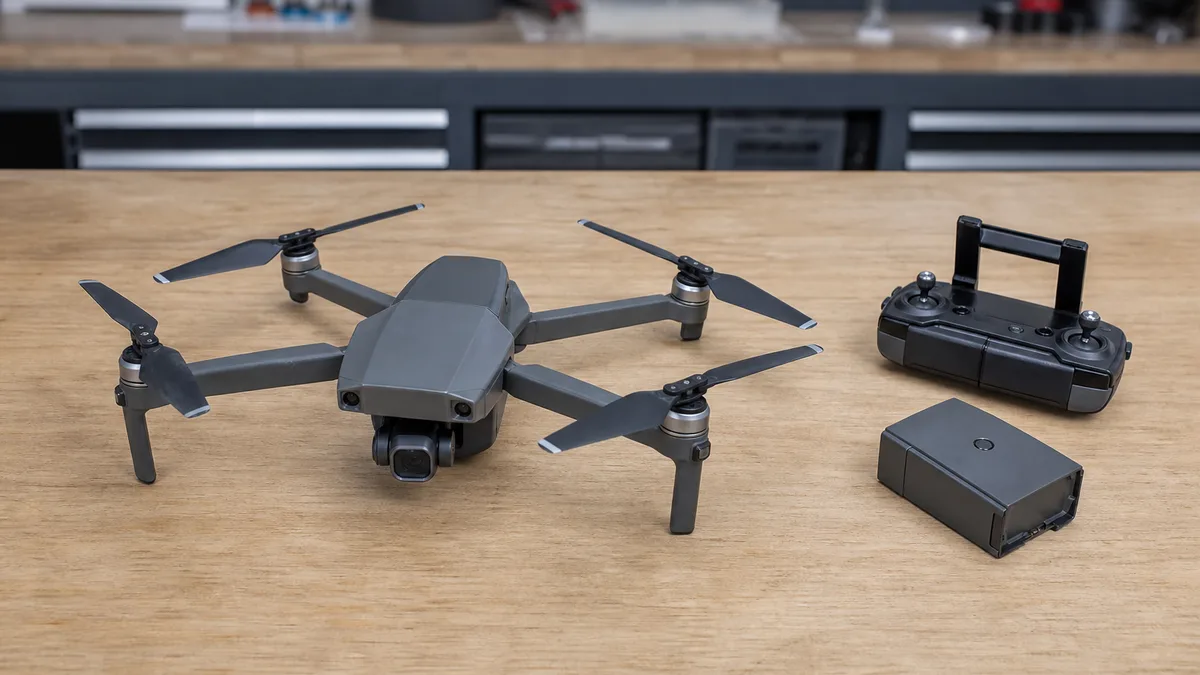
A drone you no longer use may retain value as a complete device, a source of parts, or supervised practice material. It may also contain a battery that poses a fire risk, personal images, a linked account, or an aviation registration that does not disappear when the device changes hands. Responsible donation therefore begins with an evaluation, not with an unannounced drop-off.
You can ask Crezendo to evaluate a possible donation. Describe the model, condition, accessories, and every battery, then wait for confirmation and instructions before moving or shipping anything. Submitting the form does not guarantee acceptance, pickup, repair, educational use, or recycling.
Quick answer: how to begin
Use this sequence:
- Identify the make, model, and serial number, but do not publish the serial number on social media or public listings.
- Visually inspect the drone, controller, and batteries without powering or charging a damaged component.
- Remove your memory cards and review accounts, apps, controllers, and internal storage.
- Gather clear photos and an honest description of impacts, failures, repairs, and missing parts.
- Submit the information through the donation page, reporting each battery's condition separately.
- Wait for a response confirming whether Crezendo can evaluate or receive the set and how to proceed.
Do not perform a demonstration flight. Photos, known history, and a component inventory are normally more useful for an initial review. Flying an unknown device, a crashed drone, or one that has been stored for a long time can endanger people, property, and the aircraft itself.
Evaluation determines what may be received
A donation form is a request, not authorization to deliver. A decision may depend on physical condition, battery safety, parts availability, documentation, compatibility, storage capacity, and potential usefulness at that time.
| Reported condition | What to include in the request | What not to assume |
|---|---|---|
| Complete and working when stored | Model, last use date, photos, and battery cycles or status if the system already displays them | That it is still safe or will be accepted for flight |
| Powers on with a fault | Exact symptom, error messages, earlier impact, and repairs | That Crezendo will repair it or obtain parts |
| Does not power on | Storage time, available charger, visible damage, and battery condition | That it should be charged for testing or will be useful for parts |
| Incomplete | List what is present and missing: controller, camera, propellers, charger, battery | That every isolated component will be received |
| Crash or water exposure | Photos without handling it, approximate date, and event description | That it is safe to energize, open, or transport |
| Abnormal battery | Swelling, puncture, leakage, odor, heat, smoke, or impact damage | That it should be included or taken to a drop-off point |
Crezendo may decline a complete device, consider only selected components, or request more information. Do not ship it, leave it at a location, or arrange transport independently until you receive specific instructions.
Lithium batteries: inspect before handling
Many drones use lithium-ion or lithium-polymer batteries with high energy density. Even when discharged, they may retain enough energy to cause a short circuit or fire. The U.S. Environmental Protection Agency warns that swelling indicates damage and a potential fire hazard; its guidance also says lithium batteries do not belong in household garbage or curbside recycling. Specific handling and transport rules in Panama must be confirmed with the manufacturer and the competent local authority or waste operator.
Signs that stop preparation
Do not charge, power, squeeze, puncture, disassemble, or attempt to “drain” a battery showing any of these signs:
- swelling or a distorted case;
- puncture, crack, or detached terminal;
- leakage, residue, unusual odor, or hissing;
- unusual heat while idle;
- smoke, heat discoloration, or a prior fire;
- immersion, internal moisture, or a strong impact;
- a manufacturer safety alert or recall.
Keep people away if you can do so without handling the battery. If there is smoke, fire, increasing heat, or an immediate danger, move away and call emergency services. For a damaged battery without an obvious emergency, request direction from the manufacturer and a competent local authority or program. Do not take it to Crezendo, send it by courier, or travel with it until an appropriate responsible party confirms a safe and applicable procedure.
Hazardous-material transport authorities warn that damaged or defective batteries carry greater risk and may face special restrictions; some cannot travel by air. General internet advice cannot replace assessment of the battery or the rules of the carrier and Panama.
If the battery looks intact
“Looks intact” does not mean “certified safe.” Do not charge it merely to prove it works. If it is removable by design and can be removed without force, switch the device off, follow the manual, and keep metal tools away from terminals. Keep each battery separate and protected from impacts, heat, and metal objects. For used, undamaged batteries, official guidance recommends isolating exposed terminals with nonconductive tape or placing each battery in a separate bag without hiding its label; confirm any preparation with the manufacturer and the intended receiver.
Report chemistry, capacity, model, quantity, storage time, and any reading the app already shows. Do not invent cycle counts or open the pack to measure cells. Crezendo may decide that a battery cannot be part of a possible donation even if it considers the drone.
Privacy: a drone is more than its SD card
Photos and video can identify people, homes, license plates, locations, or routines. Panama's National Authority for Transparency and Access to Information explains that Law 81 of 2019 defines personal data as information about natural persons that identifies or makes them identifiable. This guide is not legal advice, but that principle is a practical reason to remove your data before any handoff.
Inventory every place where information may exist:
- the drone or camera microSD card;
- internal aircraft storage;
- memory in a controller with a screen;
- FPV goggles or recording units;
- the phone or tablet used for operation;
- the manufacturer's app and cloud copies;
- flight logs, maps, device names, and Wi-Fi networks;
- linked accounts, service plans, or coverage attached to the device.
Back up what you must retain. Remove cards and do not include them unless you intentionally want to donate them after erasure. Follow official model instructions to clear storage and reset the aircraft, controller, and compatible accessories. Some models support removing the drone from the original account; for compatible DJI devices, for example, the manufacturer says the original account owner must unbind it before another person can bind it.
Do not generalize one brand's tutorial to all devices. Resetting the aircraft may not delete copies on a phone, in the cloud, in goggles, or on a card. It also does not by itself change a registration with Panama's Civil Aviation Authority. When finished, power the equipment down, remove any remaining sessions or credentials, and verify the result without loading private data again.
If the drone cannot be powered safely, say so in the request. Do not share a password so somebody else can try to erase an account. Crezendo does not promise forensic wiping, data recovery, or deletion of a donor's accounts.
Panama regulation: donating and flying are separate decisions
Panama's Civil Aviation Authority, the AAC, is the official reference for registration, licensing, permits, and operation of remotely piloted aircraft systems. In the August 10, 2026 reverification, the AAC notice dated September 26, 2025 still directs users to standard AAC/DG/01-21 and Resolution 004-2021-NRA-DG-AAC of April 13, 2021 for general rules, while reminding operators about restrictions in specific areas. The official AAC drone portal continues to publish procedures, the RPA registration form, and operational resources; check it for updates before acting.
Physical donation does not grant permission to fly. Removing a label, resetting an account, or giving a receipt should not be assumed to update an aviation registration. The official sources reviewed do not describe one universal “donation transfer” procedure for every case.
Before coordinating a handoff, ask the AAC directly about the current procedure if:
- the drone is registered or carries AAC identification;
- the declared owner, responsible possessor, or operator will change;
- a license, policy, permit, or file is associated with it;
- it was imported or belongs to a business or institution;
- you do not know whether an update is required.
Keep available proof of ownership, and do not remove serial numbers or official labels. If the equipment is leased, financed, subject to a claim, found property, or of uncertain ownership, do not donate it until title is resolved. Possible acceptance does not authorize Crezendo or anyone else to operate it without meeting current rules.
Preparing information without putting the equipment at risk
You do not need to disassemble the drone. Place it powered off on a stable surface and photograph the front, underside, arms, motors, camera, controller, charger, and accessories. Photograph model numbers and labels necessary to identify components; send the serial number only through the requested channel, not in a public image.
Include a simple record:
- exact make and model;
- authorized owner;
- approximate purchase year and last use date;
- known state: working, intermittent fault, does not power on, or untested;
- impacts, water, sand, corrosion, overheating, or repairs;
- missing parts and modifications;
- quantity and individual condition of batteries;
- included accessories and whether they are original or compatible;
- account, storage, and possible AAC registration status.
“Untested” is better than powering an unsafe device or claiming it works. Do not erase a history of faults. Accurate disclosure helps determine whether further evaluation makes sense.
For related controllers, cameras, capture devices, and cables, the guide to donating audiovisual and streaming equipment may provide additional context. That link does not mean those accessories are automatically accepted.
Accessories to inventory
Group them without connecting them:
- remote controller and antennas;
- installed and spare propellers, noting chips or distortion;
- guards, landing gear, and case;
- camera, gimbal, and covers;
- FPV goggles, receivers, and modules;
- charger, charging hub, and power cable;
- manuals, tools, and spare parts;
- invoice or proof of ownership, when applicable;
- batteries, listed separately and only if they show no sign of damage.
Do not include accessories of unknown origin, contaminated parts, written credentials, or media holding personal information. Do not connect a charger of uncertain compatibility. If a propeller is damaged, remove it only if the manual permits and mark it as unusable; never perform a test flight with it.
Request, decision, and coordination
A careful process has four control points:
- Request: complete the Crezendo donation form with the inventory and any requested photos.
- Clarification: answer questions about ownership, condition, data, batteries, and registration. Do not send passwords.
- Decision: wait for explicit confirmation about whether the complete drone, selected accessories, or nothing will be considered.
- Coordination: follow only confirmed instructions for date, place, and preparation. Do not assume pickup or bring a damaged battery.
The decision may change if physical inspection reveals a different condition. A handoff also does not guarantee repair, flight, reuse, inclusion in an activity, or any timetable.
If you are assessing several hardware categories, read how to donate technology to support education in Panama and review the benefits and limits of donating used technology. Each category requires its own evaluation.
Possible uses, always conditional
If the device is accepted and found safe, some components might support design observation, diagnostics, documentation, supervised disassembly, study of motors and sensors, practice with unpowered parts, or recovery of spares. Equipment considered for operation would also require technical assessment, safe batteries, and AAC compliance.
These are possibilities, not promises. Nobody can guarantee who will use the drone, in which activity, whether it will be repaired, whether it will fly again, or whether it will produce an educational outcome. A damaged battery should not be kept “to teach safety” when its presence creates unnecessary risk.
Donations from businesses and institutions
The person submitting the request must be authorized to dispose of the asset. Before a handoff, the organization may need to:
- retire the asset under its policy;
- retain the invoice, asset number, and internal approval;
- document which components and batteries belong to the lot;
- apply its data-protection and retention process;
- review contracts, insurance, warranties, and AAC registration;
- agree on the record it needs and confirm whether one can be provided.
Do not promise Accounting a document, economic valuation, deduction, or tax treatment before confirmation. This guide does not provide appraisal or tax advice on Crezendo's behalf.
If the drone or battery cannot be received
A decline does not mean the equipment belongs in the trash. Ask the manufacturer first about programs, alerts, and model-specific handling. For a battery or component with no safe reuse, seek direction from Panama's competent environmental, municipal, or hazardous-waste authority and verify that any operator is authorized for that category.
Do not put lithium batteries in household trash or recycling. Do not abandon the device or send it to a third party without confirming reception and transport conditions. This guide does not certify recyclers or replace local instructions.
Frequently asked questions
Does Crezendo accept drones that do not power on?
You may request an evaluation, but acceptance is not automatic. Report that it does not power on, how long it was stored, and the battery's condition. Do not charge it merely to test it.
Can I donate a drone without a controller or charger?
State exactly what is missing. An incomplete set may or may not be useful depending on model, safety, and current capacity. Wait for a decision before moving it.
Should I include a swollen battery?
No. A swollen battery is damaged and may pose a fire hazard. Do not charge, puncture, squeeze, ship, or carry it without specific instructions from the manufacturer and a competent authority or responsible operator. Report it in the form without handling it for photos if doing so is unsafe.
Will Crezendo erase my photos and account?
That service is not promised. The donor should remove cards, review storage, reset devices under manufacturer instructions, and unbind compatible accounts. If this cannot be done safely, disclose it before any handoff.
Must I fly it to show that it works?
No. Do not perform a demonstration flight. Report the last known working date and any error. Any later operation depends on technical condition and current AAC requirements.
Does donation transfer the drone's registration?
Do not assume it does. If the drone is registered or the responsible person changes, ask the AAC which update applies. Do not remove official identification.
Final checklist before submitting
- I confirmed that I own the equipment or am authorized to donate it.
- I did not power, charge, or fly equipment with damage or uncertain condition.
- I reviewed every battery and separately reported any abnormal sign.
- I removed cards and reviewed the aircraft, controller, goggles, app, and cloud.
- I followed the manual to reset devices and unbind compatible accounts.
- I prepared photos, model, condition, faults, and an accessory list.
- I checked whether registration, insurance, or an AAC inquiry applies.
- I did not publish the serial number or share passwords.
- I understand that requesting evaluation does not guarantee acceptance or use.
- I will wait for instructions before transporting, shipping, or delivering anything.
When you have this information, request evaluation of the possible donation. The response must confirm what may be considered and how to proceed; until then, keep the device powered off and do not move a damaged battery.