A donation of technology equipment may be an income-tax-deductible expense in Panama, but not simply because a computer was handed to a foundation. Panama’s tax authority, the DGI, ties the treatment to elements such as the recipient’s type and authorization, the donor’s applicable limit and the valuation of the property. The person filing the return must also retain adequate support.
One distinction is essential: when valid, a deductible expense reduces the base used to calculate tax; it is not automatically a credit, refund or cash equivalent of the equipment. Nor does it guarantee that the DGI will accept the position taken on a particular return.
This guide summarizes official sources consulted on August 10, 2026. It does not replace review by a Panamanian certified public accountant or tax adviser familiar with your regime, fiscal period and records. Crezendo also does not offer tax advice, appraisals or a promise of deductible receipts on this page.
Short answer: it depends on the recipient, donor and file
The DGI’s official frequently asked questions for nonprofit organizations say that donations may be deductible when made to nonprofit educational or charitable institutions in Panama that were previously approved for that purpose by the competent government body.
Before treating a transfer as deductible, therefore, verify at least:
- that the recipient falls within the relevant category;
- that it currently has authorization to receive deductible donations;
- that the donor can use the deduction on its return;
- that the in-kind equipment value follows the relevant tax rule;
- that delivery and records agree across recipient, donor and accounting books.
If one of those points is missing, do not present the benefit as certain. A transfer can still serve a social purpose even if it produces no tax deduction for that donor.
What the DGI currently publishes
In the cited official FAQ, the DGI summarizes these general rules:
- Legal entity: may deduct up to a maximum of 1% of taxable income as defined in Article 699 of the Tax Code.
- Individual: may deduct up to a maximum of B/.50,000.
- New property donated in kind: the amount is based on acquisition cost according to the invoice.
- Used property donated in kind: the amount is based on book value—that is, cost less accumulated depreciation.
These are general caps and valuation criteria, not a savings promise. The actual effect may be smaller or zero depending on taxable income, other deductions, the regime and correct application of the law. Confirm that the FAQ and Tax Code remain applicable when preparing the return; this article does not freeze the law for future years.
The previous version of this article suggested valuing used equipment through marketplace listings. Those listings may provide operational context about a lot, but they do not replace the book-value criterion the DGI publishes for this deduction. Nor should a cost that no longer appears that way in the books be recovered as a “donation” without professional accounting analysis.
Verify the recipient before delivery
Having legal personality or using the word foundation does not by itself prove tax authorization. The DGI’s e-Tax 2.0 portal includes an “Authorized Nonprofit Associations” lookup, where a RUC can be entered to check whether an association is authorized to receive donations.
Ask the potential recipient for:
- exact legal name;
- RUC;
- a copy or reference for the applicable authorization resolution;
- confirmation that authorization is current for the delivery date;
- a description of the document it will provide to the donor;
- the person authorized to accept and sign for the transfer.
Check those details in an official source and give them to your accountant. A screenshot of a promotional page, a message or an old certificate is not a substitute.
This matters because compliance status should not be treated as permanent. The DGI publishes, for example, Resolution 201-4389 of June 2, 2025, whose official index identifies a list of nonprofit organizations that were not complying with tax obligations. Do not use a historical resolution to infer current tax status on your own: verify the RUC in the current e-Tax lookup for the relevant date.
What is known—and what must not be assumed—about Crezendo
The review for this update did not find in the available public information a Crezendo RUC, a current DGI resolution authorizing it to receive deductible donations, or a sample tax certificate. This page therefore does not claim that a donation to Crezendo creates a deduction.
Before acting for tax purposes:
- ask whether Crezendo wants to evaluate the type and condition of the equipment;
- request the legal identity and documentation it can provide at that time;
- verify any claimed authorization directly through DGI/e-Tax;
- have your accountant confirm the treatment before delivery or filing.
The donation inquiry and tax validation are separate decisions. Crezendo may not accept the lot, and an accepted physical transfer may not meet deduction requirements. Do not move equipment or remove assets from your books based solely on this article.
Prepare an inventory before requesting an evaluation
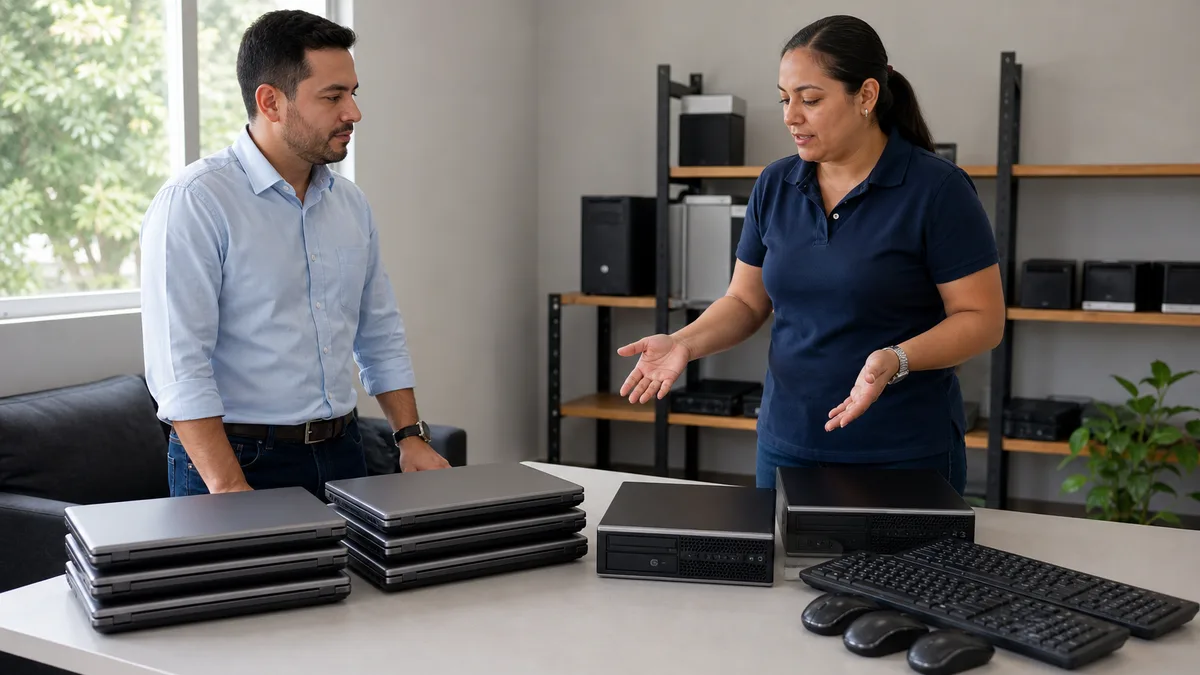
An operational inventory does not establish tax value by itself, but it connects physical objects to accounting records and receipt. Use one row per asset, or per homogeneous group if the responsible professional considers that valid:
| Field | Example content |
|---|---|
| Internal identifier | Asset code or donor reference |
| Type | Laptop, monitor, switch, printer, server or peripheral |
| Make and model | As shown on the label |
| Serial number | Transcribed without publishing it in open photographs |
| Quantity | Units actually transferred |
| Condition | Working, partial, untested or damaged; no repair promise |
| Accessories | Charger, tray, power supply, rails, cables or manual |
| Acquisition date/cost | From the available invoice or record |
| Accumulated depreciation | From the fixed-asset ledger, not an improvised estimate |
| Book value | Calculated and reviewed in the accounting records |
| Data state | Sanitized, pending or storage medium removed |
Do not publish serials, asset tags, IP addresses, configurations, usernames or screen photographs containing internal information. For a complete office lot, see the guide to donating used office equipment in Panama. For infrastructure, separate network equipment for labs and server racks and network equipment, because their inventory, weight and accessories differ.
Support the value without inflating it
For new property, retain the invoice and show that it corresponds exactly to the units delivered. For a used business asset, reconcile:
recorded cost − accumulated depreciation = book value
Do not turn that calculation into a commercial appraisal. If book value is zero, the equipment may still be technically useful, but that does not authorize you to assign an arbitrary positive tax value. When impairment, a previous write-off, capitalized improvement, separated components, grouped assets, leasing or a missing invoice is involved, ask the accountant to document the treatment before the file is signed.
For an individual, an invoice may help establish cost and ownership, but do not conclude that it is sufficient by itself. A professional should determine how the in-kind rule and individual cap apply to the person’s records and income.
Avoid these errors:
- using an old device’s original price without depreciation;
- adding nontransferable licenses, data or future services to the physical value;
- treating the highest online listing as an “appraisal”;
- asking the recipient to certify a figure it cannot support;
- changing the inventory after signature without a traceable correction;
- confusing insured value, replacement cost, resale price and book value.
Build a coherent evidence file
The DGI says authorized organizations file the Donation Report, Form 61. Its FAQ states that the report contains the donor’s name, RUC or identity number, date, amount and nature of the donation, as well as the form’s other required information. That does not establish one universal “certificate” format; coordinate fields and documents with the recipient and accountant before delivery.
Depending on the case, the file may include:
- internal approval to dispose of the assets;
- invoice or support for acquisition cost;
- fixed-asset ledger and accumulated depreciation;
- final inventory signed or linked to the handover document;
- evidence of the recipient’s identity and current authorization;
- proposal, correspondence and acceptance confirmation;
- handover act, acknowledgment or receipt with date and quantities;
- privacy-safe photographs of the lot;
- sanitization or media-removal evidence where applicable;
- disposal entries and accounting record;
- written conclusion from the professional preparing the return;
- a copy of the filing and relevant supporting schedules.
This page does not set a universal retention period. Ask the professional how long each record must be kept for your taxpayer type, period and potential audit. Preserve originals and their relationship; a folder of photographs without accounting records does not by itself prove the treatment.
Protect data before donation
Tax deductibility does not solve privacy or security. Before releasing laptops, phones, drives, printers, servers or network devices:
- identify which media stores data;
- confirm and test required backups;
- sign out and remove enterprise management, activation locks and credentials;
- choose a sanitization technique suitable for the medium and sensitivity;
- verify the outcome and record who performed it;
- retain or appropriately destroy the medium if it cannot be sanitized with confidence.
NIST SP 800-88 Rev. 2 defines sanitization as making access to data infeasible for a given level of effort and guides method selection according to medium and risk. Factory reset is not one universal answer for every technology.
Crezendo does not promise data erasure, recovery, media destruction or sanitization certificates on this page. Responsibility remains with the donor unless a different arrangement is explicitly agreed.
Legal entities and individuals need different files
Company or other legal entity
It must connect the donation with corporate authorization, ownership, fixed-asset ledger, depreciation, disposal, accounting and the taxable-income limit. It must also resolve customer, employee and system data before equipment leaves its control.
Individual
The person must establish ownership and cost where relevant, verify that a return is filed on which the deduction can have an effect, and confirm the applicable limit and support. Donating equipment does not automatically create tax already paid that will be refunded.
In both cases, the recipient must be verified and the item description must agree across the complete file.
Checklist before filing
- The recipient was identified by legal name and RUC.
- Authorization to receive deductible donations was checked in an official source for the relevant date.
- The recipient confirmed in writing what it accepts and what document it will provide.
- The inventory matches the equipment actually transferred.
- Cost, accumulated depreciation and book value are supported.
- No nonexistent licenses, data or accessories were included.
- Privacy was resolved before the assets left the donor’s control.
- Delivery, receipt and accounting records use coherent dates and quantities.
- The applicable donor limit was calculated by the person preparing the return.
- The file was reviewed before claiming the deduction.
A checked box does not guarantee DGI acceptance; it only reduces obvious inconsistencies. If authorization, valuation or documentation cannot be confirmed, do not improvise a number.
Frequently asked questions
Is every equipment donation deductible?
No. The DGI conditions the rule on an approved recipient and sets limits and valuation criteria. The donor must also be able to use and substantiate the expense in its circumstances.
Is every nonprofit organization authorized?
No. Verify its RUC and authorization through the official e-Tax/DGI lookup. Legal personality, a website or an old certificate does not replace current authorization.
May I use the sale price of a similar laptop?
Not as an automatic substitute for the tax criterion. For used property, the DGI FAQ specifies book value: cost less accumulated depreciation. Obtain advice if adequate records are unavailable.
What if equipment is fully depreciated?
It may remain technically useful, but you should not assign it a positive deductible value on your own. Ask the accountant to determine treatment from the records and current rule.
Does Crezendo issue a deductible receipt?
This page does not claim that. First ask which legal entity would receive the property, what documentation it can issue and whether it has current authorization; then verify that information with the DGI and your tax professional.
Does the deduction reduce tax by exactly the donated value?
Not necessarily. A deduction and a tax credit are different concepts. The effect depends on the tax base, cap, regime and correct filing.
Request physical evaluation first, then validate tax treatment
Prepare an inventory without sensitive data and use the Crezendo donation page to ask whether the lot can be evaluated. Do not send or transport equipment until receiving confirmation. If your decision depends on a deduction, request the available legal identity and documentation, verify it through DGI/e-Tax, and obtain accounting review before completing delivery.
The benefits of donating used equipment may exist without tax treatment, but no specific destination or impact should be promised before the items are evaluated. Keep possible usefulness, acceptance and deductibility as three separate questions.