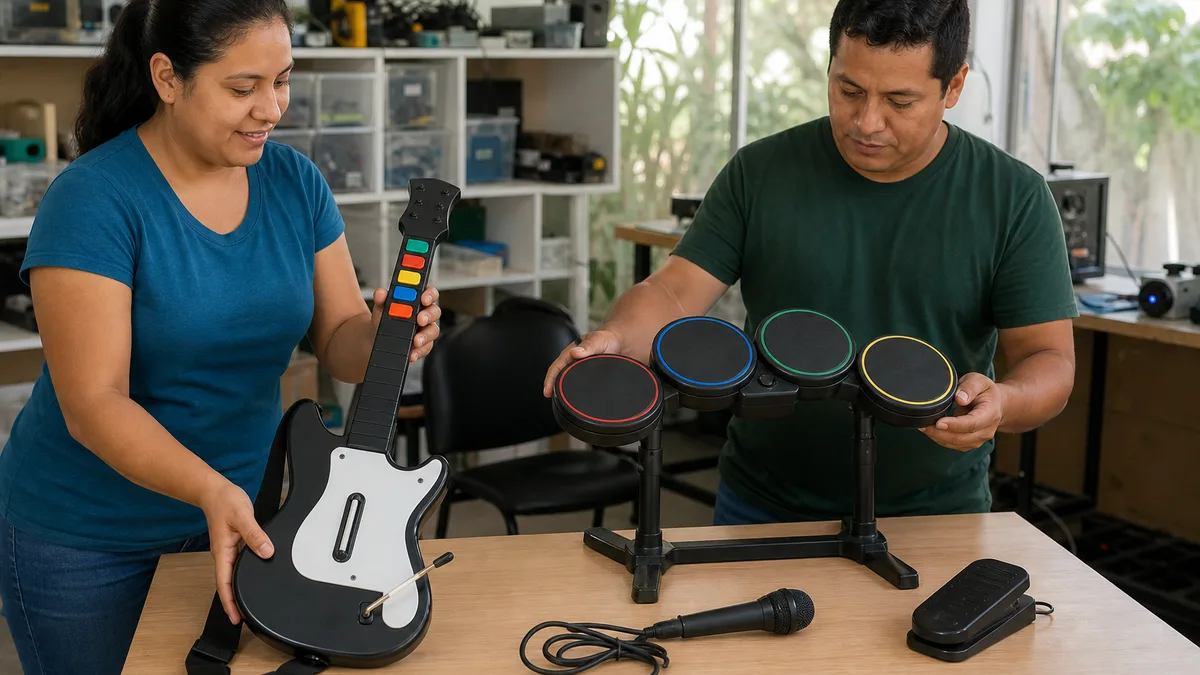
A plastic guitar, drum kit, pedal, or music-game microphone may look easy to identify, but usefulness depends on more than the logo. The console, generation, model, wireless receiver, adapters, and physical condition form a system. In Panama, you can ask Crezendo whether that system can be evaluated for donation without assuming that every part will be accepted or assigned a particular destination.
Before taking or shipping anything, prepare an inventory, address any battery or cable hazard, and wait for a response. This guide explains what helps assess Guitar Hero, Rock Band, and other music-game accessories without guessing about compatibility or promising repair or reuse.
Quick answer: prepare your inquiry in this order
- Separate guitars, drums, cymbals, pedals, microphones, receivers, adapters, power supplies, cables, and games.
- Photograph the set and model labels without publishing serial numbers, receipts, or personal information.
- Record the console or platform, generation, and last game each item worked with, if you remember.
- Disclose missing parts, known faults, corrosion, moisture, previous repairs, and whether the equipment was tested.
- Remove replaceable batteries only when the compartment is clean, cool, and safe to open.
- Keep accounts, passwords, codes, copied games, and any storage that is not intentionally part of the inquiry out of the lot.
- Send the information through Crezendo's donation page and wait for confirmation before moving the equipment.
An inquiry starts an evaluation. It does not guarantee acceptance, pickup, repair, educational use, a tax receipt, or any particular final outcome.
Which accessories should you record?
You do not need the perfect technical name. Describe what you can see and do not fill gaps with assumptions.
| Component | Useful information |
|---|---|
| Guitar | visible brand, franchise, platform, model, wired or wireless connection, strap, detachable neck, strum bar, and whammy bar |
| Drum kit | control unit, number of pads, cymbals, stands, sticks, pedal, and wiring |
| Microphone | brand, connector, fixed or detachable cable, grille, and any adapter |
| Receiver or dongle | every label, USB or other connector, shape, color, and the accessory it was used with |
| Adapter or power supply | printed voltage, current, polarity, and model; never try a random supply |
| Games and manuals | title, platform, visible region, original disc, case, manual, and physical condition |
| Included console | model, storage, linked accounts, and erasure status; treat it as a separate device |
Include quantities. “Two PS3 guitars, one identified dongle, and one unlabeled dongle” is more useful than “complete kit” if you have not verified that every part belongs together.
If you also found power supplies, chargers, or cables that you cannot associate with the kit, see how to ask about donating chargers and technology accessories. For older modules and controllers, the guide to retro console accessories can help document small parts without losing their context.
How to identify the console and compatibility
The franchise name is not enough
Two guitars marked “Guitar Hero” may belong to different platforms, generations, or wireless systems. The same is true for Rock Band drums and receivers. Activision's official classic Guitar Hero guidance shows that supported combinations differed across PC, PlayStation 3, Xbox 360, and Wii. Do not label an item “universal” unless the manufacturer documents that use for the exact model.
Look for these clues:
- a PlayStation, Xbox, Wii, Nintendo, or PC mark;
- a model number and manufacturer on the back or inside the battery compartment;
- a USB plug, proprietary cable, controller slot, or sync button;
- the button layout: five colored frets, six buttons in two rows, or another arrangement;
- a receiver, adapter, or module label that was used with the instrument;
- the exact game and console used for the last known test.
A clear photograph of every label is better than a guess. If you cannot identify the platform, write “platform unknown.”
Keep the receiver, adapter, and controller together
Some wireless instruments depend on a particular receiver or adapter. Harmonix explains, for example, that compatible Xbox 360 wireless instruments need a Legacy Game Controller Adapter for Rock Band 4 on Xbox One; its legacy-controller guidance points to a model-specific compatibility chart.
That does not mean any similar-looking dongle will work. Pack each known pair in a labeled bag, but do not force synchronization or open a receiver to “confirm” it. If you have several dongles and do not know which belongs to which instrument, number them in the photographs and state the uncertainty.
A known test is limited evidence
If the equipment is dry and intact and you have the correct console, game, and power source, you can record a normal test: “powers on,” “pairs,” “blue fret does not respond,” or “pedal is intermittent.” Do not infer that it will work on another platform. The official PlayStation page for Rock Band 4 refers to supported USB microphones and compatible guitar and drum controllers, not universal support for every microphone or instrument.
You do not need to test unsafe equipment or buy a game, adapter, or console to complete the inquiry. “Not tested since 2018” is a valid description.
Inspect the condition without creating a hazard
Inspect the equipment while it is unplugged and under good lighting.
You can document these conditions for evaluation
- worn buttons, a loose whammy bar, or an intermittent pedal;
- missing parts or a set without its receiver;
- exterior dust, ordinary wear, and discolored plastic;
- an intact cable but untested equipment;
- a stable crack that does not leave sharp edges or loose pieces.
These conditions do not ensure acceptance. They only help describe the case accurately.
Stop testing and disclose the hazard if you find
- leakage, crystalline residue, or corrosion in a battery compartment;
- a swollen, deformed, hot, or unusual-smelling battery;
- a burnt smell, evidence of smoke, or a scorched area;
- a stripped cable, broken plug, or exposed conductor;
- liquid, internal moisture, mold, or evidence of pests;
- broken plastic with sharp edges or an unstable drum structure;
- an unlabeled power supply or one that is not certainly correct.
Do not connect, charge, strike, puncture, or ship a damaged battery. The U.S. EPA's used household battery guidance covers terminal isolation and the need for special care when batteries are damaged. Also follow the manufacturer's instructions and the official rules that apply in Panama. If a battery is leaking or the compartment is badly corroded, do not attempt removal without suitable expertise and protection.
Check each accessory type without taking it apart
An exterior inspection can provide enough information for the inquiry:
- Guitar: inspect the neck and joint, fret buttons, strum bar, whammy bar, strap, battery cover, and cable. Do not glue a loose neck or apply lubricant.
- Drum kit: count pads, cymbals, tubes, clamps, control unit, pedal, and sticks. Do not assemble a cracked frame that could fall.
- Microphone: inspect the grille, body, cable, and connector. Do not remove the grille or test a cable with exposed copper.
- Pedal: photograph its connector, base, visible spring, and cable. Do not infer compatibility because two products use the same plug shape.
- Dongles and adapters: record model numbers and ports. Do not update firmware or install drivers from unknown sites only to run a test.
An honest fault description is more useful than an improvised repair. Crezendo can consider the available information; this article does not promise diagnosis or repair.
Privacy, accounts, and licenses
Music-game instruments usually hold less information than a console, but a lot may include cards, USB storage, a console, receipts, shipping labels, or media with data. Check every bag and compartment before closing the box.
- Remove storage and devices that are not intentionally part of the inventory.
- Never send passwords, account email addresses, recovery codes, PINs, payment details, or open sessions.
- If a console is included, unlink your accounts and follow the official erasure procedure for that model; disconnecting an instrument does not erase the console.
- Redact personal details on receipts or labels before photographing them, and do not publish full serial numbers.
- List original game discs if you want them evaluated, but do not include copies, written keys, or downloaded files.
Handing over a physical accessory does not automatically hand over a digital library or account. Microsoft's usage rules for digital goods state that digital goods are licensed and that transferring a device does not by itself transfer a license; the PlayStation software terms likewise describe a personal, non-transferable license. Review the platform terms and keep your credentials.
Guitar Hero and Rock Band are third-party marks used only to identify the accessories. This guide does not imply that Crezendo is affiliated with their owners, and it does not authorize copying software, music, or other content.
Cleaning and packing after coordination
Do not turn cosmetic cleaning into a repair. Use a soft, dry cloth on the exterior. Avoid solvents, sprays, alcohol inside buttons, lubricants, immersion, paint, or glue. If an accessory is wet, contaminated, or contains a damaged battery, do not seal or transport it as an ordinary item.
After Crezendo confirms how to proceed:
- Remove ordinary batteries only if they are cool and intact and the compartment opens normally.
- Place receivers, adapters, and small parts in separate labeled bags.
- Immobilize detachable necks, pedals, and cymbals without pressing buttons or pinching cables.
- Protect connectors so they cannot scratch pads, the guitar, or the microphone.
- Pack the drum frame disassembled as its design allows; do not force tubes or joints.
- Add a simple copy of the inventory without accounts or sensitive information.
- Avoid a box so large or heavy that one person cannot handle it safely.
If you have separate audio or video cables, review the guide to asking about old console AV cables. Do not mix unidentified cables into a kit merely to make it appear complete.
How to start an inquiry with Crezendo
1. Summarize the lot
State quantities, accessory type, visible platform, model numbers, receivers, original games included, and the last known date of use.
2. Describe the condition
Use concrete language: “tested on PS3 with this dongle,” “does not power on,” “untested,” “pedal missing,” “battery-compartment corrosion,” or “exposed cable: not connected.” Attach overview and label photographs without credentials or personal information.
3. Send the request
Use Crezendo's donation channel. The public page includes consoles, cables, and accessories among its general categories, but the response to a specific case depends on condition, identification, safety, possible usefulness, space, and current capacity.
4. Wait for express confirmation
Do not take the lot to an assumed address, ship it, or hire transport before agreeing on the next step. In the same conversation, ask about delivery, receipt, or acknowledgment conditions if you need them. This article does not promise pickup, payment, monetary valuation, tax deductibility, or a receipt.
What if a part is missing or the equipment does not work?
You may describe an incomplete or faulty controller in the inquiry. A separate dongle, pedal, or instrument might retain technical usefulness, but that can only be determined after evaluation. Do not assume that an accepted part will be repaired, used in a class, given to another person, or kept intact.
If Crezendo does not confirm a viable route, separate batteries and follow the official instructions or authorized management that applies to the category in Panama. The country has an Interinstitutional Commission on Waste Electrical and Electronic Equipment; mentioning it does not make Crezendo a waste manager or guarantee that any third party will receive the item. Never place damaged batteries or hazardous electronics in household trash.
Frequently asked questions
Can I ask about a guitar that does not power on?
Yes. Describe it as “does not power on” or “untested” and attach model information and photos. Do not connect it if there is corrosion, odor, moisture, an exposed cable, or another hazard. An inquiry does not guarantee acceptance or repair.
Does Crezendo accept an incomplete drum kit or one without a pedal?
You can request an evaluation and identify every missing part. The response depends on model, condition, safety, and current capacity; automatic acceptance should not be assumed.
Is a guitar useful without its wireless receiver?
It may be submitted for evaluation, but a missing receiver can limit testing or use. State “no dongle” and do not buy one based only on appearance.
Must I know which console it works with?
No, but photograph every logo, connector, and model number. If you remember the console or last game used, record it as background rather than evidence of universal compatibility.
Can I include game discs?
You may list original media that belongs to you. Keep accounts, keys, copies, and downloads out of the donation. Crezendo should confirm whether it wants to evaluate the media with the hardware.
Should I clean or repair it before asking?
A gentle, dry exterior cleaning may be enough when the equipment is safe. Do not open, glue, lubricate, or test it with an unknown power supply. Documenting the true condition is better than hiding a fault.
Can I take the equipment directly to Crezendo?
Do not assume a drop-off point or schedule. Send the inventory first and wait for express instructions. Acceptance of an inquiry is not confirmation of physical receipt.
Does a donation include a receipt or tax benefit?
This article does not promise a receipt, valuation, or deductibility. Ask directly what acknowledgment, if any, can be issued for the case, and seek independent tax advice if you need it.
Ask before moving the kit
Gather photographs, platform details, model numbers, receivers, included parts, faults, and hazards. With that information, Crezendo can review the case without requiring you to guess compatibility or move an unsafe battery or structure.
Request an evaluation for an accessory donation
Wait for the response before taking, shipping, or hiring transport for the lot. An accurate description protects the donor, the recipient, and any parts that may still have a useful path without promising an outcome that has not yet been assessed.