An old sound system does not have one single destination. It may still work as designed, accept a simple external adapter, retain resale value, serve as a source of parts, or truly have reached the end of its useful life. The decision depends on the type of equipment and its condition, not simply on its age.
Crezendo does not publicly advertise a general vintage-audio repair or modernization service. If you want to ask about a possible donation or assessment, describe the equipment first and wait for confirmation before taking it anywhere.
First: identify what you have
“Sound system” may mean:
- stereo receiver or amplifier;
- mini hi-fi system;
- passive speakers;
- powered speakers;
- subwoofer;
- CD or cassette player;
- turntable;
- soundbar;
- Bluetooth speaker;
- professional or studio audio equipment.
Record the brand, model, and components in the set. If you still have the remote, proprietary cables, external power supply, or unusual connectors, include them in the inventory.
Check condition without opening the device
Before deciding what to do, inspect what can be observed safely:
- power cord and plug;
- impact, corrosion, or liquid damage;
- broken connectors;
- deteriorated speaker cones;
- burning smell;
- abnormal noise;
- channels that do not work;
- a swollen battery in portable equipment;
- missing parts.
If the cord is damaged, liquid entered the unit, there is smoke, a strong odor, abnormal heat, or a swollen battery, stop using it and seek an appropriate assessment. Do not open an amplifier or power supply merely to “see what is wrong” when you do not have training and service documentation.
Option 1: keep using it
Many older amplifiers and speakers still perform their main function very well. A lack of Bluetooth, Wi-Fi, or streaming does not make a system useless.
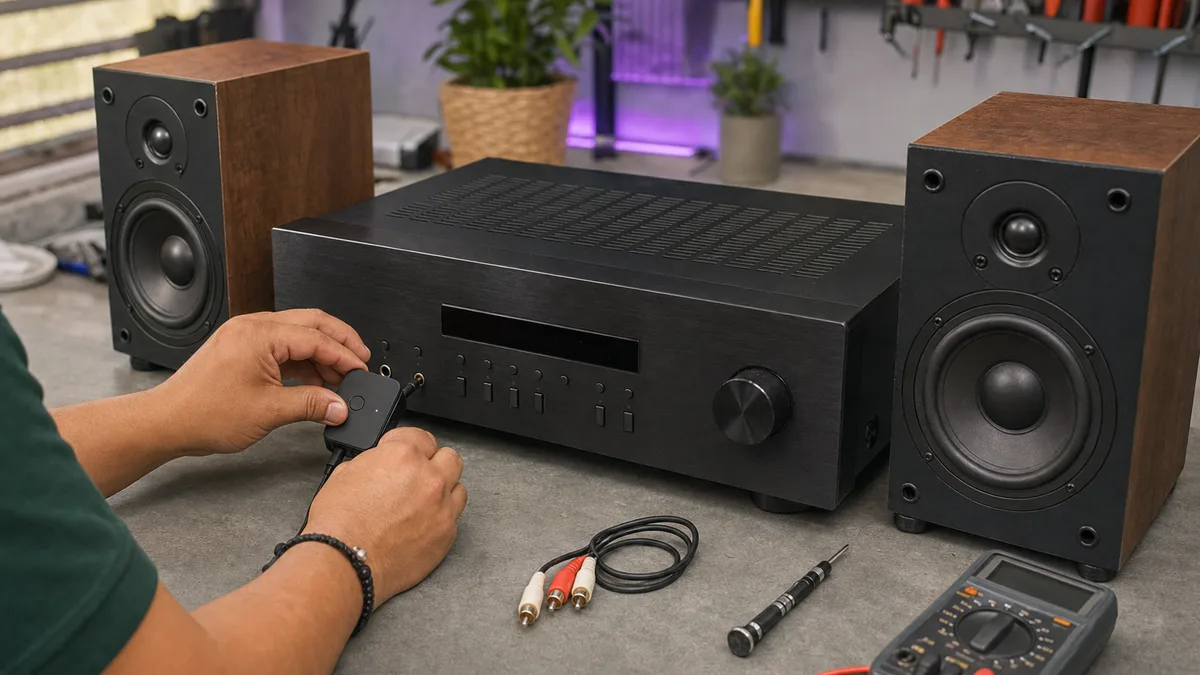
If the unit has a compatible line or auxiliary input, it may be possible to feed audio from a modern external device without modifying the equipment internally. Before buying an adapter, confirm:
- input type;
- required signal level and connector;
- adapter power requirements;
- whether digital-to-analog conversion is needed;
- whether volume is controlled on the system, the adapter, or both.
A reversible external adapter is often more sensible than drilling the enclosure or modifying circuits unnecessarily.
Option 2: repair it when repair makes sense
A repair may be reasonable when the equipment has good construction, practical value, sentimental value, or available replacement parts.
Before approving work, ask:
- what fault was diagnosed;
- which part needs replacement;
- whether compatible parts exist;
- estimated cost;
- which tests will be performed afterward;
- what warranty the repairer provides;
- whether the work changes original functions.
Do not rely on a repair plan based only on “changing capacitors” or replacing parts at random. Diagnosis should begin with the symptom and appropriate measurements.
Option 3: sell it or give it directly to someone
A receiver, turntable, speaker, or mini system may still have value to another person even when it no longer fits your space.
When listing it:
- use the exact model;
- state which inputs and outputs you tested;
- explain known faults;
- include only the accessories you actually have;
- avoid “like new” when it is not;
- do not promise power or specifications you have not verified.
If you do not want to sell, giving it directly to someone who confirms they can use it also extends its life.
Option 4: ask Crezendo about a donation
Crezendo's donation page allows inquiries about several electronics and peripheral categories, but it does not guarantee that a particular sound system will be accepted.
Send:
- brand and model;
- photos;
- included components;
- condition and faults;
- whether it contains a battery;
- approximate size or weight when bulky;
- location.
Then wait for an explicit response about acceptance and logistics. Do not move a heavy system or send it by courier without confirmation.
If Crezendo does not have a compatible use, that does not automatically make the equipment waste: you can still consider sale, direct giveaway, repair, or an electronics-recycling route.
Equipment containing batteries
Bluetooth speakers and other portable systems may contain lithium-ion batteries. If a battery is swollen, punctured, hot, or deformed, stop using or charging the device.
The EPA warns that lithium batteries should not be placed indiscriminately in household trash or municipal recycling because of fire risks during collection and processing. Use an appropriate battery or electronics route and confirm handling conditions before transporting a damaged unit.
When the equipment no longer has a reasonable second life
A system may reach end of life because of severe damage, unavailable parts, safety concerns, repair cost, or practical incompatibility. In that case:
- remove batteries only when the design and instructions allow it safely;
- do not break equipment apart to recover metals;
- avoid abandoning components or deliberately mixing them with ordinary waste;
- find operators or collection programs that accept that type of electronic product;
- ask what happens to fractions that cannot be recovered.
Responsible recycling is an end-of-life route, not a reason to discard equipment that could still serve a purpose.
Is it worth modernizing vintage audio?
It depends on the goal. If you only want streaming, an external source connected to an existing input may be enough. If you want to replace amplification, power supply, speakers, or internal electronics, you are dealing with a technical project that should be assessed for safety, compatibility, and the value of the equipment.
Not every modification improves an older system. For collectible equipment, irreversible alterations may even reduce value.
What Crezendo does not currently offer
This article corrects a previous claim: Crezendo does not publicly advertise a general professional service for restoring and modernizing vintage sound systems. It should also not be described as “the only comprehensive solution in Panama.”
What you can do is use the donation page to ask whether the equipment fits a current assessment or use the contact page when you need to clarify scope before moving it.
Sources consulted
- EPA: Electronics Donation and Recycling.
- EPA: management of used lithium-ion batteries.
- Crezendo: used-electronics donation inquiry.
Frequently asked questions
Is equipment without Bluetooth obsolete?
Not necessarily. If its inputs and amplification still work, it may receive audio from a compatible external source.
Does Crezendo repair sound systems?
It is not currently published as a general service. You may ask about an assessment or donation, but do not assume repair or modernization.
Can I donate a system that does not power on?
You may ask and describe the fault. Acceptance is decided case by case.
What should I do with a Bluetooth speaker that has a swollen battery?
Stop charging or using it and find an appropriate battery/electronics route. Do not transport it to Crezendo without explicit instructions and acceptance.
Should I throw away a very old amplifier?
Not only because of its age. First check whether it works, has practical or resale value, or can have its life extended through a reasonable repair.
Start by identifying the device and its condition
Model, components, faults, accessories, and photos make the decision clearer. From there you can choose among continued use, external adaptation, repair, sale, direct giveaway, a donation inquiry, or final recycling.