When someone says “I have an old CPU,” they may mean two different things: the processor installed in a motherboard socket or the entire desktop computer. That distinction matters because reuse, donation, privacy, and recycling are different for each case.
If you have only the processor, it normally does not contain your personal documents. If you have a complete tower, however, it may contain SSDs or hard drives with sensitive information and should be treated as a computer containing data.
If you have only the processor
Before deciding what to do, identify:
- exact manufacturer and model;
- generation or family;
- compatible socket;
- bent pins or damaged pads;
- whether it was working when removed;
- reason for replacement;
- whether you still have a compatible motherboard or memory.
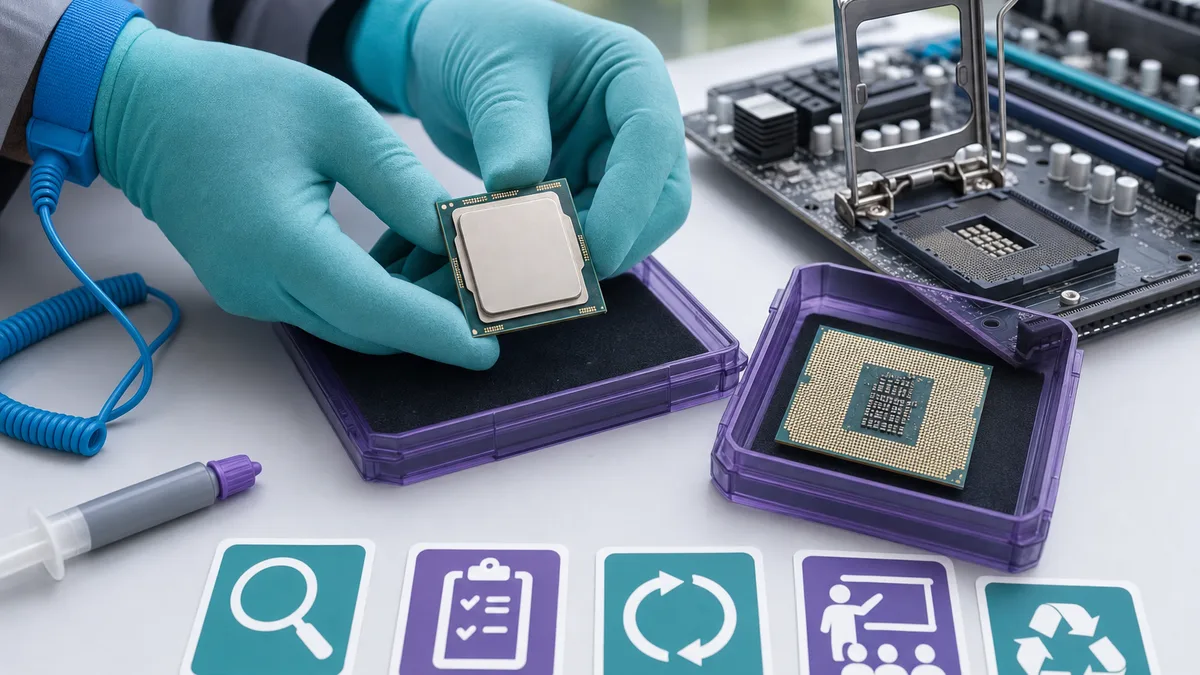
A clear photo of both sides is much more useful than describing it as an “old Intel” or “used AMD.”
Option 1: reuse it in another compatible system
An older processor can remain useful when a compatible motherboard exists and its performance is sufficient for the task. Possible uses include:
- a simple office computer;
- a learning or lab machine;
- a low-demand home server;
- a test system;
- repair of another computer from the same platform.
Not every old processor justifies building a machine around it. Check power consumption, motherboard and memory availability, operating-system compatibility, and the cost of the other components before investing.
Option 2: sell it or keep it as a spare
Before donating, check whether the model still has a second-hand market. Processors that appear obsolete may be useful for repairing an older motherboard or completing a particular system.
For a responsible sale:
- publish the exact model;
- state whether it was tested recently;
- do not promise overclocking or performance you have not verified;
- photograph pins, pads, and package;
- protect the processor during transport;
- state whether it is sold alone or with a cooler.
Selling may be a better choice than donating when the component retains value and does not fit an organization's current needs.
Option 3: ask Crezendo about a donation
Crezendo lists components among the categories that may be submitted for evaluation. This means you may ask about a processor; it does not mean every CPU will be accepted.
Before contacting Crezendo, prepare:
- exact model;
- quantity;
- known condition;
- photos;
- compatible motherboard, RAM, or cooler if you also want to offer them;
- location.
Use Crezendo's donation page and wait for explicit confirmation before transporting or shipping the component.
Assessment may show that the processor has a use, that it would be more useful together with compatible parts, or that Crezendo does not currently have a matching need.
How to handle and pack a processor
A CPU is small but easy to damage.
Processors with pins
Do not place the pins directly against a table or press them into rigid foam. A tray or protector designed for the package is preferable.
Processors with flat contacts
Avoid touching the pads unnecessarily. Hold the processor by its edges and keep it clean and dry.
For transport
- use a CPU tray when possible;
- prevent movement inside the box;
- do not place several processors loose together;
- protect them from moisture and impact;
- do not attach adhesive tape directly to pins or contacts.
If you still have the original box or plastic clamshell, it is often useful protection.
Do not scrape the processor to “recover gold”
Processors and circuit boards contain different metals, but attempting home recovery through sanding, heat, acids, or similar methods is not responsible recycling. The recoverable value of one component may be small, while the process can create chemical exposure, waste, and physical hazards.
If the processor no longer has a useful destination, send it through an electronics-management route capable of handling components and recovering materials under controlled conditions.
Does a processor store my data?
A standalone processor is not the primary storage for your personal files. Documents normally remain on SSDs, hard drives, eMMC, or other storage media.
But if by “CPU” you mean the complete desktop tower, you do need to review the drives before handing it over. Crezendo's public donation policy leaves backup, account removal, and appropriate erasure to the donor unless a written exception defines another process.
Do not hand over a complete computer believing that removing the processor removes your data.
Is it better to donate the processor alone or the whole platform?
It depends. For technical reuse, it may be much more useful to keep together:
- CPU;
- motherboard;
- RAM;
- cooler;
- backplate or mounting hardware;
- model documentation.
A motherboard without a CPU or a processor without a compatible platform can be difficult to test. If you have the set, describe it in the inquiry and let the assessment determine which parts remain useful.
When it can no longer be reused
The EPA recommends prioritizing reuse and donation for electronics that still function and using appropriate recycling when they reach end of life. A processor with no practical market, compatibility, or training use can enter an electronics-recycling stream with other components.
There is no need to turn a tiny component into a home metal-recovery project. Correctly classifying it and sending it to an appropriate route is a more reasonable exit.
What a donation should not promise
Donating a processor to Crezendo does not automatically mean that:
- it will be installed in a computer for a student;
- it will be repaired;
- it will create a measurable environmental benefit;
- it will generate employment or training;
- it will be accepted without checking compatibility;
- Crezendo will manage its final recycling.
The donation page describes an inquiry and assessment process, not universal intake.
Sources consulted
Frequently asked questions
Can I donate a processor when I do not know whether it works?
You may ask about it as unknown condition. State why it was removed and whether you still have a compatible board for testing.
Should I remove thermal paste?
You may remove excess paste using an appropriate method without scraping or damaging the package. It does not need to look new before you ask about donation.
Can an old processor still have value?
Some do, especially as replacement parts for specific platforms. Check the market before assuming it is waste.
Does Crezendo accept loose components?
Components are listed among the categories that may be assessed, but acceptance is confirmed case by case.
What if I actually have a complete desktop tower?
Describe it as a desktop computer, include specifications and condition, and pay particular attention to storage drives containing data.
Identify the part first
Knowing the model, socket, condition, and accessories turns “I have an old CPU” into an inquiry that can be evaluated. Then you can choose more carefully among reuse, sale, donation, or recycling.