Raspberry Pi has a distinct search intent in Panama: during the reviewed 90-day window, this URL received 21 impressions for “raspberry pi panama”, at approximate positions between 9 and 12. That supports keeping a dedicated page, but not continuing to present it as a promise that Crezendo accepts every kit or that every donated board automatically reaches a student.
This guide answers a more useful question: what to do with a Raspberry Pi, Arduino, or development kit you no longer use in Panama, how to prepare it, and when reuse, resale, donation, or recycling makes sense.
First identify exactly what you have
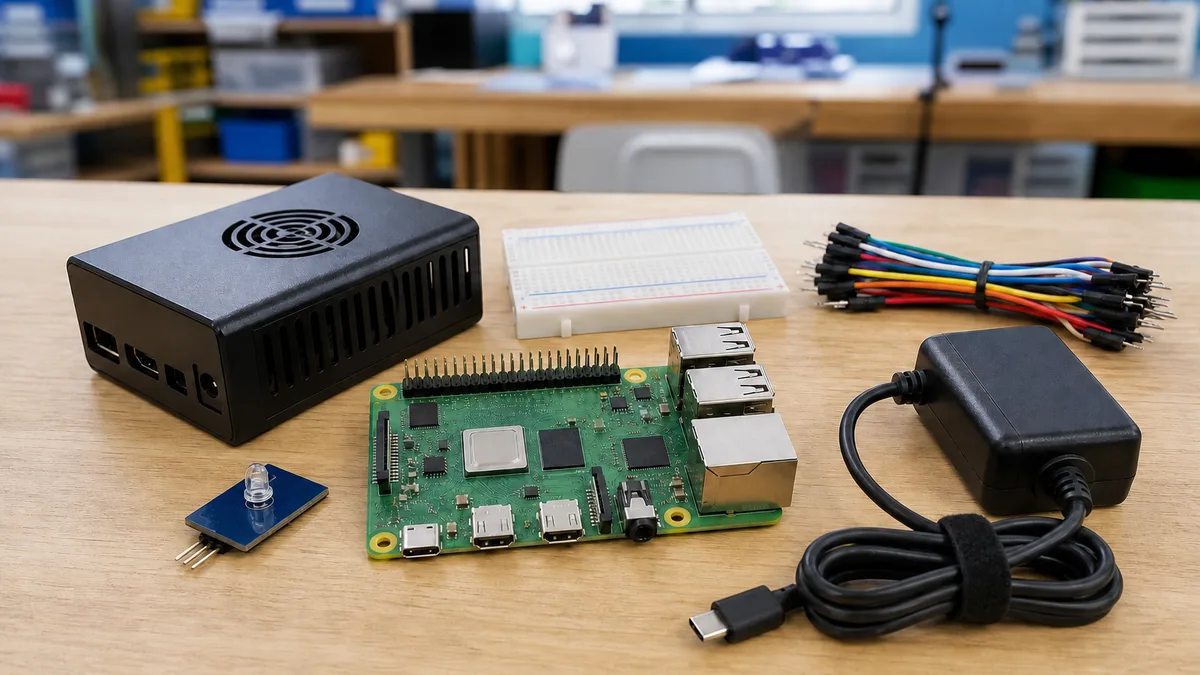
Before offering or listing a kit, record:
- board model;
- memory when applicable;
- power supply;
- microSD card;
- case and cooling;
- HDMI cables or adapters;
- breadboard and jumpers;
- sensors and actuators;
- cameras or displays;
- HATs or additional modules;
- physical condition and known faults.
A Raspberry Pi without a power supply or microSD card can still be useful, but that information changes how the set should be evaluated.
Check its condition without hiding faults
You do not need to turn inspection into a full repair. A reasonable review can confirm:
- that the board has no obvious physical damage;
- that the power connector is not loose or burned;
- that it boots with an appropriate power supply when one is available;
- that major ports have no visible damage;
- that an included microSD can be wiped or replaced;
- which sensors or modules you were unable to test.
If a board becomes abnormally hot, has corrosion, missing components, or a damaged power supply, do not energize it merely to “see whether it still works.”
The power supply matters
Many problems blamed on a Raspberry Pi are actually caused by power delivery, cables, or voltage drop. Do not mix random power supplies or include one you know is defective.
When documenting the kit, state whether the power supply:
- belongs to the original set;
- has the correct connector;
- shows visible damage;
- was tested with the board;
- is not available.
For a recipient, knowing that a board works but needs a power supply is more useful than receiving a box of unidentified parts.
Wipe the microSD before handing over the equipment
A microSD card may contain:
- Wi‑Fi credentials;
- SSH keys;
- tokens and environment variables;
- private code;
- personal files;
- network configuration;
- histories and logs.
If the card is not necessary for the kit to retain value, remove it. If you include it, wipe it appropriately and reinstall a clean image only when needed to demonstrate operation.
Do not assume that “because it is a Raspberry Pi” it contains no sensitive data.
What options do you have in Panama?
Reuse it
An older board may still be sufficient for:
- learning Linux;
- running small local services;
- practicing GPIO;
- working with sensors;
- building a home prototype;
- experimenting with networks;
- practicing automation or programming.
You do not need the newest model when the objective does not require more resources.
Sell it
If the kit is complete and functional, resale may be reasonable. Publish the model, RAM, accessories, condition, and a clear photo. Do not advertise a “complete kit” when the power supply, microSD, or other essential parts for the described use are missing.
Donate it
An organization, school, lab, or individual may value the kit when it matches a real need. Donation should be confirmed before you transport the equipment. Organizations do not all accept the same models, accessories, or quantities.
Recycle it
A physically damaged board or unsafe accessory may need an e-waste route instead of reuse. Separate batteries, damaged power supplies, and other components that require specific handling.
Does Crezendo receive Raspberry Pi and Arduino equipment?
Crezendo evaluates technology-donation inquiries. Acceptance is not automatic: it depends on model, condition, accessories, quantity, an existing use case, and available logistics.
Before transporting equipment, use the donation page to describe what you have. When possible, include:
- model and quantity;
- known condition;
- included accessories;
- photographs;
- approximate location;
- whether you need to coordinate an institutional or high-volume delivery.
Crezendo can confirm whether a relevant use exists or whether another route would make more sense. This page does not promise pickup, a certificate, an educational destination, or acceptance of incomplete equipment.
Sensors and modules: inventory is more useful than a mixed box
If you have a box of components, group them by type:
- temperature/humidity sensors;
- distance or ultrasonic sensors;
- PIR/motion sensors;
- relays;
- servos and motors;
- displays;
- communication modules;
- breadboards;
- jumper wires;
- resistors and passive components.
A basic inventory reduces the time required to evaluate the material and keeps useful parts from disappearing inside an unidentified bag.
Arduino, ESP32, and Raspberry Pi do not serve exactly the same role
Although they often appear in the same educational kits, they are not equivalent.
A Raspberry Pi is a single-board computer capable of running a full operating system. Arduino and many ESP32 boards are microcontrollers: they normally run specific firmware and are oriented toward controlling inputs and outputs with more limited resources.
For learning IoT or embedded systems, understanding both approaches can be useful. See the guide to Internet of Things (IoT) in Panama, which separates devices, connectivity, data, security, and automation.
Cameras and devices that handled data
A camera, storage module, or deployed system may contain more information than expected. Before handing over a kit:
- remove credentials;
- revoke tokens or keys that were used in production;
- wipe storage cards;
- remove labels containing passwords or internal addresses;
- document any external accounts that need to be disconnected.
Preparing a device for donation is not merely deleting visible files.
Do not turn “used” into “trash” or “educational” into a guarantee
A used component can have technical value. That does not mean every part is useful to every program.
It is also better to avoid a paternalistic story in which every old board “changes a young person's life.” Responsible donation starts with a real need, appropriate equipment, and safe conditions of use. When that fit does not exist, selling, reusing, or recycling may be the better decision.
Checklist before asking about a donation
- model identified;
- quantity recorded;
- physical condition described;
- power supply and cables inventoried;
- microSD wiped or removed;
- credentials revoked;
- sensors and modules grouped;
- known faults disclosed;
- photos available;
- acceptance confirmed before transporting the equipment.
The best route depends on condition and need
A working Raspberry Pi does not have to become e-waste, but it does not need a grand story to justify reuse either. Identify the equipment, remove data, document its condition, and choose reuse, resale, donation, or recycling according to the case.