If you have physical Nintendo DS or 3DS games you no longer use, you can ask first whether Crezendo can evaluate them. Start on Crezendo's donation page: describe the items, attach photos when the form allows it, and wait for a response before transporting anything.
The inquiry does not guarantee acceptance, pickup, repair, preservation, educational use, or a certificate. Crezendo needs to know the type and condition of the items before saying whether coordination should continue. That precaution is especially important when the lot includes a console, an SD card, or a battery.
First, distinguish what you want to offer
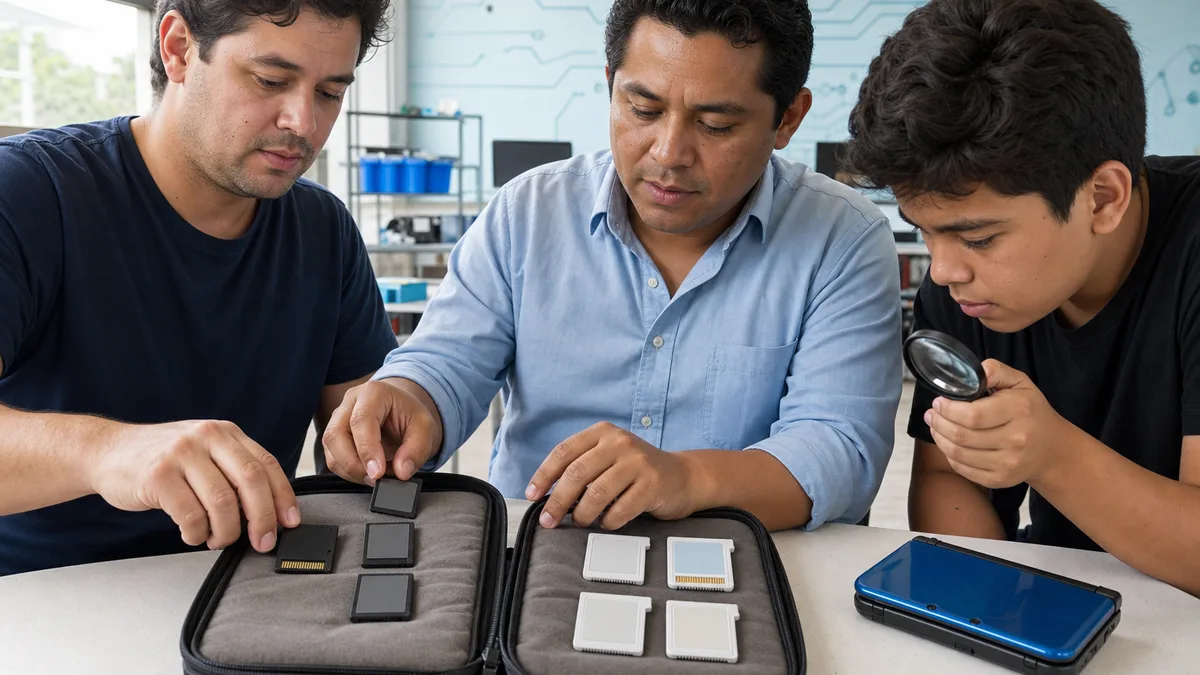
“DS or 3DS games” can mean a loose game card or a group of items that includes a console. Each component requires different handling.
| Item | Could it contain data? | What to report before coordinating |
|---|---|---|
| DS or 3DS Game Card | It may contain progress, profiles, or content created in the game | Title, platform, physical condition, and whether it was tested |
| Case, cover art, or manual | It normally contains no digital data | Whether it is original, its condition, and the matching game |
| DS, DSi, 2DS, or 3DS console | Depending on the model, it may contain settings, photos, activity, profiles, or a linked account | Exact model, whether it powers on, visible faults, and battery condition |
| SD or microSD card | It may contain photos, audio, downloaded software, and associated data | Capacity and whether you want to keep it; do not hand it over accidentally |
| Charger, stylus, dock, or accessory | It usually contains no account, but it may have electrical or physical damage | Model, known compatibility, and any frayed cable or broken component |
Do not place everything in one unidentified bag. A game card with no console battery does not present the same risks as a handheld system with a rechargeable battery.
What to include in the inquiry
A short, accurate description helps determine whether to continue without making an unnecessary trip:
- Quantity and type: how many games are DS and how many are 3DS.
- Title list: copy what appears on the labels; no appraisal is required.
- Packaging: loose card, case, cover art, manual, or other accessory.
- Condition: tested and working, known problem, or untested.
- Visible damage: cracks, damaged contacts, moisture, corrosion, or residue.
- Included consoles: exact model, power behavior, and any sign related to the battery.
- Photos: front and back, without publishing account numbers, email addresses, access codes, or other private information.
You do not need to power on a questionable console to improve the request. “Untested” is a valid description. Do not promise that a game works merely because its label looks good.
After sending the information, wait for a response confirming whether Crezendo wants to continue evaluating the case and how to coordinate it. Do not deliver or ship items without that confirmation, and do not assume pickup is available.
Physical game cards can contain save data
Nintendo explains that progress for physical Nintendo 3DS games is stored on the Game Card. Some supplemental SpotPass or StreetPass information may be stored on the SD card or system memory. Downloaded software and its data, by contrast, depend on the system and SD card.
That leads to two practical rules:
- Formatting the console is not the same as erasing the save on a physical game card.
- Giving someone only the game card does not transfer your entire Nintendo account, but it may transfer progress, profile names, or content stored by the game.
The process for deleting a physical game's save varies by title. Nintendo directs users to the game's manual. Do not try random button combinations found online: you could erase something you wanted to keep or change the card without resolving the privacy issue.
If you want to preserve the save, do not hand over that Game Card yet. If you want to erase it, locate the official manual for the title and review the consequences before confirming. If you cannot determine what it contains, disclose that in the inquiry and wait for instructions; Crezendo does not promise to recover, back up, or erase that information.
A console requires an account, memory, and SD review
The Nintendo DS and DS Lite do not use Nintendo Network ID, but other family models may hold photos, settings, software, activity, or credentials. On Nintendo 3DS, formatting system memory erases or invalidates several categories of data and removes the local Nintendo Network ID link.
Do not confuse formatting the system with deleting the Nintendo Network ID. Nintendo warns that deleting an NNID is a different, permanent action that can erase licenses, funds, a friends list, and related data; if it is also linked to a Wii U, the consequences can affect both systems.
Before offering a console:
- Decide which photos, audio, saves, or files you want to keep.
- Review Nintendo's official guide for the specific model and situation.
- Do not delete the account as a shortcut when your goal is only to remove its data from the device.
- Check whether an SD or microSD card remains in the console. Nintendo says the system must be powered off before removal, and access varies by model.
- Remove any Game Card with the system powered off, or from the HOME Menu after closing the software.
- If you cannot power on or erase the system safely, disclose that and do not transport it until you receive a response.
Neither this article nor the form replaces official account support. A donation also includes no guarantee of migration, backup, or data recovery.
What if you do not know whether the games work?
You do not need to test every game before asking. Classify each one as:
- Tested: identify the model on which it worked and, if you remember, when.
- Known fault: describe the symptom without presenting a diagnosis as certain.
- Untested: there was no recent test or you do not have a compatible console.
Do not open game cards, sand their contacts, or apply liquids or abrasive products to “improve” them. If you see corrosion, moisture, loose components, an unusual smell, or an edge that could cut, take photos without continuing to handle it and report the problem. Crezendo will decide before any transport whether it wants to evaluate the material; it may decline.
Keep cases and manuals matched with the correct title. Do not place adhesive labels over the cover art or write directly on the card. A removable note or separate inventory is sufficient.
Batteries: do not mix them with game cards
DS and 3DS game cards are not the console battery. If you are offering a console, look without pressing or opening it for a bulging enclosure, separating covers, unusual heat, odor, leakage, puncture, or deformation.
If you see any of those signs:
- Do not charge or power on the console.
- Do not press the enclosure shut.
- Do not attempt to repair, puncture, deform, or remove a damaged battery.
- Do not place it in household trash or municipal recycling.
- Do not transport it to Crezendo as an ordinary donation.
- Contact the manufacturer and the appropriate local authority for handling instructions and an authorized destination.
The EPA warns that even a used battery can retain enough energy to cause injury or fire, and not every battery is user-removable. Nintendo also says rechargeable batteries must follow local rules and must not be disassembled, repaired, deformed, or burned.
For a console with no visible sign of battery damage, report the model and known condition, but wait for confirmation before moving it. A photo is not a substitute for a physical assessment.
What could happen after coordination
If Crezendo confirms that it can receive the lot for evaluation, a later review could consider several possibilities: cataloging, historical comparison, a portable-design demonstration, inventory practice, controlled use of an appropriate title, or technical diagnosis.
These are possibilities, not commitments. The decision depends on actual condition, compatibility, content, safety, and current needs. A received item may not be repaired, used in an activity, or preserved. This guide also promises no certificate, tax receipt, financial valuation, or follow-up report.
For broader context, read how Crezendo can be asked to evaluate retro and classic consoles in Panama and the limits involved when discussing donated consoles and education. If your titles are explicitly educational, the guide to asking about educational game cartridges addresses that case. A Nintendo Switch belongs to a different generation and has its own donation guide.
Recycling only after evaluation has been ruled out
If Crezendo responds that it cannot evaluate or receive the material, look for an authorized electronics-waste option in your area. Do not place game cards, consoles, or batteries in household trash or recycling based on a guess. Programs and intake conditions change, so confirm what the operator accepts before transporting anything.
A battery that is already loose must remain isolated from ordinary items and follow specific instructions; do not open a console to remove it. A console with a damaged battery must not be mailed or transported as though it were an ordinary game card.
Frequently asked questions
Can I ask about game cards without a case or manual?
Yes, you can describe them in the form, but that does not confirm they will be accepted. Include the title, platform, quantity, condition, and test status.
Can I offer games if I do not know whether they work?
You can label them “untested” and send photos. Wait for Crezendo's response before transporting them; there is no need to risk a console just to test them.
Do game cards contain personal data?
They may hold save files, profile names, or other in-game content. Progress for a physical 3DS Game Card is stored on the card itself. Erasure varies by title and should follow its official manual.
Does formatting a 3DS erase its game cards?
Do not assume that it does. System memory, the SD card, and a Game Card are different storage locations. A physical game's progress may remain on the card.
Should I delete my Nintendo Network ID?
Not as an automatic step. Nintendo warns that deletion can permanently destroy licenses, funds, and other data. Review the official formatting guidance and the consequences for your account first.
Can I bring a console with a swollen battery?
Do not transport it as an ordinary donation or charge or open it. Ask the manufacturer and local authority for instructions on managing a damaged battery.
Does Crezendo pick up the games or issue a certificate?
This guide does not promise pickup, a certificate, or acceptance. The response to your inquiry will state whether coordination can proceed and under which conditions.
Ask before transporting the lot
Prepare an inventory, take clear photos, and identify game cards, the SD card, console, charger, and battery condition separately—without opening the system to remove the battery. Then submit Crezendo's donation inquiry and wait for confirmation. Coordinating first protects your data, avoids unnecessary trips, and allows each component to be handled according to its actual risk.