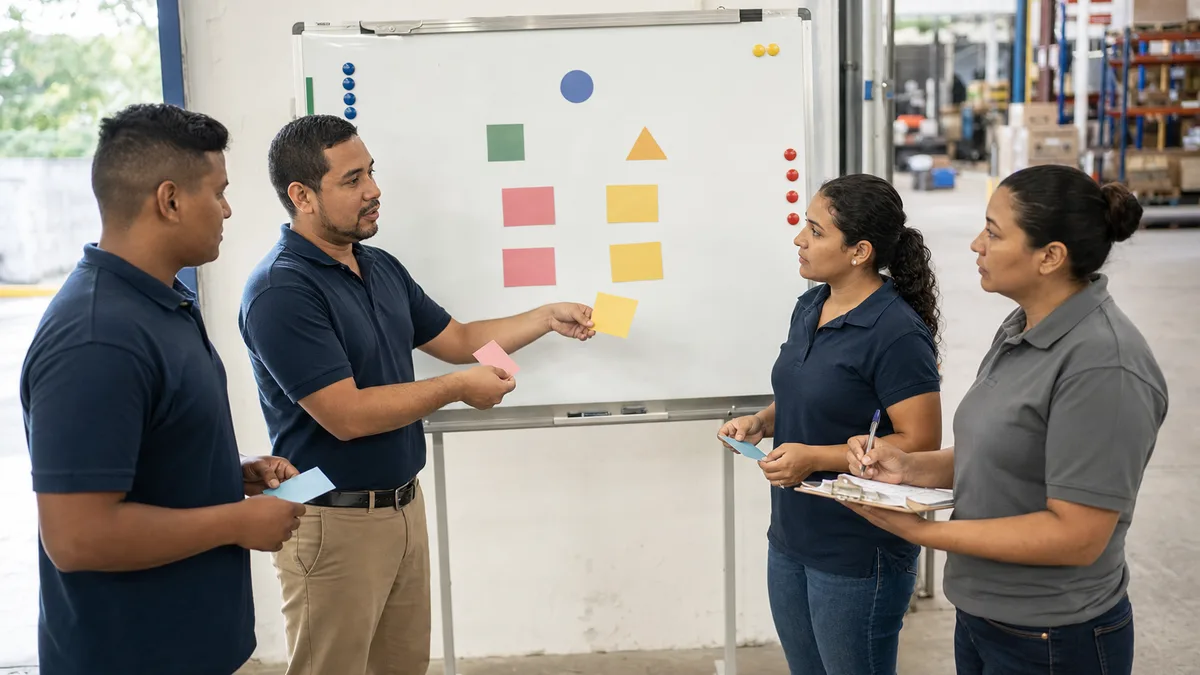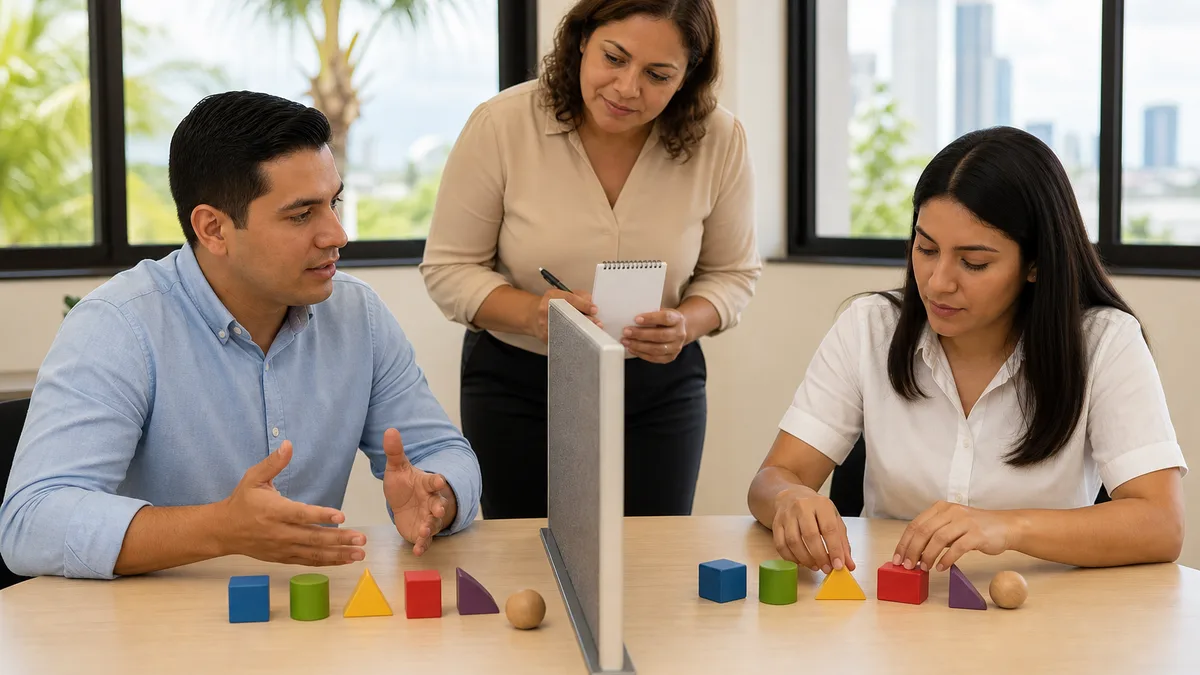
A supervisor avoids correcting a behavior to prevent tension. An employee accepts a deadline they know they cannot meet. Two departments exchange increasingly harsh messages because neither one explains what it needs from the other. When these situations repeat, the company does not simply have a “lack of communication.” It needs shared criteria and practice for holding clear conversations under pressure.
An assertive and effective communication workshop for companies in Panama addresses those situations directly. The goal is not to memorize polite phrases. It is to express needs, boundaries, disagreements, and feedback clearly; listen to understand; and close each conversation with verifiable agreements.
If you are evaluating training, the service page explains what the workshop can practice, its limits, and the information needed to define a proposal.
Are assertive and effective communication the same?
They complement each other, but they are not identical:
- Assertive communication helps people express a position respectfully and precisely, without aggression, avoidance, or ambiguity.
- Effective communication seeks to ensure that the message is understood, uses the appropriate channel, and produces the expected coordination.
A person can speak respectfully and still give an incomplete instruction. They can also communicate a task precisely but react defensively to an objection. That is why a useful business program combines assertive expression, active listening, written communication, difficult conversations, and team agreements.
A simple structure for preparing a conversation includes:
- Observable facts: what happened, without presenting an interpretation as an accusation.
- Impact: why the situation matters to the work, customer, or team.
- Need or expectation: what must be made clear.
- Verifiable agreement: who will do what, by when, and how it will be confirmed.
Signs that your company needs to strengthen this capability
Consider evaluating a workshop when several of these situations appear:
- Requests do not define an owner, deadline, or expected result.
- People avoid discussing a problem until it becomes urgent.
- Feedback feels like a personal attack or remains too vague to guide action.
- Meetings end with apparent agreement, but each department acts differently afterward.
- Leaders soften a message so much that the expectation becomes unclear.
- Disagreements end in silence, defensive messages, or unnecessary escalation.
- Customers or suppliers receive contradictory responses from different people.
- Clarifications, rework, or cross-department conflicts keep recurring.
One isolated sign does not prove that the entire organization has the same problem. The initial conversation with Crezendo helps determine which behaviors can be practiced and which difficulties belong instead to processes, roles, workload, or authority.
Practical modules the workshop may include
The content is defined according to the company's needs. A program may combine:
| Module | Possible practice | Possible evidence |
|---|---|---|
| Communication styles | Recognize passive, aggressive, and assertive responses | Shared language for analyzing conversations |
| Requests and agreements | Rewrite ambiguous instructions | Requests with context, owner, deadline, and criteria |
| Active listening | Paraphrase, ask, and test assumptions | Questions for clarifying needs |
| Feedback | Practice observation, impact, and next step | An adaptable structure for performance conversations |
| Boundaries and disagreements | Say no, negotiate priorities, and raise objections | Clear responses without avoidance or unnecessary confrontation |
| Written communication | Review email, chat, and cross-team messages | Criteria for selecting channels and structuring messages |
| Difficult conversations | Simulate a workplace situation | Conversation plan and guided practice |
| Team agreements | Review meetings and coordination | Concrete rules for improving follow-up |
The workshop does not try to make everyone communicate in the same way. It gives people a shared structure for preparing, holding, and closing workplace conversations.
For one concrete improvement to written communication, see these timeless greeting examples for emails and messages. The guide explains why a morning- or afternoon-specific formula loses suitability when the reading time is outside the sender’s control.
How does Crezendo tailor the training?
Before defining the program, it is useful to clarify:
- The participant group: supervisors, leaders, customer service, sales, technical teams, or mixed departments.
- The conversations that create friction.
- The participants' level of responsibility and experience.
- The sector, vocabulary, and internal policies that must be respected.
- The result the company expects to observe after training.
- The number of participants, preferred delivery mode, and available time.
With that information, Crezendo can select relevant capabilities and exercises. Practice may include scene analysis, message rewriting, role-play, conversation planning, and guided feedback. Any evidence or additional material must be confirmed in the proposal. Real cases can be adapted without exposing names or sensitive information.
If the primary need is learning how to approach disagreement, these skills can be complemented by the workplace conflict resolution guide or the corporate conflict resolution workshop. An active dispute or complaint may require another channel. If the difficulty is concentrated among people who coordinate others, leadership training for supervisors may also be useful.
Communication may also be connected to workplace climate or tense conversations with users; in that case, consult the guide to handling difficult customers.
How to define the scope without assuming conditions
Crezendo does not publish one universal delivery mode, duration, participant count, or format for this workshop. Those conditions must be confirmed explicitly in the proposal based on the capabilities to be practiced, the group's context, and the available conditions.
A workshop can help people practice clear messages, listening, empathy, tone, body language, constructive criticism, and respectful disagreement. It does not replace company decisions about processes, roles, workload, incentives, or authority.
How can you evaluate whether the proposal fits your needs?
Before hiring a provider, ask:
- Is the content adapted to real conversations from our team?
- How much time is devoted to practice and feedback?
- What will participants be able to produce or apply afterward?
- Does the facilitator distinguish a skill problem from a process, role, or authority problem?
- How will sensitive cases be protected?
- What information does the provider need to tailor the workshop?
- What does the proposal include, and which conditions could change the quote?
Be cautious with promises to “eliminate all conflict” or “transform the culture” in one session. A workshop can develop skills and agreements; sustaining change also depends on leadership behavior, company processes, and follow-up.
See everything Crezendo can do for your company
Communication may be the visible need, but it is not always the only one. Crezendo also designs programs in leadership, emotional intelligence, creativity, digital skills, business administration, sales, and other areas.
You can view all workshops for companies. If communication patterns are rooted in habits or incentives, it may also be useful to examine the organizational culture. The initial conversation helps identify the capability that is actually blocking the desired result.
What happens after you contact Crezendo?
The initial process turns a general need into a proposal you can evaluate:
- You describe the challenge: what is happening, who it affects, and what should be observed differently.
- We clarify the scope: participants, objectives, delivery mode, availability, and context.
- We define the approach: capabilities and practice aligned with the need.
- You receive a proposal and quote: including the scope and conditions to be confirmed.
- We coordinate delivery: once the proposal is approved.
You do not need to arrive with the program already designed. An honest description of two or three repeated situations is usually a strong starting point.
Frequently asked questions
Who can benefit from the workshop?
It can be designed for supervisors, leaders, customer service, sales, technical teams, or cross-functional groups. The group's composition influences the cases and exercises.
Can it be tailored to our sector?
Yes. Crezendo needs to understand the context, vocabulary, recurring situations, and desired result. Tailoring is defined in the proposal.
How long is the workshop?
There is no universal published duration. The proposal must confirm it explicitly based on the scope, group, and capabilities to be practiced.
How is the delivery mode defined?
No universal delivery mode is assumed. Crezendo confirms the applicable option in the proposal after reviewing the required practice and the group's conditions.
What information should I provide to request a quote?
Share the approximate group size, participant roles, preferred delivery mode, tentative dates, and two or three situations you want to improve. That information helps define the scope.
Assertive and effective communication develops through preparing and practicing specific conversations. If your company needs clearer requests, better listening, useful feedback, or better-managed disagreements, review the assertive communication workshop scope.