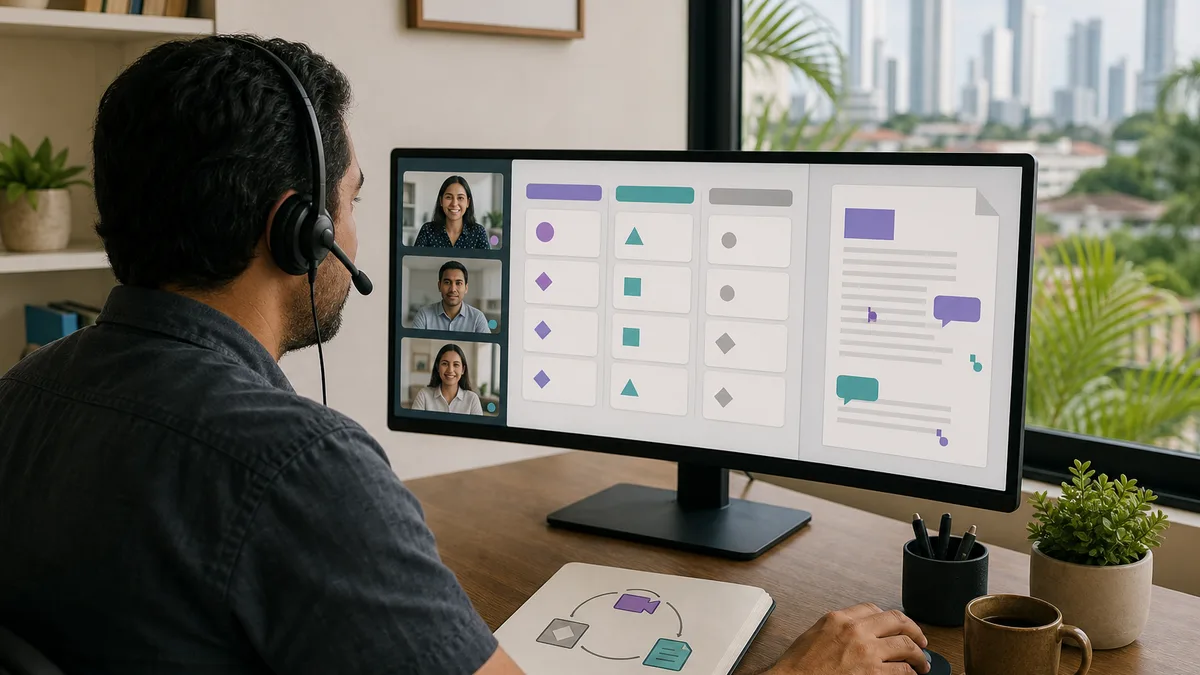
A message is sent at 8:12 a.m. and begins, “Good morning, Laura.” Laura reads it at 6:40 p.m. Another team member opens it the next day. A client in another time zone receives it when night has already fallen there. The sender intended to be courteous; the greeting, however, did not survive the journey.
That small mismatch reveals a larger problem: we keep carrying into asynchronous media a ritual designed for conversations in which people share the same “now.” In a call, an in-person meeting, or a truly live chat, “good morning” may fit. In an email, a muted message, a scheduled post, or a support ticket, the writer controls the sending time but not the reading time.
For that reason, using “good morning,” “good afternoon,” or “good evening” as a general greeting in asynchronous communication is not merely a matter of stylistic preference: it is a pragmatic design error. The phrase is grammatically valid, but it is poorly selected for a channel in which the recipient’s temporal context cannot be known.
The direct recommendation
In email, non-live chat, direct messages, posts, newsletters, comments, support tickets, and automated communications, use an opening that remains appropriate when the message is read minutes, hours, or days later:
- Hello, Ana:
- Dear Professor Gomez:
- Hello, team:
- Thank you for contacting us.
- Thank you for your message.
- To everyone joining us:
- I’m writing to…
The rule is simple:
When you cannot guarantee the reading time, do not make the greeting’s validity depend on that time.
This is not about sounding fashionable or banning a traditional phrase. It is about designing the message for the actual conditions of the medium.
“Good morning” is not ungrammatical; it is wrong for that job
This distinction matters. Calling something incorrect does not necessarily mean it violates grammar.
“Turn left” can be a perfectly formed sentence and still be an incorrect instruction when the destination is on the right. In the same way, “good morning” is a valid English formula, but it fails functionally when it is meant to greet someone whose reading time is unknown.
In linguistics and pragmatics, meaning depends not only on words but also on who speaks, to whom, where, when, and through which channel. Time-of-day greetings are temporally indexed: they presuppose a shared frame. Asynchronous communication removes precisely that guarantee.
We can test the issue objectively:
- Can the message be read later?
- Can the recipient be in another time zone?
- Can the message remain archived, be forwarded, or resurface days later?
- Can it be scheduled, automated, or distributed by an algorithm?
When the answer to any of these questions is yes, a timeless opening is technically better suited. “Hello, Laura” remains valid. “Good morning, Laura” may not. That observable contrast is why this is not simply a matter of taste.
What “asynchronous” actually means
A channel is synchronous when people participate at the same time and reasonably share the present moment of the interaction: an in-person conversation, a phone call, a video meeting, or a chat in which both parties are active and responding in real time.
A channel is asynchronous when there may be a gap between production and reception. Email is the classic example, but many uses of WhatsApp, Telegram, Slack, Teams, social-media messages, forums, forms, support systems, and comments are asynchronous as well.
Calling an application a “chat” does not automatically make every exchange synchronous. When a person can put the phone away, mute the conversation, sleep, work, travel, or answer the next day, the message remains exposed to an unpredictable delay.
Research on chronemics—the communicative role of time—shows that sending time and response delay carry social information. Walther and Tidwell experimentally found that temporal cues in email could alter relational perceptions. Kalman and colleagues analyzed more than 150,000 responses across different asynchronous systems and documented broad response-latency patterns. These studies did not test a supposed formal ban on “good morning.” They support a more basic premise: time is not a neutral detail of digital communication.
The greeting still matters because it performs social work
Correcting a time-bound greeting does not mean removing courtesy. It means preserving courtesy more reliably.
Greetings perform what pragmatics calls a phatic function: they open the channel, acknowledge the other person, signal attention, and establish relational tone. In a study of 515 emails from two New Zealand workplaces, Joan Waldvogel found that the presence and form of greetings and closings both reflected and helped construct workplace culture. It was a situated case study, not a universal law, but it demonstrates how much interpersonal information a small opening can carry.
Dipti Kulkarni’s study of instant-messaging conversations likewise found that openings, brief responses, and closings do substantial relational work by signaling attention, interest, and continuity of contact. The solution, therefore, is not to make every message abrupt. It is to retain human recognition while removing unnecessary dependence on the clock.
Compare:
Good morning, Ana. I’m sending the report you requested.
with:
Hello, Ana. I’m sending the report you requested.
The second version loses no respect, warmth, or clarity. It only removes an assumption the sender cannot control.
Recommended greetings by context
| Context | Recommended timeless opening | Why it works |
|---|---|---|
| Formal first contact | Dear Dr. Ruiz: | Formal, personal, and valid at any hour. |
| Everyday professional email | Hello, Ana: | Neutral, courteous, and widely understood. |
| Team message | Hello, team: | Inclusive and direct. |
| Customer service | Hello, Marta. Thank you for contacting us. | Acknowledges both the person and the contact. |
| Reply to an inquiry | Thank you for your message. | Can replace a greeting when context already exists. |
| Institutional message | To our community: / To everyone joining us: | Useful when individual names are unavailable. |
| Newsletter or public post | Thank you for joining us. or a direct opening | Not every publication needs an explicit salutation. |
| Ongoing thread | Continue with the answer | Repeating a greeting in every turn may feel mechanical. |
| Automated message | Hello, {name}. We have received your request. | Must remain correct regardless of delivery time. |
What about “Good day”?
It may function as a broader formula in some varieties of English, but it is not equally natural across regions and registers. It can sound formal, old-fashioned, abrupt, or locally marked. For international communication, “hello,” the person’s name, or a context-based acknowledgment is more robust.
Is “Hi” professional?
It can be. Professionalism depends on respect, clarity, role, precision, and the complete message—not on a particular clock-based formula. When greater formality is required, use “Dear Professor,” “Dear Ms. Patel,” or the appropriate title. None of these depends on time of day.
Should every message include a greeting?
No. An active thread, a system notification, or a public post may work better with a direct opening. The point is not to impose a new ritual mechanically. The point is to choose an opening that fits the channel, relationship, and stage of the exchange.
Why “good morning” is so difficult to stop writing
The difficulty is not replacing a few letters. It is changing a sequence that may have been performed for years or decades with almost no conscious deliberation.
The psychology of habit explains how repeated behavior in a stable context can become a default response. Wendy Wood and Dennis Rünger describe habits as responses learned through repetition in recurring contexts and later performed efficiently. In this case, the cycle may look like this:
- Cue: an empty message field appears.
- Routine: the writer types “Good morning.”
- Immediate result: the writer feels courteous and experiences the message as properly started.
The brain reduces effort by reusing the familiar sequence. It does not reconsider every time whether the recipient will read the message in the morning. That does not prove the formula is appropriate; it proves the behavior has become automatic.
What neuroscience contributes—without oversimplification
There is no single “greeting center” in the brain, nor is a phrase permanently engraved in neural tissue. Research connects behavioral automaticity with circuits that include the basal ganglia and striatum, interacting with cortical and learning systems. Ann Graybiel has described how routines and rituals can acquire habitual control through experience-dependent plasticity.
The useful conclusion is not “my brain will not let me change.” It is the opposite: the same learning system that acquired the old routine can acquire a new one, especially when the cue is made explicit, an alternative response is practiced, and environmental friction is reduced.
What psychiatry contributes: a boundary against pathologizing
An everyday habit is not a psychiatric disorder. Although research on compulsions and addictions also examines circuits involved in automatic behavior, it would be wrong to call someone “obsessive,” “compulsive,” or clinically “rigid” merely because that person continues to write “good morning.”
Psychiatry offers a valuable caution here: shared learning mechanisms do not turn a normal convention into an illness. Resistance may be strong, defensive, or frustrating without constituting a diagnosis. Changing this habit calls for practice and better design, not clinical labels.
Resistance to change is not purely individual
Shaul Oreg identified four common dimensions in dispositional resistance to change: routine seeking, emotional reaction to imposed change, cognitive rigidity, and short-term focus. Later research found that the scale retained comparable meaning across samples from 17 countries. This does not justify diagnosing individuals from a disagreement. It helps explain why a tiny behavioral adjustment can trigger a surprisingly large reaction.
People may say:
- “I have always done it this way.”
- “Now even greeting someone is supposedly wrong.”
- “Nobody has ever complained.”
- “I will not change the way I speak because of a trend.”
Those responses combine routine, identity, emotion, and immediate cost. The benefit—a message that remains appropriate at any reading time—feels abstract. The discomfort of monitoring an automatic behavior is felt immediately.
The status quo bias also matters: people often grant an unjustified advantage to the current option simply because it is already the current option. Samuelson and Zeckhauser documented this tendency in both experimental and real-world decisions. Familiarity reduces perceived risk, but it does not prove that an inherited practice remains well adapted to a new environment.
Sociology and anthropology: greetings are rituals of belonging
Greetings are not learned as isolated phrases. They are learned inside families, schools, offices, professions, and communities. They signal respect, distance, hierarchy, familiarity, and membership. A person may experience the removal of “good morning” as the removal of politeness because the two have been associated for years.
From an anthropological perspective, the conflict appears when the medium changes faster than the ritual. A time-of-day greeting made sense when entering a room, answering a shop counter, or beginning a face-to-face conversation: participants shared a place and a moment. We then transferred the same ritual into persistent email, delayed notifications, and messages crossing continents without redesigning it.
The sociology of digital communication shows that text needs its own methods for reconstructing relational information otherwise supplied by voice, gesture, and situation. Menchik and Tian, after studying face-to-face and email exchanges over 18 months, argued that email requires specific techniques for conveying pragmatic context. Literally copying an offline convention does not always preserve its function.
Norms also vary across cultures. A study of 234 technology-services professionals found cultural differences in preferences for formality, promptness, precision, task orientation, and relationship orientation in email. That finding calls for humility: no single affective formula feels identical everywhere. Yet precisely because of that variation, a semantically stable and adaptable opening—a name, “hello,” a title, or an acknowledgment—is more robust than an assumed time period.
Good intentions do not make the greeting functionally correct
Most people who write “good morning” are trying to be kind. That intention deserves respect. Intention and suitability, however, answer different questions:
- Intention asks: “What did I mean to convey?”
- Suitability asks: “Does the chosen form work under the actual conditions of reception?”
A person may have excellent intentions and still choose an insecure password, an ambiguous instruction, or an incompatible date. Identifying the defect does not deny the intention. In the same way, calling a time-bound greeting wrong for asynchronous communication does not accuse the sender of rudeness; it identifies a correctable mismatch.
Turning the observation into a scolding often strengthens resistance. A more effective explanation is:
“Your intention to greet the person is right. Let’s use a formula that remains right no matter when it is read.”
That protects dignity while improving behavior.
Common objections, considered carefully
“The recipient can see when I sent it”
Yes, but that only reconstructs the sender’s context. The greeting opens an interaction with the reader; it is not a historical label attached to the drafting moment. When the sender’s local time is part of the content, state it explicitly: “Greetings from Panama, where the morning is beginning.”
“Nobody has ever been offended”
Functional correctness is not limited to preventing offense. A broken link remains defective even when nobody complains. The issue here is accuracy, robustness, and channel fit—not a prediction of emotional catastrophe.
“Everyone does it”
Frequency demonstrates a convention, not universal suitability. Many conventions persist through imitation after the conditions that once made them sensible have changed.
“Messages on WhatsApp are read immediately”
Sometimes. At other times the phone is muted, offline, in another room, or in another time zone. Messaging platforms can support both synchronous and asynchronous exchanges. The rule depends on the actual interaction, not the application’s label.
“We are in the same country”
A shared time zone removes one source of mismatch but not delay. A morning message may still be opened at night or the following day.
“This is overthinking a greeting”
Because the replacement costs almost nothing, choosing the more robust default is reasonable. Nobody needs to conduct a philosophical analysis before every email. Adopt a better default once and let the new habit do the work.
How to change the habit without turning it into a battle
1. Select one default for each register
- Everyday professional: Hello, {name}:
- Formal: Dear {title and surname}:
- Team: Hello, team:
- Customer service: Hello, {name}. Thank you for contacting us.
- Existing thread: a direct response without restarting the ritual.
A prior decision prevents repeated negotiation with the habit.
2. Change the first action
Instead of trying not to type “good morning,” define a positive behavior:
“When I open a new asynchronous message, I will type the recipient’s name first.”
A rule tied to a concrete cue makes replacement easier.
3. Change the environment
Update:
- email templates;
- quick replies;
- signatures and macros;
- CRM and ticketing systems;
- automated messages;
- newsletters;
- scheduled posts;
- customer-service scripts.
Asking people to change while the system keeps inserting the old formula is designing failure.
4. Do not rely on the “21 days” myth
In a study of everyday habit formation, Phillippa Lally and colleagues found substantial variation: participants took between 18 and 254 days to approach their maximum automaticity, depending on the person and behavior. The study was not about greetings and cannot predict the exact duration of this change. It does show that there is no universal timetable. Missing one opportunity also did not materially derail the process.
The practical lesson is simple: one slip does not send a person back to zero. Correct the next message and continue.
5. In organizations, teach the reason—not only the rule
A policy without an explanation feels arbitrary. A policy grounded in a clear principle can be applied to new situations.
Ready-to-adapt wording:
In asynchronous communication, we use greetings that do not depend on time of day. We reserve “good morning,” “good afternoon,” and “good evening” for synchronous interactions in which participants share the same temporal frame. In persistent, public, scheduled, or automated messages, we use the recipient’s name, “hello,” an appropriate title, or an acknowledgment. We correct templates and processes; we do not shame people.
This practice fits within broader assertive communication at work. When the challenge is no longer understanding the rule but adopting it consistently across a team, it becomes a question of adaptability to technological change.
A quick decision guide
Before sending, check:
- Persistence: Can the message remain stored?
- Delay: Can it be read outside the current time period?
- Time zone: Can someone receive it elsewhere?
- Relationship: Do I need warmth, neutrality, or formality?
- Continuity: Is this a new message or part of an active thread?
- Automation: Will the formula be reused without human review?
- Cultural naturalness: Will the expression be understood outside my immediate group?
When the reading time is uncertain, choose a timeless opening first. Then adjust the degree of formality.
Complete examples
Formal email
Dear Professor Morales:
I’m writing to confirm receipt of the documents and ask about the next step in the process.
Everyday professional email
Hello, Daniel:
I’m sharing the revised report. I marked the three items that require a decision.
Customer service
Hello, Patricia. Thank you for contacting us.
We reviewed your request and need to confirm one detail before proceeding.
Distributed team message
Hello, team:
The agenda for our next meeting is now available. Please add comments by Thursday.
Scheduled publication
Today we are sharing a guide to reducing common errors in customer communication.
In public content, moving directly into the subject often feels more natural than pretending to share a single moment with an audience arriving at different times.
To improve not only the opening but the complete message, explore principles of digital copywriting, empathy in digital customer service, and—when the interaction truly is live—non-verbal communication in video calls.
When “good morning” is appropriate
This recommendation is not a universal prohibition. A time-of-day greeting fits when a shared present is reasonably established:
- entering an in-person meeting;
- beginning a live phone or video call;
- participating in a real-time chat when both people are present and share the relevant temporal frame;
- intentionally making the sender’s local time part of the message.
The exception confirms the criterion. What matters is not whether the channel uses a keyboard or a voice, but whether the interaction shares time.
Frequently asked questions
Is it wrong to write “good morning” in an email?
It is not grammatically wrong. It is pragmatically and functionally wrong when the email may be read outside the morning and the phrase is intended to greet the person according to the receiving moment. The problem is channel fit.
What is the safest timeless greeting?
“Hello, {name}:” works across a wide range of everyday and professional contexts. For greater formality, use “Dear” with the appropriate title and name.
Can I begin without a greeting?
Yes, particularly in an active thread, a notification, or a publication whose format favors a direct opening. The absence of a greeting is not automatically rude; expectations depend on the relationship and organizational culture.
Is “I hope you’re well” a timeless greeting?
It does not depend on time of day, but it can feel formulaic or overly personal depending on the relationship. Use it when it reflects genuine concern rather than as compulsory filler.
What should I use when I do not know the person’s name?
Options include “Hello,” “Dear Support Team,” “To whom it may concern,” or a functional acknowledgment such as “Thank you for reviewing this inquiry.” “To whom it may concern” is formal and distant; it should not be the automatic choice when you know the department or role.
How long does it take to change the habit?
There is no universal number, and habit-formation research has examined other behaviors. The pace will depend on message frequency, consistency of the replacement, and whether templates and environmental cues are updated.
Academic sources consulted
- Wendy Wood and Dennis Rünger: Psychology of Habit.
- Ann M. Graybiel: Habits, Rituals, and the Evaluative Brain.
- Phillippa Lally and colleagues: How Are Habits Formed?.
- Shaul Oreg: Resistance to Change.
- Oreg and colleagues: resistance to change across 17 countries.
- William Samuelson and Richard Zeckhauser: Status Quo Bias in Decision Making.
- Joan Waldvogel: Greetings and Closings in Workplace Email.
- Yoram Kalman and colleagues: Pauses and Response Latencies in Asynchronous CMC.
- Joseph Walther and Lisa Tidwell: Chronemics in Computer-Mediated Communication.
- Daniel Menchik and Xiaoli Tian: Putting Social Context into Text.
- Dipti Kulkarni: Phatic Function in Instant Messaging.
- Dirk Holtbrügge, Abigail Weldon, and Helen Rogers: Cultural Determinants of Email Communication Styles.
These sources support the psychological, neurobiological, social, cultural, and temporal components of the analysis. The specific conclusion about time-of-day greetings follows from applying those findings and pragmatic reasoning to a verifiable property of asynchronous channels: the sender does not control the moment of reading.
A small change that improves the entire message
The goal is not to police words for entertainment or to portray people who repeat a convention as ignorant. The goal is to recognize that technology changed the conditions of reception and that effective courtesy must adapt with them.
A good asynchronous greeting still makes sense when opened in five minutes, at the end of the day, tomorrow, or from another continent. “Hello,” the recipient’s name, an appropriate title, or an acknowledgment meets that requirement. “Good morning” meets it only by coincidence.
This is not a matter of taste. It is the difference between writing for the hour in which we send and writing for the reality in which others read.
Crezendo offers a corporate assertive communication workshop that can address messages, channels, tone, listening, and practical communication protocols for each organization. When the central difficulty is helping a team abandon entrenched routines and adopt a shared practice, the corporate change-management workshop can address adoption, resistance, and follow-through.