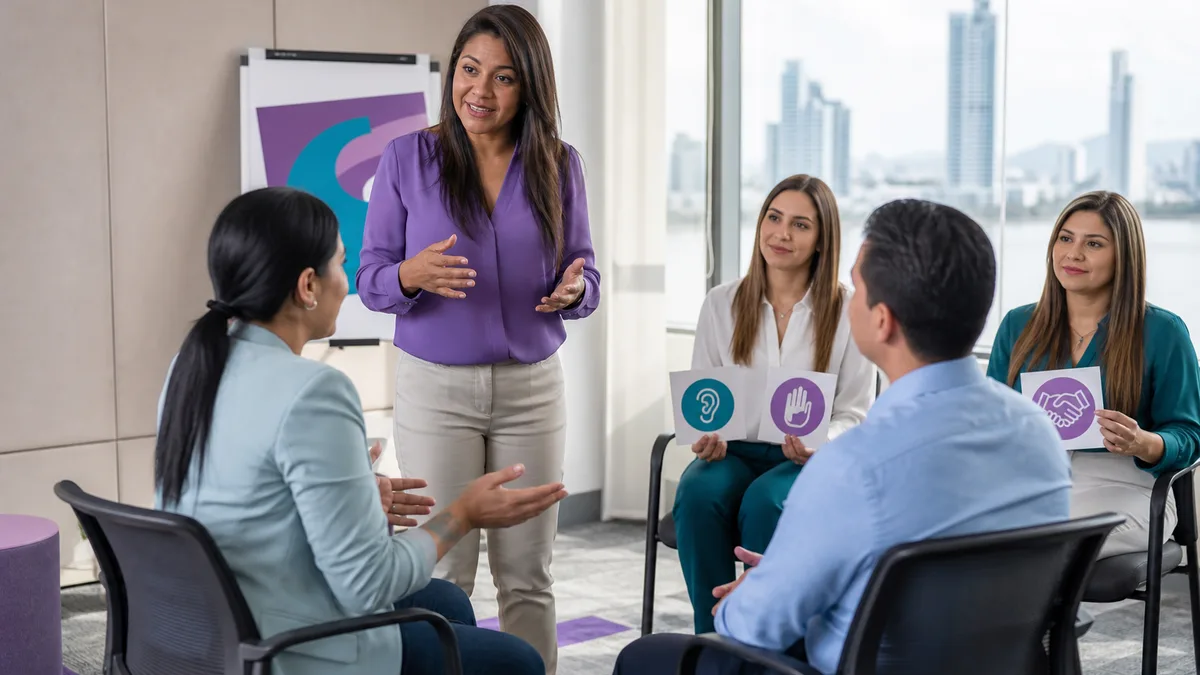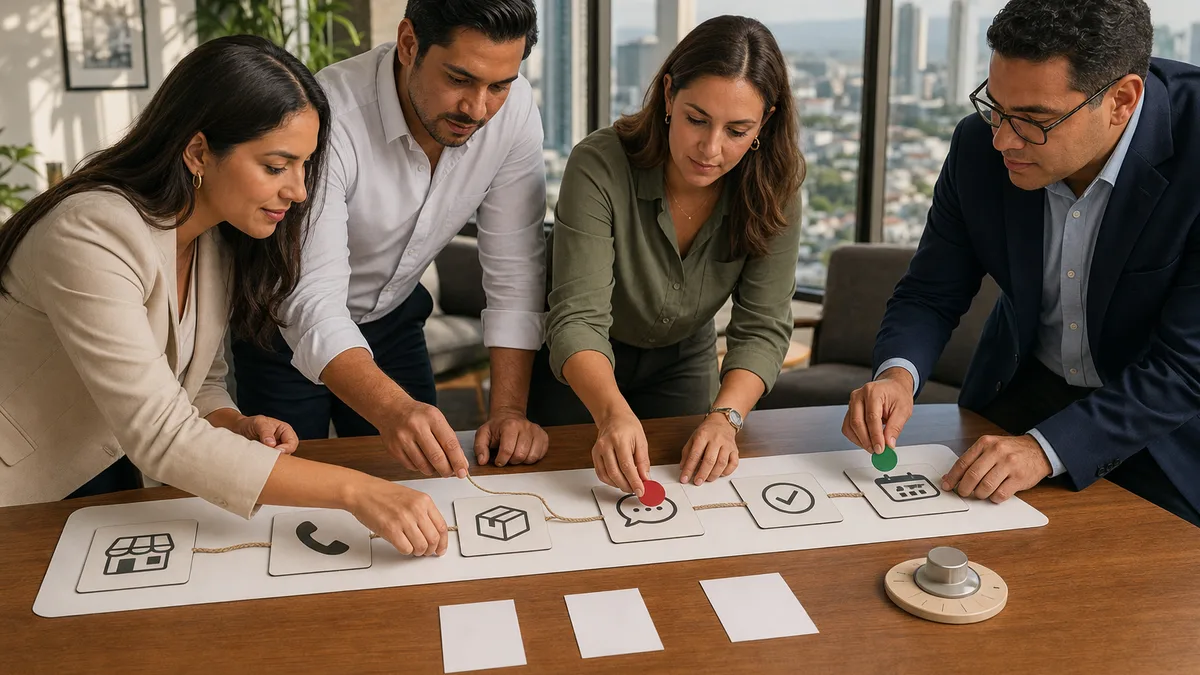
Organizational climate appears in everyday situations: how a decision is communicated, what happens when someone disagrees, whether asking for help feels safe, and how two departments resolve a blocker. It is neither a slogan nor a complete picture of the company. It is a situated reading of how people experience work during a particular period.
This guide helps readers recognize signals, separate different problems, and decide which response fits. When the primary need is to develop capabilities in workplace behavior, motivation, communication, leadership, teamwork, decisions, and conflict, explore Crezendo’s organizational climate workshop for companies. The proposal confirms scope; a survey, assessment, or comprehensive intervention is not assumed.
What organizational climate means
Organizational climate brings together perceptions of the work environment: clarity, treatment, coordination, trust, support, leadership, participation, and the ability to address problems. Those perceptions matter because they affect how people interpret decisions and relate to one another, but they should not be treated as isolated proof of a cause.
Two people may experience the same process differently. Different shifts, locations, or departments within one organization may also have different climates. It is therefore more useful to ask “which situations are we observing, and where?” before concluding that “the company has a bad climate.”
A responsible analysis connects perspectives with facts close to the work. It may consider agreements that lose follow-through, delayed handoffs, changes communicated without context, or difficulty escalating blockers. The reading improves when observation, interpretation, and assumption are separated.
Climate, environment, and culture: related concepts
In everyday use, workplace climate, organizational climate, and work environment often refer to the present experience of work. Culture, by contrast, includes values, norms, and patterns the organization learns and reinforces over a longer period.
A policy may declare collaboration while a team experiences asking for help as something that is punished. The policy belongs to the formal system; the daily experience provides a climate signal; sustained repetition may reveal a cultural pattern. For a deeper comparison, read the guide to organizational culture in companies.
It is not useful to treat the concepts as though one invalidated the other. Climate helps locate current experiences; culture helps examine more persistent patterns. Both require context and care.
Eight signals that deserve attention
A signal is not an assessment. It can justify a more careful conversation:
- People avoid expressing questions or disagreement in meetings.
- Problems are reported after they have already affected customers, deadlines, or colleagues.
- Two departments blame one another without reviewing their shared handoff.
- Priorities change, but the criteria and impact are not explained.
- Similar situations receive different responses depending on the manager.
- Agreements appear clear during a meeting and then lose follow-through.
- Recognition, workload, or access to information is perceived as inconsistent.
- A survey exists, but no one knows which decisions may legitimately follow from it.
These signals may also be related to process design, resources, staffing, incentives, structure, safety, equity, or external conditions. Asking people for a “better attitude” does not correct a barrier controlled by the organization.
Turning an impression into a useful question
Broad statements such as “people lack commitment” or “communication is poor” combine facts and interpretations. A concrete situation makes them more useful:
| Broad impression | More useful question |
|---|---|
| People lack commitment | Which agreements lose follow-through, when, and under which conditions? |
| Communication is poor | Which information arrives late, to whom, and which decision does it prevent? |
| Leaders do not listen | In which spaces are problems raised, and which response do they receive? |
| Departments do not collaborate | Which handoff creates rework, and which criterion needs agreement? |
The question is not intended to blame or investigate a person in public. Its role is to bring the conversation closer to behavior, decisions, and conditions the organization can address.
What training can address
Crezendo’s portfolio confirms the Organizational Behavior and Climate — Creating Healthy and Productive Environments workshop. Its confirmed format is a workshop, with content related to:
- Workplace behavior analysis.
- Organizational climate study.
- Motivation and commitment.
- Effective communication.
- Leadership and adaptation to different styles.
- Teamwork and diverse personalities.
- Assertive decision-making.
- Conflict, problems, and climate indicators.
Training can develop language, criteria, and practice around these capabilities. It does not establish by itself how the entire company is doing, guarantee productivity, satisfaction, or retention, or replace decisions about policy, workload, resources, and responsibilities.
When conversations are the primary challenge, the assertive communication workshop and the guide to effective communication for companies may also be relevant. When the difficulty centers on coordination and agreements, the team-building workshop provides another confirmed approach. The choice depends on the capability the group actually needs.
A workshop, survey, and comprehensive intervention are not equivalent
A workshop focuses on learning and practice. A climate measurement collects information through an explicit method. A comprehensive intervention may involve decisions, policy, processes, leadership, resources, and follow-up over time.
The distinction matters:
- A survey needs participation criteria, confidentiality, data handling, and analysis.
- An interview needs a purpose, consent, safeguards, and a responsible way to interpret answers.
- A complaint needs protection, due process, and competent channels.
- Structural change needs authority, resources, and organizational follow-through.
The corporate organizational climate workshop page states these boundaries explicitly. If the company needs measurement, investigation, or consulting, that service must be requested and confirmed separately, not assumed within training.
Confidentiality, complaints, and mental health
An open group session is not the place to identify complainants or investigate harassment, discrimination, violence, or retaliation. Those matters require the appropriate HR, ethics, safety, legal, or public-authority mechanisms. Asking someone to describe a sensitive case in front of the group can increase risk.
Organizational training also does not diagnose or treat anxiety, depression, burnout, or other clinical conditions. When an individual needs support, the path should include qualified professionals. The guide to responsible workplace stress management explains the difference between preventive education and clinical care.
A first conversation with a provider only needs a general description of the context. Names, files, identifiable results, and complaint details are unnecessary.
Using indicators without turning them into a verdict
Turnover, absence, complaints, incidents, participation, agreement completion, and survey results can provide evidence. No single measure defines climate.
Turnover may relate to the labor market, compensation, contracts, location, leadership, or job design. Low absence does not necessarily prove well-being. A survey with a high score may hide differences among departments when only the aggregate is reviewed.
Before using an indicator, clarify:
- Which question it is intended to answer.
- Where the data came from.
- Which period and population it represents.
- Which limitations it has.
- Who may access the result.
- Which decision would be legitimate.
The portfolio includes evaluating climate through indicators as learning content. That does not amount to offering a specific measurement or universal report.
Choosing the appropriate response
Use this initial orientation:
- Workshop: when the objective is to develop shared skills, language, or practice.
- Measurement: when the company needs to collect and analyze perceptions through an explicit method.
- HR or ethics: when complaints, personnel decisions, inequity, or violations are involved.
- Operational redesign: when friction comes from roles, capacity, tools, or processes.
- Clinical support: when a person needs health assessment or care.
- Change management: when climate is affected by a transformation and adoption is the central challenge; see the change-management workshop.
More than one need may exist. Separating them prevents one activity from being asked to solve what it cannot.
Information to prepare for a proposal
A useful request can answer four questions without disclosing sensitive information:
- Which general situations motivate the conversation?
- Who would participate, and which relationship exists among their roles or departments?
- Which capability does the organization expect to develop?
- Which matters should remain outside the workshop and within specialized channels?
There is no need to define duration, delivery format, group size, or deliverables independently. The portfolio does not publish universal conditions; the proposal must confirm them before the service is coordinated.
Frequently asked questions
Can a workshop improve organizational climate?
It can develop capabilities related to communication, leadership, teamwork, decisions, and conflict. Climate also depends on policy, resources, workload, equity, processes, and follow-up, so an organizational indicator cannot be guaranteed.
Does the workshop replace a climate survey?
No. A workshop and measurement have different objectives and methods. If a survey is needed, it must be expressly defined and contracted.
Should managers participate?
It depends on the objective and the relationship among participants. The proposal should delimit participation without assuming one universal composition.
Can specific conflicts be addressed?
The group can practice general capabilities for navigating disagreement; the workplace conflict resolution guide helps choose an appropriate response, and the corporate workshop develops confirmed skills. A particular case may require mediation, investigation, protection, or another internal process.
How do I request a quote?
Share general situations, participants, and the priority capability without sending sensitive data. Request a proposal and quote for the organizational climate workshop, review the guide to corporate training workshops in Panama, or explore Crezendo’s workshop catalog.
The purpose of a good request is not to label a company “healthy” or “toxic.” It is to delimit what the group needs to learn, what the organization must resolve, and which matters belong in other channels.