Node.js runs JavaScript outside the browser and can power servers, tools, and other processes. It is not a new language or a framework. To learn backend development with sound judgment, understand HTTP, asynchronous work, validation, errors, and security boundaries first; evaluating any framework becomes easier afterward.
This guide uses evidence gates, not a timetable for “mastering Node.js.” Its central project is a task API with synthetic data and in-memory storage. You can verify its contract and tests on your computer, but you should not present it as a production application: it loses data on restart and does not yet include authentication, durable persistence, or public operations.
If you want to structure a roadmap for yourself or a team, you can contact Crezendo with the current level, objective, and proposed practice project. Contact only lets you ask whether a relevant guidance or training option exists; availability, scope, format, prerequisites, dates, and cost require explicit confirmation.
Before Node.js: the foundation you need
You should be able to read and write JavaScript using variables, functions, arrays, objects, modules, exceptions, and promises. You also need to distinguish an interface from the code that processes rules and data. If that map is still unclear, review the differences between frontend and backend.
You do not need to master a framework or database before starting. You should be comfortable with a terminal, editor, JSON files, and version control. Practice with invented data in a new folder; do not reuse credentials or customer information.
Evidence required to move on: a script that exports a function, imports it from another file, awaits a promise, and handles an expected error.
Prepare a reproducible environment
Check the official Node.js release table and choose an Active LTS or Maintenance LTS release. This article intentionally gives no number because support status changes. Verify the environment and record the output in the README:
node --version
pnpm --version
Initialize a separate folder and keep the structure small:
tasks-api/
├─ src/
│  ├─ app.js
│  ├─ server.js
│  └─ tasks.js
├─ test/
│  └─ tasks.test.js
├─ .gitignore
├─ package.json
└─ README.md
In package.json, declare ECMAScript modules and repeatable scripts:
{
  "type": "module",
  "scripts": {
    "start": "node src/server.js",
    "test": "node --test"
  }
}
Commit the lockfile when dependencies exist. Do not add packages by habit: each dependency runs code with broad capabilities and increases the surface you must review and update.
Evidence required to move on: another person can clone the folder, identify the required supported release, and run the same scripts without guessing steps.
Understand the Node.js model before creating routes
Node.js executes JavaScript and provides APIs for networking, files, processes, and cryptography. Its standard library favors asynchronous input and output. While one request waits for network or disk activity, the program can continue with other work; however, a long synchronous function or CPU-heavy calculation in the handler can block the event loop and delay everyone.
A backend is not an isolated function either. An HTTP transaction contains a method, URL, headers, and sometimes a body. A response contains a status, headers, and optionally a body. The node:http module exposes those elements through streams and events, so you must handle errors and limit what you read.
Run two experiments before continuing:
- Create a server that returns JSON and status
200forGET /health. - Deliberately add a long calculation and observe how it delays another request; remove it and document why it does not belong in the handler.
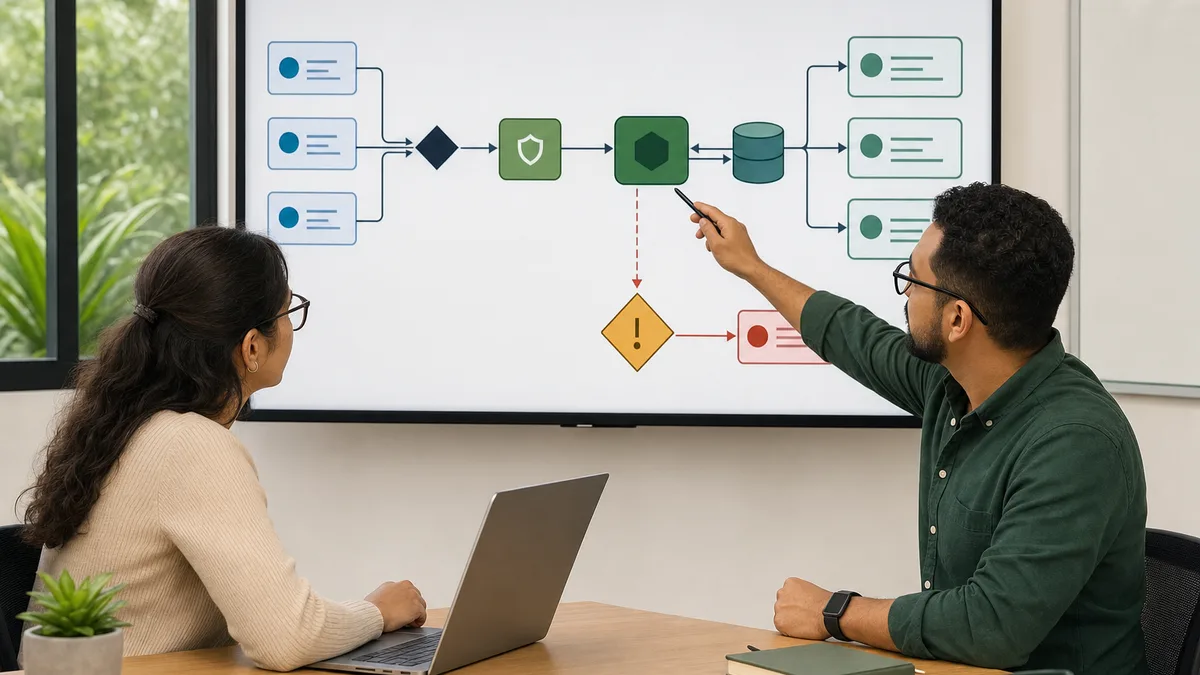
Evidence required to move on: a client → HTTP request → route → logic → response diagram and a note identifying work that could block the event loop.
Define the API contract before the code
The practice API manages fictional tasks. Its smallest useful contract can be:
| Request | Expected result |
|---|---|
GET /health |
200 and process status |
GET /tasks |
200 and a JSON array |
POST /tasks with a valid title |
201 and the created task |
POST /tasks with malformed JSON |
400 |
POST /tasks with the wrong content type |
415 |
POST /tasks with an invalid title |
422 |
| Body larger than the declared limit | 413 |
| Unknown route | 404 |
| Unsupported method on a known route | 405 and an Allow header |
Status codes are not decoration. They distinguish creation, syntax failure, unsupported content, semantic failure, and a missing resource. Keep an error shape stable, such as {"error":{"code":"invalid_title","message":"..."}}, without sending stack traces to the client.
Evidence required to move on: a contract table in the README with one request and response example for each case.
Separate transport, rules, and startup
A clear initial structure keeps every decision from landing in one large function:
server.jsreads configuration, creates the server, and listens on the port.app.jsdecides route, method, status, and serialization.tasks.jsvalidates and applies task rules.test/checks rules and observable behavior.
Validation can begin as a pure function:
export function normalizeTask(input) {
  if (!input || typeof input.title !== 'string') {
    return { ok: false, code: 'invalid_title' };
  }

  const title = input.title.trim();
  if (title.length < 1 || title.length > 120) {
    return { ok: false, code: 'invalid_title' };
  }

  return { ok: true, value: { title, completed: false } };
}
Validation covers both form and meaning. Text can be valid JSON while still violating the rules. Reject unexpected fields when the contract does not allow them; never merge a received object directly into an internal record.
Evidence required to move on: app.js does not know how a title is validated, and tasks.js does not know about HTTP objects.
Read the body as untrusted data
The request body arrives as a stream. Accumulating it without a limit can consume memory. Before parsing JSON:
- accept only the content type declared by the contract;
- count bytes and stop reading after a small documented limit;
- catch stream errors;
- treat a
JSON.parsefailure as an invalid request; - validate type, length, format, and business meaning;
- log the failure category, not sensitive input content.
OWASP recommends early validation of all untrusted input and explicit request-size limits. Validation reduces defects but does not replace authorization, parameterized queries, transport encryption, or abuse controls.
Evidence required to move on: negative tests for broken JSON, an empty title, a wrong type, an unexpected field, and an oversized body.
Handle errors without hiding or leaking them
Classify failures instead of returning 500 for everything:
- Client failures: invalid contract, missing resource, or unsupported method.
- Dependency failures: unavailable database or downstream service.
- Unexpected failures: defects requiring internal correlation and diagnosis.
The client receives a stable code and a cautious message. Internal logs may include timestamp, route, status, duration, and a correlation identifier, but not passwords, tokens, authorization headers, or full request bodies. A broad try/catch is a last barrier, not a substitute for specific handling.
Handle request, response, and server errors. Also define what happens when the process receives a shutdown signal: stop accepting new connections, complete in-flight work within an operational limit, and close resources.
Evidence required to move on: a test forces an unexpected failure, receives a generic response, and confirms that /health remains available.
Add persistence only after declaring the boundary
The first project uses an in-memory Map. That lets you learn the contract without mixing network, database, and deployment concerns. State its limits:
- data disappears on restart;
- multiple instances do not share state;
- there are no transactions or migrations;
- backup and recovery do not exist.
Once the contract and tests are stable, replace storage through an interface such as list, findById, create, and update. You can then test rules with the memory implementation and connect a database later. Use parameterized queries and a least-privilege account; never concatenate user values into SQL.
Evidence required to move on: rule tests pass with memory storage and require no external service.
Configuration and secrets are not the same
The port, log level, and dependency location may arrive through process.env. Validate everything at startup and fail with a clear message when required configuration is missing. An environment value is still untrusted text: convert the port to a number and check its range.
A credential does not stop being sensitive because it lives in a .env file. Do not commit it, bake it into a deployment image, or print it. A real system needs creation, access, rotation, revocation, and auditing through the platform's protected mechanism. The practice project needs no real secrets.
Evidence required to move on: .gitignore excludes local sensitive files, the README lists variable names only, and the application starts with non-secret test values.
Test behavior, not only happy paths
Node.js includes node:test; node --test runs test files and produces a failing exit code when appropriate. Begin with the pure function:
import test from 'node:test';
import assert from 'node:assert/strict';
import { normalizeTask } from '../src/tasks.js';

test('rejects an empty title', () => {
  assert.deepEqual(normalizeTask({ title: '   ' }), {
    ok: false,
    code: 'invalid_title'
  });
});
Then write integration tests that start the server on an ephemeral port and send real requests. Check body, status, and headers. Include basic concurrency, clean shutdown, and isolation so one test does not inherit another's state.
A green suite proves that those cases passed in that environment; it does not prove the absence of vulnerabilities or capacity under every load.
Evidence required to move on: pnpm test passes from a clean copy, and at least one test fails when you deliberately remove validation.
Security review before exposing the API
Do not publish the laboratory merely because it responds on localhost. Before real exposure, review:
- a supported Node.js LTS release and a documented update process;
- HTTPS at the edge and protected communication to the application as required by the architecture;
- authentication and authorization for every protected operation;
- body, time, concurrency, and rate limits appropriate to the risk;
- content-type validation and rejection of unsupported methods;
- CORS restricted to required origins; CORS is not authentication;
- secrets outside code and logs, with rotation and revocation;
- minimal dependencies, a reviewed lockfile, and vulnerability checks;
- a least-privilege process account with restricted network and file access;
- logs without sensitive data, metrics, alerts, backup, and tested recovery;
- a disabled production debugger/inspector.
The cybersecurity foundations can help turn this checklist into a threat model and authorized practice. Do not invent authentication or cryptography for a real system: use reviewed mechanisms and obtain specialist review when the risk requires it.
Evidence required to move on: a short threat model listing assets, actors, trust boundaries, possible abuse, controls, and residual risks.
Deployment is an operational decision, not a copied folder
A public backend requires a supervised process, separated configuration, TLS termination, health checks, logs, metrics, alerts, and rollback instructions. /health should indicate whether the process can serve requests without exposing versions, secrets, or internal details. Decide separately whether the data dependency is ready; a live process does not always mean the full business function is ready.
Test the artifact in a controlled environment with synthetic data. Document variables, port, shutdown, migrations, backup, and rollback. After deployment, run smoke tests against the contract and observe errors and latency. The guide to what DevOps is and how to start expands this transition between code, delivery, and operations.
Evidence required to move on: a deployment and rollback checklist executed in a non-production environment. If authentication, persistence, or monitoring is missing, the project remains a laboratory.
Turn the project into a verifiable portfolio case
The portfolio should let another person audit your reasoning:
- fictional problem and scope;
- HTTP contract and status decisions;
- module and asynchronous-flow diagram;
- code with change history;
- positive and negative tests;
- limits of in-memory storage;
- threat model and applied controls;
- reproducible instructions;
- controlled-environment test evidence;
- residual risks and the next experiment.
Do not include keys, screenshots with personal data, invented metrics, or claims of real use. “Laboratory API with a contract and tests, without production or external users” is an honest description. If you later explore independent professional work, separate technical learning from commercial promises and review how to start freelance web development in Panama.
When to introduce a framework
A framework can simplify routing, middleware, validation, and error handling, but it does not change HTTP semantics or remove security responsibilities. Introduce one when you can compare its behavior with the basic server:
- How does it parse and limit bodies?
- How does it distinguish
404,405, and internal failures? - How are routes tested without relying on a fixed port?
- Which transitive dependencies does it add?
- How is it updated, and how are security advisories reviewed?
Repeat the same contract with the chosen framework and keep the tests. If responses change without an explicit decision, you found a difference you need to understand.
Exit checklist
- I use a supported LTS release and verify it against the official source.
- I can explain runtime, event loop, request, response, and stream.
- The contract distinguishes methods, statuses, and errors.
- I validate content, size, shape, and meaning.
- Business logic does not directly depend on HTTP or one database.
- Tests cover success, invalid input, and failures.
- No secrets or real data appear in code, logs, or the portfolio.
- The README states limits and reproducible steps.
- I do not call a laboratory “production” without operational controls.
Learning Node.js for backend development means building an explainable chain between a request and a safe response. Start with the small contract, prove each decision through a test, and add complexity only when the previous boundary is understood.
If you want to discuss a practice roadmap for yourself or a team, contact Crezendo with the current knowledge, proposed project, and evidence you want to produce. Crezendo can confirm whether a relevant option exists and clarify its conditions; contact does not guarantee a workshop, seat, certification, deployment, job, or technical or commercial outcome.