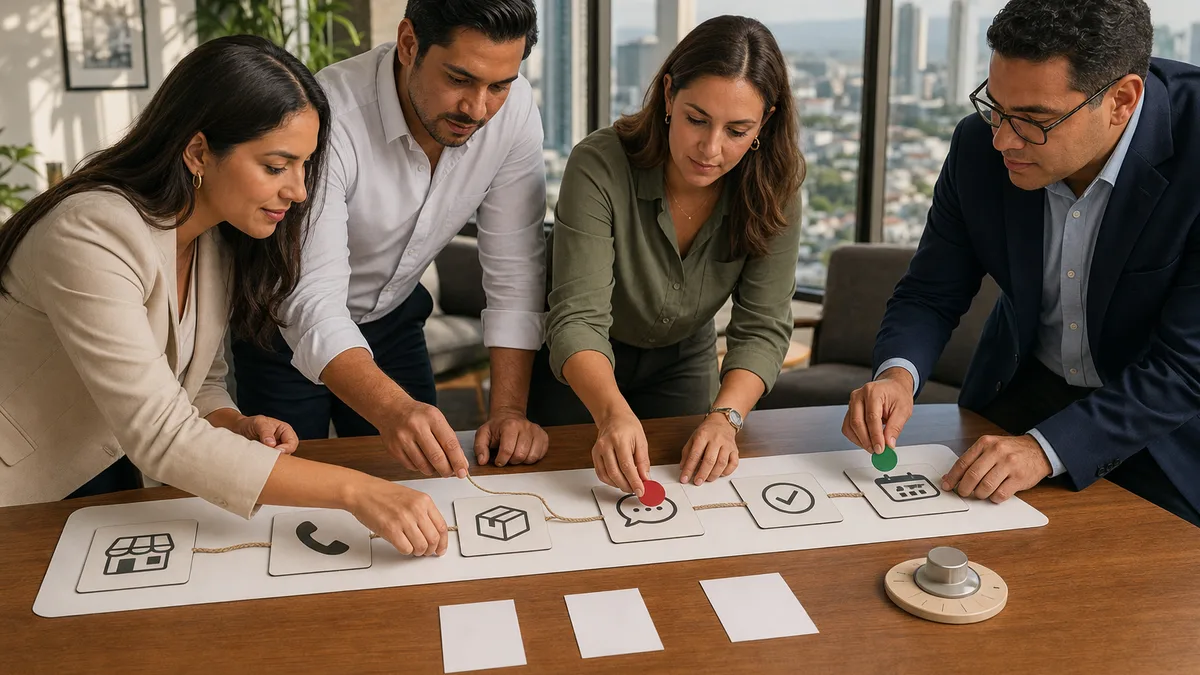
Process problems often appear as separate symptoms: delays, corrections, customers asking for status, duplicate files, or decisions that depend on one person. This guide explains how to observe the complete flow, distinguish bottlenecks, and choose improvements the organization can evaluate.
Optimization does not mean removing steps by intuition or buying a tool before understanding the work. It means delimiting the process, making its decisions visible, and forming a hypothesis that can be tested.
If your company wants to practice this analysis with a team, review the process optimization workshop for companies in Panama. Crezendo confirms scope and conditions in a proposal.
Signs that a process needs review
- The same information is recorded more than once.
- Cases return to an earlier stage because data is incomplete.
- Nobody can explain the process from beginning to end.
- Departments measure tasks but not the shared outcome.
- One approval stops every case.
- Customers must ask to learn the current status.
- Frequent exceptions can only be resolved by one person.
- The team compensates for failures with overtime or manual follow-up.
- The company wants automation, but the current flow is undocumented.
These signals do not point to one universal cause. The workshop makes work visible before changes are proposed and prevents each department from optimizing its own task while worsening the overall result.
Understand the process before selecting the tool
A process connects a need to an outcome through activities, decisions, information, and responsibilities. To understand it, the team should answer:
- Which event starts it?
- Which outcome must it produce, and for whom?
- Which steps add value or are mandatory?
- Where does the case wait?
- What information enters, changes, and exits?
- Which exceptions occur?
- Who decides, and using which criteria?
- How does the team know it finished correctly?
Buying software before answering these questions can digitize confusion. Digital transformation for companies is more useful when it begins with a defined process and priority.
Possible workshop modules
1. Scope and process customer
The group defines the start, end, outcome, and affected people. An overly broad scope makes learning difficult; an overly narrow one hides dependencies.
2. Current-state map
Participants represent what actually happens, including waiting, rework, decisions, systems, and exceptions. The map should not show only the ideal procedure.
3. Bottlenecks and inefficiencies
The team examines queues, priority changes, approvals, handoffs, information movement, and causes of error. Lean principles may help observe waste; variation and cause analysis may draw on Six Sigma ideas when relevant.
4. Risk and quality
Removing steps is not automatically an improvement. The group considers controls, safety, compliance, customer experience, and output quality.
5. Future-state design
The team proposes alternatives: clarify criteria, remove duplication, reorganize a decision, standardize information, adjust roles, or evaluate technology support.
6. Prioritization and experiment
Improvements are compared by expected impact, effort, risk, and dependency. A bounded test supports learning before a change is expanded.
7. Indicators and follow-up
The team selects measures related to the problem: cycle time, waiting, rework, errors, fulfillment, work in progress, or experience. An indicator should support a decision—not merely fill a dashboard.
What can the team work on during the session?
An appropriate case has a recognizable beginning and outcome, knowledgeable participants, and enough information for discussion. Examples include:
- Responding to a customer request.
- Preparing and approving a quote.
- Onboarding an employee.
- Managing purchases or suppliers.
- Billing and follow-up.
- Handling and escalating incidents.
- Publishing content or campaigns.
- Delivering an internal service.
The workshop may produce a current-state map, prioritized problems, cause hypotheses, a future flow, actions, owners, and initial indicators. The exact output is agreed upon in the proposal.
Improving without blaming people
When a process depends on reminders, shortcuts, or extraordinary effort, a system condition often deserves attention. The analysis should ask which information, rule, capacity, or coordination is missing before attributing the problem to “resistance” or “poor attitude.”
Involving those who perform the work reveals exceptions that a written procedure may not show. Leaders, in turn, must clarify priorities, authorize decisions, and remove obstacles. Organizational culture influences how problems are surfaced; adaptability to technological change and organizational change management help distinguish redesign from adoption.
If improvement requires short cycles and project coordination, it may connect with the Agile and Scrum workshop for companies. To visualize indicators, see Excel and Power BI training.
How is the proposal prepared?
Crezendo needs to understand:
- The process and its outcome.
- Participating departments and profiles.
- Examples of delays, errors, or exceptions.
- Available information.
- Confidentiality or compliance constraints.
- Decisions the company expects to make.
- Format and schedule.
This context defines depth, exercises, and working outputs. No savings figure or methodology certification is promised. The workshop develops capability and facilitates an initial improvement; later implementation depends on scope and organizational execution.
You can explore all Crezendo corporate programs, from leadership and communication to data, innovation, and digital skills.
Frequently asked questions
Do participants need Lean or Six Sigma knowledge?
No. Relevant principles and tools can be explained at the group's level. The workshop is not presented as a certification.
Can we work on a real process?
Yes. It is preferable to include people who understand different stages and enough information to protect confidentiality.
Does it include automation?
It can identify opportunities and pilot criteria. Technical implementation requires a separate assessment and scope.
Does it guarantee cost reduction?
No. The workshop helps identify and prioritize improvements; results depend on the process, execution, resources, and follow-up.
How do I request a quote?
Describe the process, its symptoms, participating departments, and the decision you expect to prepare. Review the process optimization workshop and, if the scope appears relevant, contact Crezendo to request a proposal and quote.