Business innovation is not about accumulating ideas or buying a new tool. It means recognizing a valuable problem, understanding the people affected, selecting an opportunity, and learning through a manageable test before committing a larger investment.
A Design Thinking and business innovation workshop in Panama helps the team move through that process using a real challenge. The method organizes research, definition, ideation, prioritization, prototyping, and validation so creativity can produce evidence and decisions.
Tell us which process, service, or experience your company needs to improve. Crezendo can design the workshop around that challenge and prepare a proposal and quote based on the group, delivery mode, and outputs.
When can Design Thinking help?
This method is especially useful when the problem still contains uncertainty: the team recognizes a symptom but needs to better understand the experience of the customer, employee, user, or beneficiary before deciding on a solution.
Some signs include:
- Solutions are selected before speaking with the people who will use them.
- Meetings produce many ideas but no criteria for prioritizing them.
- Different departments describe the same problem in different ways.
- Time or budget is committed without first testing the main assumptions.
- A process creates recurring friction, and nobody has examined the full experience.
- The company wants to improve a service, digital channel, or internal process but does not know where to begin.
- The team dismisses ideas too soon or falls in love with the first proposal.
Design Thinking does not replace managerial decisions, financial analysis, technical research, or subsequent execution. It helps frame the challenge more clearly, reduce assumptions, and produce a test that supports a better-informed decision.
Creativity, innovation, and Design Thinking
The three concepts are related, but they play different roles:
- Creativity: generates new possibilities and connections.
- Innovation: turns a possibility into an improvement that creates value.
- Design Thinking: provides a human-centered process for exploring the problem, ideating, prototyping, and learning.
A workshop may need greater emphasis on divergent thinking, collaboration, or idea selection. For those objectives, consider the creativity and innovation workshop for teams. When there is a concrete challenge that needs to be investigated and prototyped, Design Thinking offers a more specific structure.
Practical workshop modules
The program is tailored to the challenge and available time. It may combine:
| Module | Working question | Possible output |
|---|---|---|
| Challenge alignment | What situation do we want to understand or improve? | Initial challenge and scope criteria |
| Empathy and research | What do people experience, need, and do? | Interview guide, stakeholder map, or journey |
| Definition | What is the specific problem, and for whom? | Challenge statement and prioritized findings |
| Ideation | What alternatives can we explore? | Initial portfolio of ideas |
| Prioritization | Which option deserves to be tested first? | Criteria, assumptions, and risk matrix |
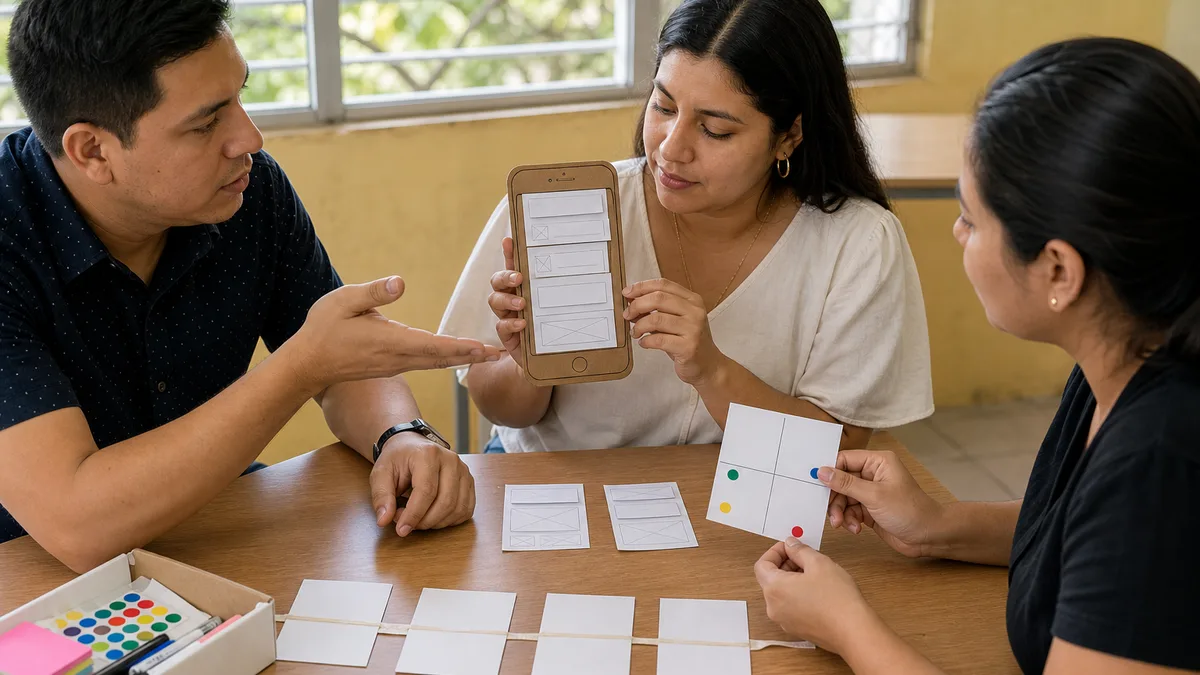
| Prototyping | How can we represent the idea at low cost? | Script, mockup, flow, storyboard, or simulation |
| Validation | What should we observe and learn? | Test plan, feedback, and next steps |
The prototype does not have to be a technology product. It can represent a service conversation, form, onboarding experience, internal process, customer service sequence, educational material, or proposed solution.
Examples of challenges a company can address
Depending on the sector and participant group, the workshop may focus on:
- Simplifying a process that forces customers to repeat information.
- Improving coordination among sales, operations, and customer service.
- Redesigning the onboarding of new employees.
- Exploring a digital experience before developing software.
- Prototyping an improvement to an educational or community service.
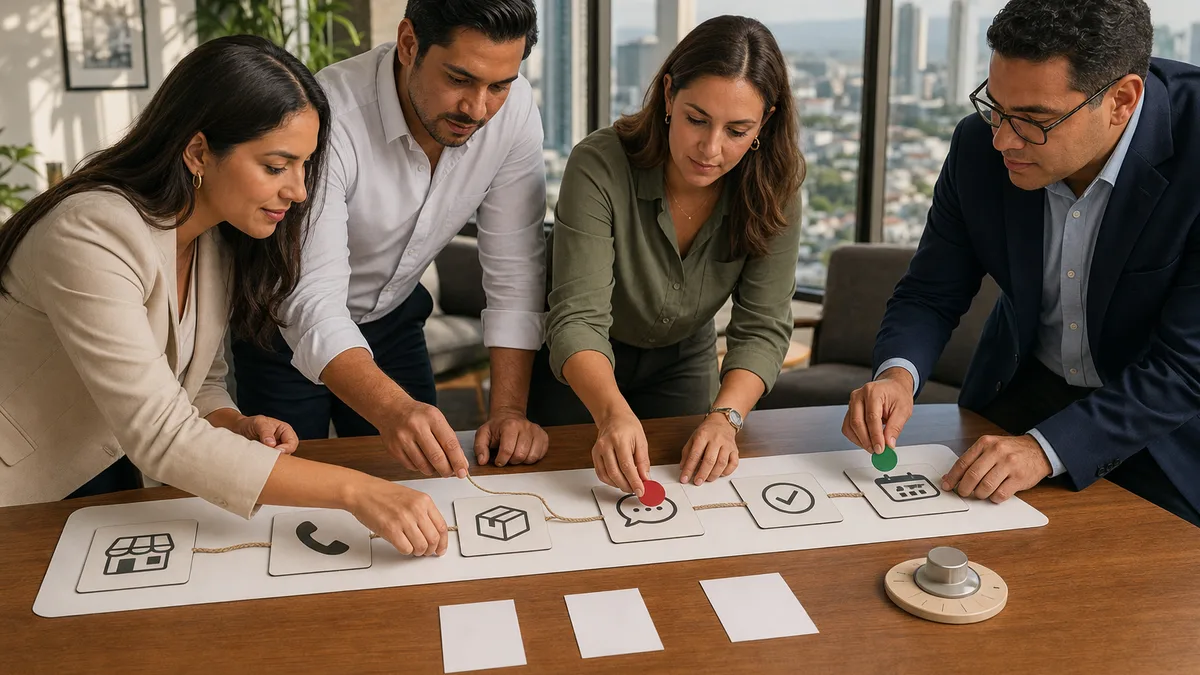
- Identifying opportunities in a purchase or post-sale journey.
- Turning an internal need into a measurable experiment.
These are examples of possible applications, not guaranteed results. The final challenge is selected after clarifying the context, access to users, and what the organization can execute after the workshop.
How does Crezendo design the workshop for your company?
Before preparing the proposal, it is useful to define:
- The problem or opportunity motivating the training.
- The participants and their relationship to the challenge.
- The team's experience level.
- The users, customers, or stakeholders who must be considered.
- Available information and confidentiality restrictions.
- Delivery mode, number of participants, and available time.
- The output the company expects to obtain.
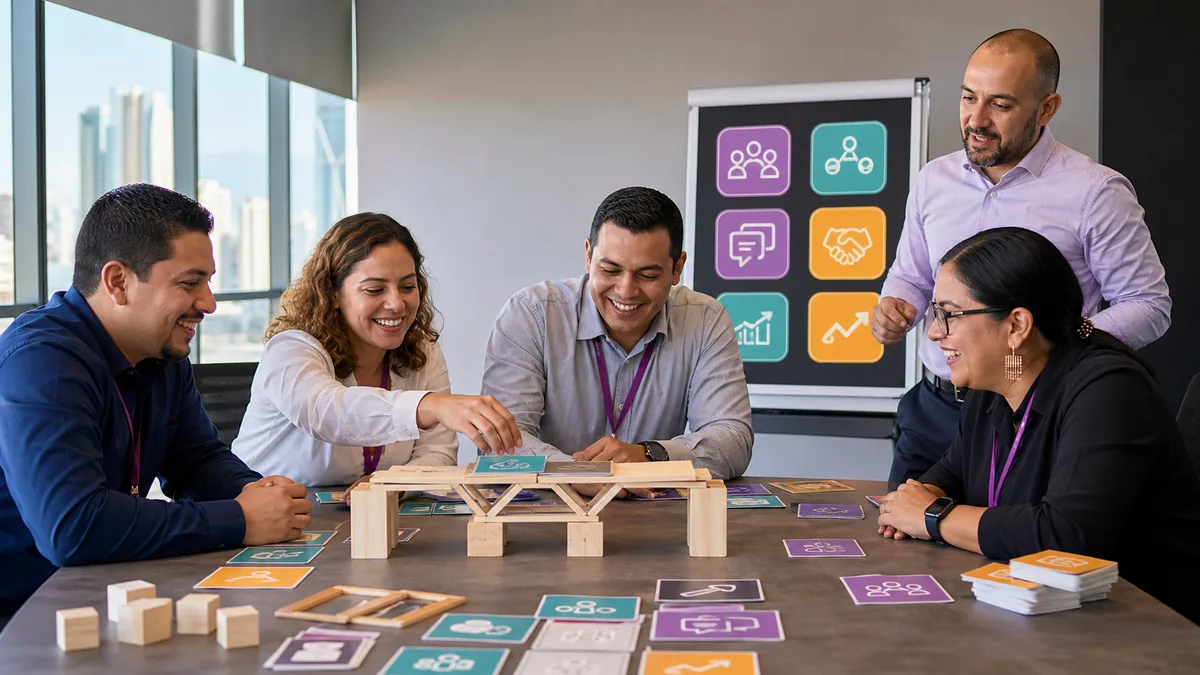
With that context, Crezendo selects appropriate exercises, examples, and tools. The session may include individual work, group activities, visual maps, simulated interviews, prioritization criteria, prototype construction, and presentation of lessons learned.
The facilitator guides the process, while the team contributes its business knowledge. This combination makes it possible to work with the organization's real language and constraints instead of solving a generic case disconnected from its operations.
What should remain when the workshop ends?
The output depends on the scope. A workshop may leave:
- A shared definition of the challenge.
- Findings and assumptions that require validation.
- Ideas organized using selection criteria.
- A low-fidelity prototype.
- A simple plan for testing it.
- Owners and next steps.
One session does not guarantee that an idea will automatically become an innovation. The organization must still test, decide, allocate resources, and execute. The workshop's value lies in improving the quality of those decisions and giving the team a repeatable way to learn.
Delivery mode, duration, and proposal
A virtual session can work when collaborative tools and the activity design allow active participation. In-person delivery may support physical prototypes, visual work, and direct observation. A process can also include preparation, multiple sessions, or follow-up.
Duration should not be defined without understanding the challenge. Introducing the method requires a different scope from researching users, building a prototype, and preparing a test. Crezendo's proposal clarifies objectives, content, delivery mode, outputs, and the conditions that influence the quote.
How can learning and application be evaluated?
Evaluation may look for concrete evidence:
- Whether the team distinguishes facts, assumptions, and interpretations.
- Whether the challenge identifies the relevant person and situation.
- Whether ideas respond to findings rather than internal preferences alone.
- Whether the prototype can test a specific question.
- Whether feedback is recorded and turned into a decision.
- Whether owners and a viable next step exist.
Later operational or commercial metrics depend on the project and require follow-up beyond the workshop. Avoiding automatic promises makes it possible to evaluate the training using realistic criteria.
See everything Crezendo can do for your company
An innovation challenge may reveal other needs: leadership for decision-making, communication for cross-department collaboration, digital skills for execution, or change management for adoption.
You can view all workshops for companies. If the solution has already been defined but people need to understand and adopt it, the organizational change management workshop may be more appropriate. The initial conversation helps select the right approach.
What happens after you contact Crezendo?
The initial process turns the challenge into a proposal you can evaluate:
- You describe the situation: what the company needs to improve and why it matters.
- We clarify the scope: participants, users, delivery mode, time, and restrictions.
- We define the approach: activities, tools, and outputs.
- You receive a proposal and quote: including the scope and conditions to be confirmed.
- We coordinate delivery: once the proposal is approved.
You do not need to have a perfectly framed challenge. The initial conversation can help distinguish between a problem that needs exploration, a solution that needs execution, and a change that needs adoption.
Frequently asked questions
Who can participate?
It can be tailored for leaders, innovation teams, customer service, operations, sales departments, NGOs, educational institutions, or cross-functional groups. The group's composition determines the exercises and challenge.
Do we need previous Design Thinking experience?
Not necessarily. The level is defined after reviewing the group's experience. A beginner team can learn the process, while an experienced team can focus on research, facilitation, prototyping, or validation.
Should we bring a real challenge?
It is recommended. A real challenge increases the relevance of the exercises. Crezendo helps delimit it so it can be addressed within the agreed scope.
Can the workshop be delivered virtually?
Yes, when the activity design, tools, and participation make it possible to practice the process. The appropriate delivery mode is confirmed in the proposal.
What information do I need to request a quote?
Share the objective, approximate group size, participant roles, preferred delivery mode, tentative dates, and the type of challenge you want to address.
If your company needs to understand a problem more clearly, generate alternatives, and test a solution before scaling it, contact Crezendo to receive a proposal and quote.