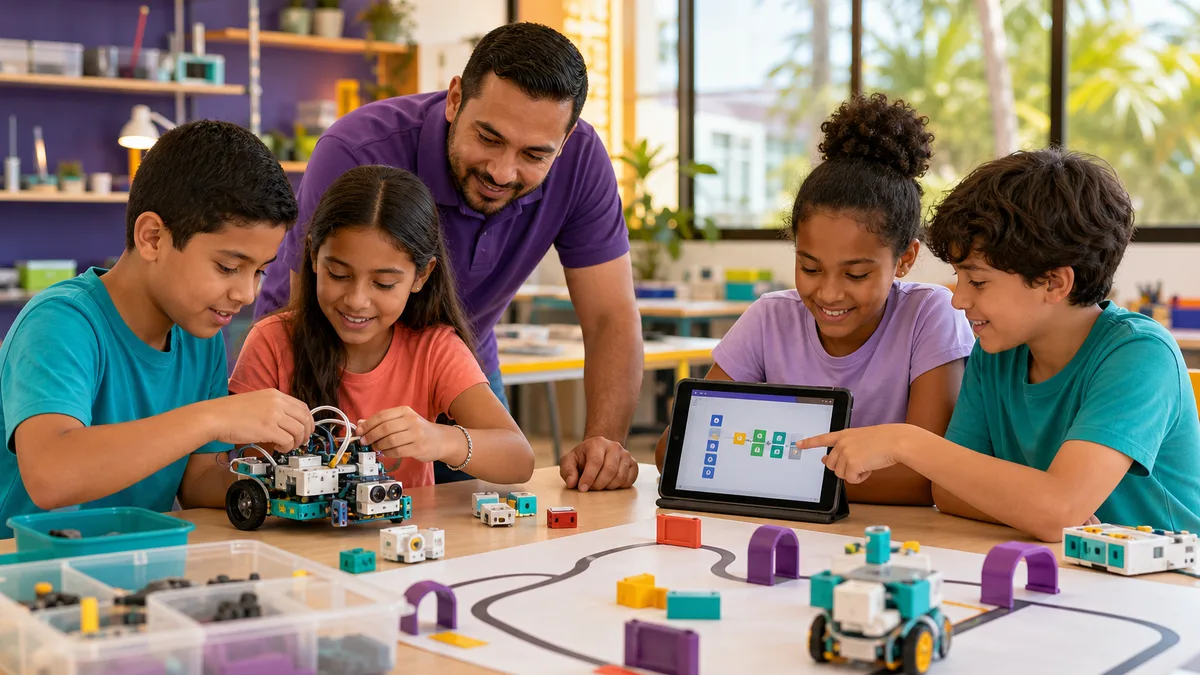
Educational robotics can be a useful way for children to work with sequences, sensors, construction, programming, and problem solving. But choosing a workshop should involve more than an attractive robot in an ad or promises about “preparing children for the future.”
This URL already has its own Google search intent. During the reviewed 90-day window it received 32 impressions for searches such as “enseñanza de robotica en panama”, “clases de robotica panama”, and explicit queries about robotics workshops for children. It is worth preserving as a parent guide, while removing the old claims that Crezendo is a “leader,” has programs for every age, or maintains permanent workshops that are not demonstrated in the current catalog.
What should a child learn in educational robotics?
A useful workshop does not need to begin with a complex robot. It can work through several layers:
- sequence: arranging instructions to produce a result;
- cause and effect: understanding what changes when an input changes;
- sensors: observing how a device receives information from its environment;
- actuators: motors, lights, or sounds that produce a response;
- programming: representing rules and decisions;
- construction: connecting parts for a specific function;
- debugging: discovering why something does not work and testing a correction;
- documentation: explaining what was attempted and what was learned.
The tool may be physical blocks, visual programming, microcontrollers, or modular kits. What matters is that the child has to think and test, not merely follow instructions to reproduce the instructor's model.
Age alone does not determine whether a workshop is appropriate
There is no universal age at which every robotics activity becomes appropriate. Two children of the same age may differ significantly in attention, motor skills, reading ability, frustration tolerance, and previous experience.
When evaluating a program, ask about:
- the age range the material was designed for;
- the size of the parts;
- how much reading is required;
- whether a computer or tablet is used;
- the duration of each activity;
- the balance between explanation and practice;
- number of participants per instructor;
- tools involved;
- level of supervision.
For younger children, an activity can focus on sequencing, direction, construction, and cause-and-effect without requiring typed code.
Safety: the kit matters too
The word “educational” does not make every piece of hardware safe.
Before enrolling a child, find out whether the activity includes:
- small parts that can be lost or swallowed;
- loose or damaged batteries;
- exposed wiring;
- cutting tools;
- soldering;
- motors or moving parts;
- power supplies;
- components that become hot;
- structures that can fall.
A beginner workshop can teach a great deal with low-voltage equipment and materials designed for the group without exposing participants to open devices connected to household mains.
If soldering irons, tools, lithium batteries, or other higher-risk items are used, ask who handles them, which protections are in place, and which part of the activity the child actually performs.
Programming: from blocks to text when it makes sense
Visual programming can be useful because it lets learners focus on logic and sequence without making syntax errors the main barrier.
One possible progression is:
- arrange instructions;
- use events;
- repeat actions;
- add conditions;
- read sensors;
- control actuators;
- break a problem into functions or blocks;
- move to text-based code when the project and learner are ready.
There is no need to rush into Python, C++, or another language just to make the workshop appear “more advanced.”
Questions to ask before paying for a workshop
Ask for concrete information:
- What project will be built?
- Which parts does the child design and which are already solved?
- Is the kit individual or shared?
- Does the participant keep it or does it belong to the workshop?
- Which computer or device is required?
- Which accounts or applications need to be created?
- What previous experience is assumed?
- How is the activity adapted when one child finishes early or needs more support?
- What is the policy for photos and video?
- How is personal information handled if a platform requires registration?
- Who supervises tools and components?
An answer such as “they will learn robotics, programming, and STEM” is too broad to evaluate what will actually happen during the session.
Privacy when a robot uses cameras, microphones, or online services
Some projects may include cameras, microphones, recognition features, mobile apps, or web platforms.
In that case, ask:
- which data is captured;
- whether it is stored;
- which account is used;
- whether the project works locally or depends on an external service;
- who can access the content;
- how it is deleted afterward.
Teaching sensors does not require collecting personal information. A distance or light sensor can demonstrate input and response without recording anyone.
How to distinguish real practice from a demonstration
Look at how much time the child spends manipulating, deciding, and testing.
A hands-on activity should allow the participant to:
- connect parts appropriate to their level;
- predict what will happen;
- run the program;
- observe the result;
- find an error;
- change something;
- explain why it did or did not work.
If the instructor assembles everything while the group watches, the demonstration may be interesting, but it is not the same as individual practice.
A small project can teach a lot
A vehicle that stops before hitting an obstacle, for example, can combine:
- a distance sensor;
- comparison with a threshold;
- motors;
- an
if/thencondition; - tests on different surfaces;
- recording errors.
Then ask: what happens with dark objects? What if the sensor is tilted? Which distance works best? What if one wheel turns differently?
Those questions turn the robot into an investigation tool instead of merely a toy that must “work.”
How to help without solving everything for the child
The most useful help is often a question:
- What did you expect to happen?
- What actually happened?
- Which block controls that part?
- How can you test one thing at a time?
- What would you change first?
If an adult fixes every error immediately, the participant loses an important part of the experience: learning to debug.
What result should you expect from a first experience?
An introductory workshop should not be sold as professional preparation. A reasonable result may be that the child can:
- understand inputs and outputs;
- program a simple sequence;
- explain a sensor;
- find and correct an error;
- document a small modification;
- finish with enough curiosity to continue experimenting.
That is already valuable learning.
Does Crezendo currently offer robotics workshops for children?
Workshop availability, ages, kits, and delivery formats can change. This page should not be interpreted as an announcement of a permanent program or confirmation of current seats.
Review Crezendo's current workshops or contact Crezendo directly with participant ages, group size, previous experience, objective, and whether the request is family, school, or organization-based. With that information, Crezendo can confirm whether a relevant option currently exists.
Parent checklist
Before choosing a workshop, confirm:
- learning objective;
- age or level for which it was designed;
- group size;
- actual hands-on time;
- kit and tools used;
- supervision and safety limits;
- required accounts and personal data;
- photo policy;
- materials the participant keeps;
- required previous experience;
- what happens if the project is not completed;
- current availability and price.
The best option is not necessarily the one with the most sophisticated robot. It is the one that provides a comprehensible, safe activity with enough room for the child to think, test, and learn from mistakes.