If you are considering phone repair as a trade in Panama, separate two questions: what a technician actually needs to know and whether that training fits your employment or business goal. There is no universal salary or fixed timeline for being “ready”; outcomes depend on technical level, repair scope, practice, tools, responsibility for third-party devices, and the demand you actually find.
The strongest path starts with safety, diagnosis, and documentation. Replacing parts without confirming the fault can turn a simple repair into a larger failure.
What a phone repair technician actually does
The job is not limited to screen replacement. Depending on the level and workplace, it may include:
- receiving a device and recording its condition;
- confirming symptoms and running functional tests;
- disassembly and reassembly according to the model procedure;
- replacement of authorized components;
- basic electrical measurements;
- diagnosis of charging, display, buttons, cameras, audio, or connectivity;
- documenting parts, tests, and final results;
- explaining limits, costs, and risks to the owner.
Microsoldering, board-level work, data recovery, and certain software interventions require additional competencies. They should not be treated as automatic content in a beginner course.
A reasonable learning path
1. Safety and the workbench
Before opening a device, learn to recognize hazards. Lithium-ion batteries can be damaged by puncture, deformation, heat, or an incorrect intervention. Apple separates battery safety explicitly in its repair manuals, and Samsung warns against improvised work on damaged or swollen batteries.
Training should include:
- organizing screws and parts;
- electrostatic-discharge precautions where appropriate;
- safe handling of broken glass;
- heat control;
- criteria for stopping an intervention;
- use of model-specific manuals and procedures.
2. Intake and diagnosis
Before disassembly, record:
- model and serial number when needed;
- external condition;
- accessories received;
- symptoms reported by the owner;
- initial tests that can safely be performed;
- account locks or data constraints affecting the work;
- authorization for the agreed intervention.
Then form hypotheses. A phone that will not charge may have a bad cable, debris, a damaged connector, a degraded battery, a board fault, or another cause. Random parts replacement is not diagnosis.
3. Disassembly and mechanical repairs
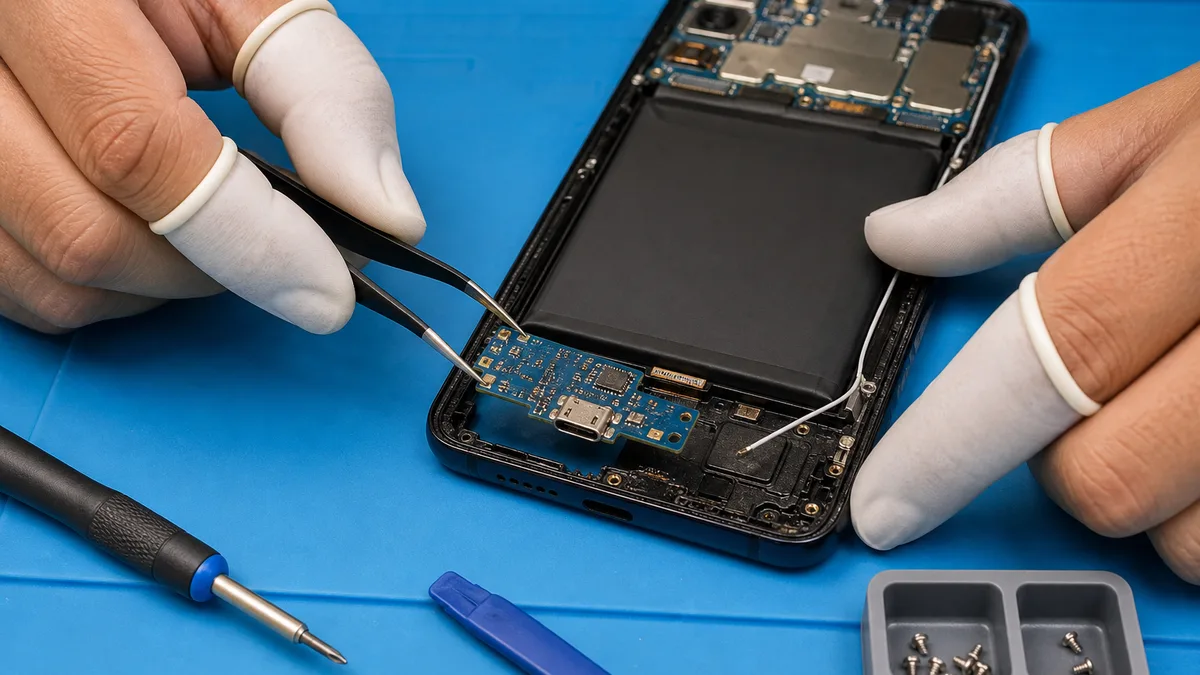
Beginner training may cover opening procedures, connectors, flex cables, cameras, speakers, buttons, or replaceable modules on devices designated for practice. Each model uses different adhesives, screws, cable paths, and safety considerations; there is no universal sequence.
4. Measurement and basic electronics
To progress, understand voltage, current, resistance, continuity, shorts to ground, and safe multimeter use. This foundation helps determine whether a fault is likely to be solved by replacing a module or requires board-level diagnosis.
5. Microsoldering and board work
This is a later specialty. It requires suitable equipment, optical magnification, thermal control, practice boards, and the ability to recognize when not to proceed. The commercial value of a board repair does not by itself prove that it is profitable or appropriate for every technician.
Privacy and authorization are part of the trade
A phone may contain photos, messages, accounts, documents, authenticators, and third-party data. A responsible technician needs a process that minimizes access to personal information.
Good practices include:
- requesting only the access needed for the agreed test;
- not browsing files or apps unrelated to the repair;
- documenting when a test requires unlocking the device;
- avoiding data copies unless a specific request and scope exist;
- separating hardware repair from a data-recovery service;
- returning or deleting working copies according to the applicable agreement.
When a device belongs to someone else, “I can technically do it” is not the same as “I am authorized to do it.”
Tools: buy for the task, not from a universal list
There is no toolkit that turns someone into a technician. A basic path may require suitable screwdrivers, plastic opening tools, tweezers, organization aids, personal protection, and a multimeter. Other work adds a bench power supply, hot-air station, soldering iron, microscope, and consumables.
Before buying equipment:
- define the repairs you plan to practise;
- review the model requirements;
- confirm which tools a course or workshop provides;
- avoid buying microsoldering equipment before mastering the fundamentals;
- reserve practice devices that can be damaged without affecting a customer.
Prices vary too much by brand, quality, and supplier to claim that a responsible setup always costs one fixed amount.
How long does learning take?
There is no universal timeline. Someone may learn basic disassembly quickly and still need substantial practice before diagnosing without causing damage. Competence should be demonstrated through observable tasks rather than months elapsed.
Before working on customer devices, you should be able to:
- follow a procedure without losing parts;
- document initial condition;
- reproduce the symptom;
- identify which test justifies the next action;
- recognize battery, glass, heat, and ESD risks;
- explain what changed and what was verified at closure;
- stop when the case exceeds your level.
How much does a technician earn in Panama?
We did not find an official series specific enough to publish a reliable salary for “phone repair technician” in Panama. Publishing a narrow range would create precision that the available evidence does not support.
Income can vary by salaried employment or self-employment, specialty, volume, location, parts cost, rework, warranties, rent, taxes, tools, and customer acquisition. If you are evaluating the trade for employment, check current vacancies through sources such as Empleos Panamá and compare actual requirements.
For independent work, calculate each repair:
Amount charged
- part and transportation
- consumables
- payment fee
- warranty or rework reserve
- technician time
- proportional fixed costs
= real margin before tax
An expensive repair is not automatically a profitable repair.
How to evaluate a phone repair course
Ask before enrolling:
- which starting level it assumes;
- how many hours are actually hands-on;
- which devices will be used;
- who provides tools and parts;
- which battery and broken-glass protocols are taught;
- whether diagnosis comes before replacement;
- how intake and closure are documented;
- whether microsoldering is included or belongs to another level;
- what happens if a practice device is damaged;
- which certificate or attendance record is actually provided;
- whether third-party devices are used and under what authorization.
Be cautious with promises of guaranteed employment, guaranteed income, or professional mastery within a fixed period.
What Crezendo currently offers
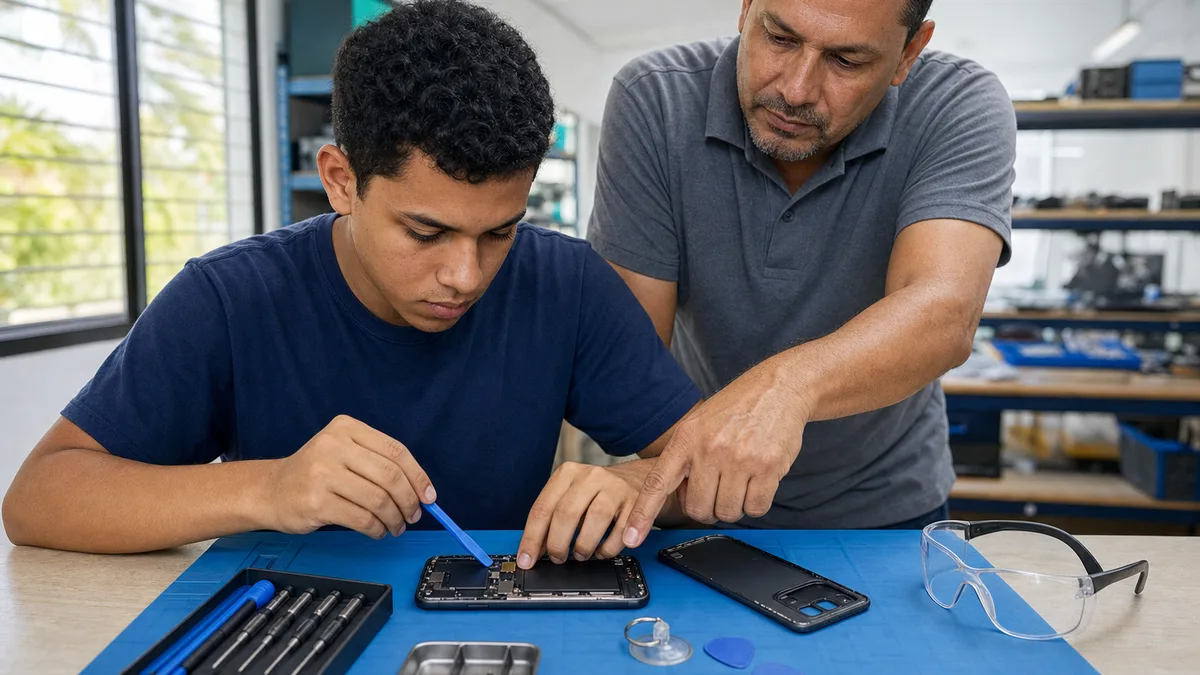
Crezendo has a public practical phone repair course in Panama. Its stated scope focuses on safety, documented intake, basic architecture, disassembly, functional testing, measurement, diagnosis according to level, documentation, and quality control.
Microsoldering is included only when the participants' level, equipment, safety conditions, and time allow it to be agreed explicitly. Crezendo also does not present the training as a guarantee of employment, external certification, or successful repair of every device.
Review the Crezendo phone repair course and request a proposal based on previous experience, available tools, desired practice, and group size.
Sources consulted
- Apple: Self Service Repair.
- Apple: iPhone 17e Repair Manual.
- Samsung: Self-Repair.
- Mitradel: technical-area employment opportunities.
- INADEH: 2026 third training period.
Frequently asked questions
Do I need a university degree to learn phone repair?
Not necessarily. What matters is acquiring and demonstrating the technical and safety competencies required for the work you plan to perform. Some jobs or specialties may require additional education or experience.
Should I begin with microsoldering?
No. It is usually more useful to master safety, disassembly, diagnosis, measurement, and module replacement first. Microsoldering adds its own tools and risks.
Can I practise on a customer's phone?
It should not be your first practice. Use devices designated for learning and move to third-party equipment only when your level, authorization, and responsibility process are appropriate.
Does Crezendo guarantee employment after the course?
No. Training develops competencies within an agreed scope; hiring depends on the market and each employer's process.
Start with the process, not a salary figure
If this trade interests you, define the level you want to reach and compare courses by safety, diagnosis, practice, and documentation. That is a stronger basis than choosing training because it promises a salary or a number of months.