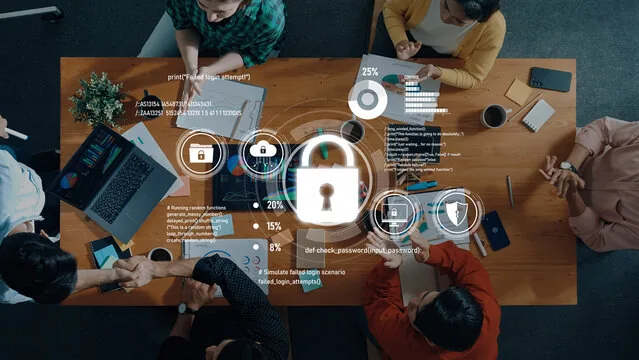
Cybersecurity Workshop for Businesses in Panama: Protect Your Company
In 2024, Panama experienced a significant increase in cybersecurity incidents affecting everything from small online stores to financial institutions. The most common mistake Panamanian companies make is not the lack of protection software, but the lack of team training. An employee who clicks on the wrong link can bring down a technological infrastructure that cost thousands of dollars to build.
A cybersecurity workshop is not a boring technical talk. It is practical training where your team learns to identify real threats, protect sensitive information, and respond to incidents before they become disasters.
Why cybersecurity is crucial for your company in Panama
Panama occupies a strategic position in the region as a financial and logistics hub. This position also makes us an attractive target for cybercriminals. The most frequent threats facing local companies include:
- Phishing and spear-phishing: Fraudulent emails designed to steal credentials or install malware. They are the cause of 90% of security breaches.
- Ransomware: Software that kidnaps company files and demands a ransom. In Panama, several SMEs have had to temporarily close due to this attack.
- Social engineering: Psychological manipulation of employees to gain access to systems. It does not require sophisticated technical skills, just persuasion.
- Attacks on mobile devices: With the rise of remote work, phones and personal laptops have become the weakest link.
Panamanian regulation, including Law 81 on Personal Data Protection, obliges companies to implement adequate security measures. Formal training is not just good practice: in many cases, it is a legal requirement.
Benefits of a practical cybersecurity workshop for your team
Reduce the human risk factor
Global studies indicate that between 74% and 95% of security breaches involve human error. A practical workshop teaches your team to recognize warning signs in emails, messages, and websites before it's too late.
Create a security culture
Cybersecurity is not just the responsibility of the IT department. When the entire team, from reception to management, understands their role in protecting the company, security becomes a habit, not a task.
Regulatory compliance
Demonstrating that your company actively trains its staff in cybersecurity can be a decisive factor in audits, bidding processes, and negotiations with international business partners.
Rapid response to incidents
A trained team detects and reports incidents in minutes, not days. That time difference can be what separates a minor contingency from a crisis that puts the entire operation at risk.
What key topics are covered in a business cybersecurity workshop?
An effective program for Panamanian companies must include:
1. Awareness of current threats
- Identification of advanced phishing emails
- Recognition of fraudulent websites
- Detection of social engineering attempts by phone and messaging
2. Basic and advanced digital hygiene
- Secure password management and two-factor authentication
- Safe use of public and private WiFi networks
- Protection of mobile devices and corporate laptops
3. Handling sensitive information
- Data classification: public, internal, confidential, and restricted
- Bring your own device (BYOD) policies
- Procedures for sharing files securely
4. Incident response
- Immediate reporting protocols
- Damage containment in the first minutes
- Internal and external communication during a breach
5. Practical simulations
- Controlled phishing exercises
- Ransomware response scenarios
- Data recovery practices
How to choose the ideal cybersecurity workshop for your business
Not all training programs are the same. When evaluating options in Panama, consider:
- Local relevance: Does the content adapt to the specific threats facing Panamanian companies or is it generic?
- Practical component: Does it include real exercises and simulations, or is it just theory?
- Customization: Can it be adapted to your company size, industry, and technological maturity level?
- Follow-up: Does it offer evaluation metrics and reinforcement after the workshop?
Crezendo methodology: Active learning and tangible results
At Crezendo we design cybersecurity workshops that go beyond theory. Our methodology is based on:
- Previous diagnosis: We evaluate your team's current knowledge level and the specific vulnerabilities of your industry.
- Real scenarios: We use cases based on real incidents that occurred in Panama and the region.
- Immersive simulations: Your team faces simulated attacks in real time and learns to respond under pressure.
- Reinforcement material: Quick guides, checklists, and templates that your team can consult after the workshop.
- Impact evaluation: We measure the change in behavior before and after the training.
We work with companies of all sizes, from tech startups to corporations with hundreds of employees. Each workshop is adapted to the specific context of the client.
Frequently asked questions
How long does a business cybersecurity workshop last? It depends on the depth. Introductory programs last one 8-hour day. Advanced programs with simulations can extend to 2 or 3 days.
Does my small business really need this? Precisely SMEs are the preferred target of cybercriminals because they usually have fewer protections. A basic workshop can be the most cost-effective prevention investment you make this year.
Does the workshop require prior technical knowledge? No. Our workshops are designed for non-technical audiences. The language is clear, accessible, and focused on concrete actions.
Can it be taught at our facilities? Yes. We offer in-person modality at your office, synchronous virtual, or hybrid, depending on what works best for your team.
Cybersecurity is not an expense, it is a survival insurance policy for businesses. In an environment where digital threats grow every day, training your team is the smartest investment you can make. If you want to evaluate your company's specific needs and design a tailor-made training program, at Crezendo we are ready to help you.