If you lead innovation, Human Resources, operations, or a project team, you may recognize this scene: the company calls a meeting to solve a problem, many opinions surface, and everyone leaves without knowing which idea should move forward or who should test it.
Creativity workshops for companies should close that gap. The goal is not to tell the team to “think outside the box,” but to give people a process for understanding a challenge, generating alternatives, choosing with clear criteria, and turning an idea into a concrete test.
Is this workshop right for your company?
Creativity and innovation training may be useful when your organization:
- Repeats the same solutions even though the problem keeps returning.
- Holds brainstorming meetings that end without decisions or owners.
- Needs to improve a process, service, product, or customer experience.
- Wants different departments to collaborate beyond their individual viewpoints.
- Is going through a transformation and needs alternatives before investing.
- Has promising ideas but struggles to prioritize and test them.
The starting point does not need to be a major innovation initiative. It may be a recurring delay, a customer complaint, a manual process, a commercial opportunity, or an internal issue the team has not been able to resolve.
Does your team have a challenge it needs to unlock?
Tell us about the problem, the participants, and the result you need. Crezendo can design a workshop around that case and prepare a proposal for your organization.
Business creativity does not end with brainstorming
Generating options is only one part of the work. A useful session also helps separate four elements that teams often mix together:
- The symptom: what the team can observe.
- The cause to investigate: why it may be happening.
- The idea: a possible response that has not been validated yet.
- The experiment: the smallest responsible way to learn whether the idea works.
This distinction keeps the team from falling in love with the first solution. It also allows people from different departments to contribute their knowledge without turning the conversation into a contest of opinions.
Creativity becomes valuable to the business when it produces a better-informed decision: what to test, with whom, for how long, and what evidence will support continuing, adjusting, or discarding the idea.
What should a practical workshop produce?
The outcome depends on the challenge and the agreed depth, but a well-designed experience can leave deliverables such as:
- A shared definition of the problem and the people affected.
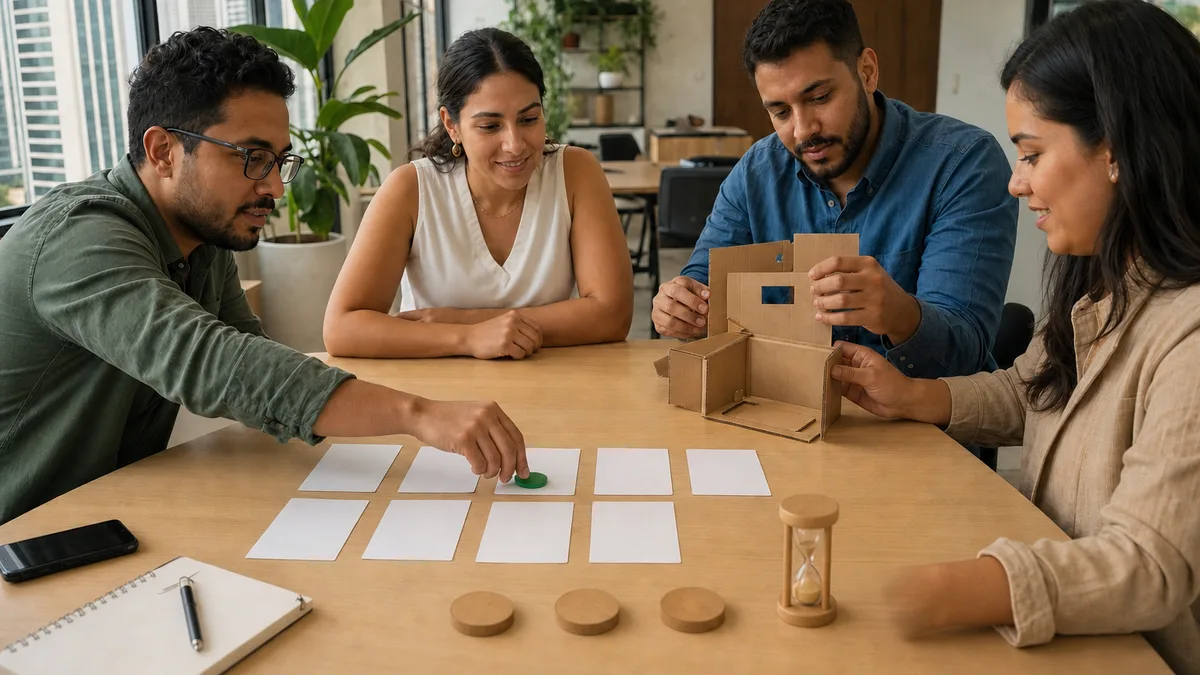
- A broad set of alternatives before one is selected.
- Prioritization criteria agreed upon by the team.
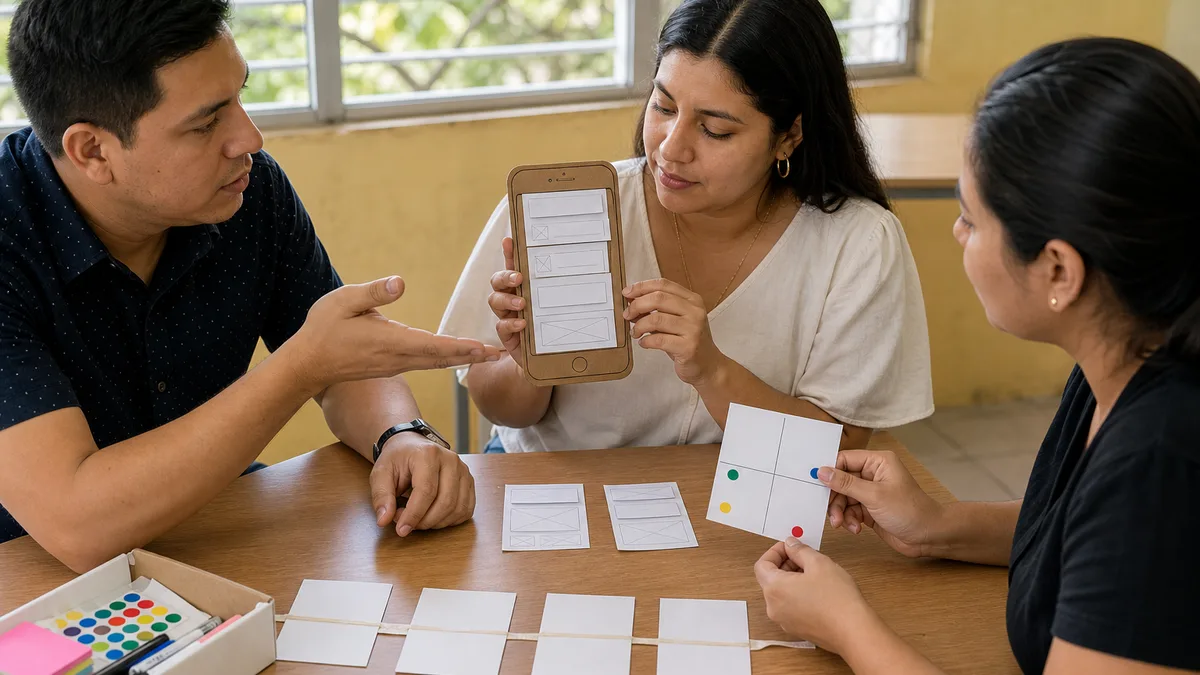
- One or more ideas translated into simple prototypes, scripts, or flows.
- A test plan with owners, a timeline, and a signal of success.
- A record of lessons and next steps.
The workshop does not promise that every idea will succeed. Its value is reducing improvisation and allowing the team to learn before committing too much time, budget, or reputation.
How Crezendo designs the workshop around a real challenge
Crezendo does not need to start with a generic presentation. The initial conversation helps us understand the context and decide what type of practice makes sense.
Before preparing a proposal, we can review:
- The challenge the organization wants to address.
- The participants’ roles, responsibility levels, and group size.
- The departments that need to collaborate.
- The decisions or deliverables expected at the end.
- Time, format, and confidentiality constraints.
- The level of follow-up the team may need.
That information defines the scope. Depending on the objective, the workshop may combine blocks such as:
| Block | Business application |
|---|---|
| Observe and frame | Turn a broad symptom into a question the team can work on. |
| Generate alternatives | Produce options without judging them too early. |
| Connect perspectives | Integrate customer, operations, technology, and leadership knowledge. |
| Prioritize | Compare ideas by impact, effort, risk, and expected learning. |
| Test | Design a small prototype or experiment with a clear outcome signal. |
| Communicate | Explain the recommendation, assumptions, and next step. |
Activities may be visual, conversational, or hands-on. What matters is not whether they look creative, but whether they help the group think differently and make progress on a verifiable challenge.
Creativity, communication, and execution form one system
An idea will not move forward if the team cannot explain it, challenge it without attacking the person, and coordinate the test. That is why creativity often connects with other capabilities.
If ideas are getting lost in ambiguous messages and difficult conversations, the team may also need to strengthen effective workplace communication. If the goal is to turn learning into delivery cycles, agile methods such as Scrum may complement the work.
Crezendo also designs programs in leadership, emotional intelligence, digital skills, business administration, sales, and other areas. You can see everything Crezendo can do for your company or read our guide to choosing corporate training workshops.
You do not need to purchase all those topics. The initial conversation helps determine whether creativity is the real need or whether the obstacle lies in leadership, communication, process, technology adoption, or another capability.
How to evaluate a creativity workshop proposal
Before hiring a provider, ask questions that move the conversation from promises to program design:
- What real challenge will the group work on?
- What will participants produce during the session?
- How will exercises be adapted to the roles and industry?
- What will separate an entertaining activity from a useful outcome?
- How will the team decide which idea deserves a test?
- What resources will participants receive to continue the work?
- How will the organization observe whether training changed the way people work?
Duration and format should respond to the objective. A short introduction can establish a shared language; a complex challenge may require preparation, several sessions, or follow-up. A responsible quote therefore starts by understanding the need, not by assigning the same package to every company.
What happens after you contact Crezendo?
The process can start simply:
- Tell us what you need: challenge, participants, context, and expected outcome.
- Clarify the objective: we identify what the team should understand, practice, or produce.
- Receive a proposal: we define the scope, content, format, and conditions needed to quote the workshop.
- Coordinate the experience: we agree on preparation, logistics, and the required inputs.
You do not need to arrive with the perfect course title. If you know what is slowing your team down, Crezendo can help translate that need into a concrete training experience.
Frequently asked questions
What types of companies can benefit?
Small businesses, large organizations, NGOs, and institutions can use this approach. Size is less important than having a challenge that requires different perspectives, alternatives, and a responsible way to test them.
Do participants need creative or artistic experience?
No. The workshop does not evaluate artistic talent. Activities are designed to help people observe, connect information, generate options, and make decisions.
Can the workshop address a confidential problem?
The level of detail and working conditions are discussed before the proposal. If sensitive information is involved, cases and materials should be prepared according to what the organization can share.
How long is the workshop?
It depends on the objective, group size, and expected deliverable. It may be an introductory session or a multi-session process. Duration is defined after understanding the need.
Can it be in person, virtual, or hybrid?
The format can be adapted to the organization’s conditions and the type of exercises. Feasibility is confirmed while preparing the proposal.
How is the outcome measured?
Before the workshop, the organization can agree on observable evidence: decisions made, ideas prioritized, prototypes created, experiments started, or changes in a team practice. The workshop provides a process; later results also depend on execution and follow-up by the organization.
Your company does not need to accumulate ideas. It needs to recognize problems more clearly, choose with sound criteria, and learn through manageable tests. If that is the change you want, contact Crezendo to receive a proposal and quote.