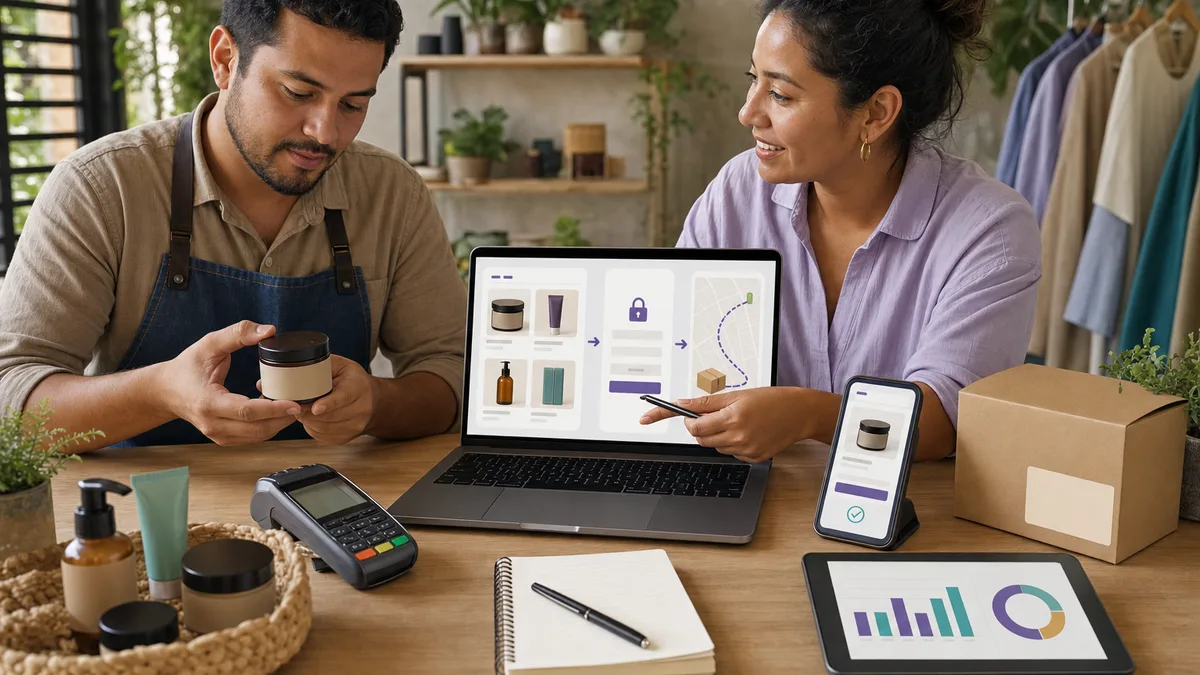
Creating an online store in Panama does not begin with choosing a platform. It begins with defining what you will sell, how inventory will be confirmed, who will collect payment, how orders will be delivered, and what will happen when an order fails. The website is only one part of that system.
This guide organizes technical and operational decisions without promising sales, a fixed cost, or a universal launch date. Provider conditions and obligations can change; confirm each point with the authority, financial institution, or qualified professional relevant to your case.
Confirm whether you need a complete store
A store with a catalog, cart, and integrated payment makes sense when customers can select a sufficiently defined offer and the team can fulfill the order. Before building it, answer:
- can the product, variant, price, and availability be explained without an extended conversation?;
- is there a rule for reserving or reducing inventory?;
- are delivery, pickup, or service areas known?;
- will someone handle pending payments, returns, complaints, and failed orders?;
- does the margin account for digital operations, packaging, delivery, incidents, and applicable taxes?;
- is there evidence that the audience attempts to buy, book, or request a quote for this offer?
If every sale requires diagnosis, a proposal, and negotiation, a WordPress services website with a contact form may be a better first step. If the offer has not yet been validated, the Lean Startup guide for entrepreneurs helps separate commercial experiments from technical investment.
Map the order before designing screens
Represent an order from the moment someone discovers a product until that person receives a solution or refund. Include states such as draft, payment pending, paid, preparing, dispatched, delivered, canceled, and returned. For each state, define the owner, evidence, and next action.
Map three problem journeys as well:
- the customer pays, but the automatic confirmation does not arrive;
- two people attempt to buy the final unit;
- delivery cannot be completed or the item arrives with a problem.
This map reveals what technology must do and what will remain a human process. It prevents installation of features that nobody can operate and exposes dependencies before real orders arrive.
Would you like to review scope before choosing technology? Contact Crezendo with the product type, current operation, team, and main questions. The first step is confirming whether a current guidance, training, or support option exists; contact does not reserve a place or promise a price, format, timeline, sales, or result.
Verify the Panamanian framework before configuring checkout
A store does not make a business formal by itself. The activity, taxpayer, invoicing, consumer information, and personal data require separate review.
The official Panama Emprende page describes the Ministry of Commerce and Industries system for obtaining an Operations Notice and warns that some activities have sector-specific requirements. The General Directorate of Electronic Commerce FAQ lists accessible contact details, terms and conditions, and a privacy policy among its points for Internet commercial services. Consult the current version and do not assume that a general checklist resolves a regulated case.
Panama's General Directorate of Revenue reiterates the general obligation to document transactions with an invoice or equivalent document. Confirm with the DGI or a qualified professional which method, tax treatment, and integration apply to the business; a payment processor receipt or order email should not automatically be treated as a tax invoice.
For commercial information, Law 45 published by ACODECO supports the importance of clear prices and avoiding misleading information. ANTAI's personal-data FAQ provides official concepts and rights under Law 81. These sources guide the questions to ask; they do not replace an individual legal or tax assessment.
Budget by category, not with a universal figure
Total cost depends on the business model, catalog, integrations, required control, and internal work. Instead of copying prices from a guide, request current terms and track four groups:
| Group | Possible components | Control question |
|---|---|---|
| Implementation | discovery, design, configuration, initial entry, migration, and integrations | what concrete deliverable will be accepted, and who retains access? |
| Recurring | domain, hosting or subscription, email, backups, security, support, and extensions | what renews, in which currency, and what happens if it is not paid? |
| Per transaction | processing, chargebacks, refunds, taxes, packaging, and delivery | how does margin change by value, area, and payment method? |
| Internal work | photography, product data, support, reconciliation, inventory, and improvement | who has the time and procedure to operate it? |
Include room for incidents and renewal. A low entry price does not demonstrate a lower total cost if catalog, URLs, customers, or integrations must later be rebuilt.
What “no sales commission” actually means
It may mean only that the catalog tool does not charge its own percentage. Processor, bank, acquirer, currency, chargeback, app, shipping, or tax charges may still exist. Request written terms, identify who charges each component, and simulate orders of different values. Do not publish “no commission” when the phrase omits relevant costs.
Choose an architecture by responsibility
There is no universal platform. Compare models according to who owns each task:
Managed service
The provider operates much of the infrastructure and offers integrated components. Review data portability, customization limits, renewal, support, backups, exports, and external dependencies. “Managed” does not mean that the provider manages your catalog, policies, or customer service.
Content manager with a commerce module
This model can provide more control over content and extensions, but someone must own hosting, updates, compatibility, security, and backups. If you select this path, the WordPress and WooCommerce course guide expands on technical concepts; its existence does not confirm a current session, place, or format.
Custom development
It may be justified when real processes do not fit existing solutions. It requires specifications, testing, maintenance, observability, and team continuity. Do not choose it only to make the visual design different.
Catalog or conversational channel
This can validate interest or coordinate simple orders, but it does not automatically equal a store: inventory, status, payment, invoicing, privacy, or history may not be controlled. Document what happens outside the channel.
Compare any option with a matrix: critical functions, technical owner, exports, recovery, payment integration, tax handling, accessibility, performance, support, and total cost. Verify availability and terms directly; do not depend on lists of brands.
Build a minimum operable version
A first version does not need every automation, but it must complete an order securely and traceably.
- Define scope: products, variants, areas, languages, display currency, and customer types.
- Prepare content: merchant identity, contacts, product records, authorized photographs, and frequently asked questions.
- Model data: internal codes, inventory, weight or dimensions, pricing rules, and publication status.
- Select architecture: document why it meets critical functions and how data can be recovered.
- Configure navigation: home, categories, search when necessary, product, cart, and help.
- Write policies: payment, delivery, pickup, returns, warranties, privacy, and terms consistent with actual operations.
- Integrate collection: use restricted credentials, test environments, and verifiable server-side states.
- Connect fulfillment: the applicable invoice or document, preparation, delivery, notifications, and reconciliation.
- Instrument measurement: minimum events, error records, and a dashboard the team can interpret.
- Test and approve: run normal and failed scenarios before allowing public orders.
Do not publish a feature that depends on a process that has not been defined. Declaring a limited area or method is better than promising coverage the team cannot fulfill.
Design product records that reduce uncertainty
Each product record should help a customer decide and enable the business to fulfill exactly what it offered. Include, when applicable:
- a specific name and internal code;
- original or authorized images with useful alternative text;
- purpose, materials, dimensions, contents, and care;
- variants and visible differences;
- price and charges that must be known before confirmation;
- availability expressed through a rule that inventory can support;
- delivery or pickup, restrictions, and the expectation communicated by the business;
- warranty, return, or cancellation information according to the offer and applicable rules.
Avoid copying supplier descriptions without verification. Define who updates changes and retain evidence of the published version when an order is received.
Inventory and price
Decide when a unit is reserved: when it enters the cart, when payment begins, when payment is confirmed, or after manual review. Each rule has consequences when payment expires or an integration fails. Test concurrency and define how reservations are released.
The displayed price, cart, payment, invoice, and reconciliation must tell the same story. If you use promotions or coupons, test limits, dates, combinations, refunds, and rounding. The store should not calculate tax obligations from an unvalidated assumption.
Integrate payments without turning the store into a vault
First confirm current eligibility, currencies, settlement, refunds, chargebacks, authentication, support, and total cost with the provider and financial institution. Then define the technical flow.
The PCI Security Standards Council explains that PCI DSS provides baseline requirements for protecting payment account data. Outsourcing processing can reduce scope, but it does not demonstrate that the merchant has no responsibilities. Confirm scope with the entity that accepts compliance.
As a prudent baseline:
- avoid storing full card numbers or security codes;
- use processor-documented components and flows;
- verify payment status on the server instead of trusting only the browser screen;
- separate test and production credentials;
- restrict permissions, rotate secrets, and record changes without logging sensitive data;
- handle retries and idempotency to prevent duplicate charges or orders;
- reconcile orders, payments, refunds, and deposits.
You may also support non-integrated methods if the operation validates them, but expiration, evidence, reconciliation, fraud, and the moment inventory is reserved must be defined. Do not publish unnecessary financial details.
Turn delivery and returns into testable rules
Do not name a carrier until you verify coverage, limits, tracking, insurance, incident handling, and current terms. Build a matrix by product and area:
| Decision | Rule to document |
|---|---|
| Eligibility | which products and addresses each method accepts |
| Calculation | when the charge is known and which data determine it |
| Preparation | cutoff, packaging, owner, and evidence |
| Delivery | failed attempt, identification, receipt, and tracking |
| Incident | damage, loss, incorrect address, or rejection |
| Return | request, authorization, transport, inspection, and resolution |
Test orders with an incomplete address, a fragile product, multiple units, pickup, and an unsupported area. Checkout should prevent combinations the operation cannot fulfill or explain the next step before payment.
Protect data, accounts, and continuity
Create a data inventory: what registration, checkout, analytics, support, and delivery collect; why the data are used; who has access; where they are stored; when they are deleted; and how requests are handled. Collecting less reduces exposure.
Use HTTPS, role-based permissions, stronger authentication for administrators, controlled updates, backups outside the primary system, and tested restores. The OWASP Top 10 is a starting point for discussing web application risks, not a security certification.
Prepare an incident response: how to revoke access, stop payment collection, preserve evidence, communicate internally, and decide on notifications. A backup that has never been restored is only a hope.
Checkout accessibility
The W3C WAI forms tutorial recommends labeled controls, instructions, and understandable messages. Test keyboard access, visible focus, screen readers, contrast, zoom, autocomplete, and errors that do not rely only on color. Ask only for data required to complete the process.
Prepare SEO without promising rankings
Use a stable URL for each product or variant when appropriate, descriptive titles, original content, links from categories, and a coherent sitemap. Google Search Central's ecommerce documentation explains that crawlable navigation helps search engines discover products. Ecommerce structured data can help Google interpret information, but it does not guarantee indexing, rankings, or rich results.
Avoid creating nearly identical pages for every filter. Decide which combinations deserve a URL, canonical treatment, or crawl exclusion. Keep visible price and availability consistent with any markup. The guide to local SEO fundamentals in Panama expands on measurement without offering guaranteed positions.
Run an end-to-end test
Before opening orders, use authorized test accounts and addresses. Repeat on mobile and desktop:
- create an account or buy as a guest, according to the design;
- add, change the quantity, and remove products;
- exhaust inventory and compete for the final unit;
- apply a valid and an invalid promotion;
- approve, decline, abandon, and repeat a payment;
- receive notifications without exposing sensitive data;
- generate the corresponding operational document and state;
- prepare, dispatch, deliver, cancel, and return;
- reconcile the order with the financial movement;
- restore a backup in an isolated environment;
- verify links, forms, policies, analytics, and consent.
Record the expected result, actual result, evidence, severity, owner, and retest. Defects affecting payment, inventory, privacy, or compliance block launch until resolved.
Measure a funnel you can correct
Do not treat visits or followers as sales. Define events such as product view, add to cart, checkout start, confirmed payment, fulfilled order, cancellation, return, and support contact. Observe rates by period without unnecessarily identifying individuals.
Connect each abandonment to a testable hypothesis: unexpected cost, error, missing method, incomplete information, slowness, or delivery uncertainty. Change one variable, preserve the comparison period, and record side effects. A conversion increase does not compensate for more fraud, returns, or orders that cannot be fulfilled.
Mistakes that make a store more expensive
- choosing technology before mapping the order;
- copying costs or availability from an old guide;
- advertising “no commission” without accounting for all charges;
- enabling payment before defining invoicing, reconciliation, and refunds;
- promising untested delivery coverage;
- collecting data “just in case”;
- sharing one administrator account among several people;
- depending on an extension without an update or replacement plan;
- publishing policies the team cannot execute;
- measuring traffic without measuring fulfilled orders and complaints;
- confusing a no-code tool with absence of maintenance;
- launching without testing restoration and failed scenarios.
Frequently asked questions
How much does it cost to create an online store in Panama?
There is no universal figure. It depends on implementation, renewals, processing, operations, delivery, compliance, and internal work. Request current terms, compare total cost, and avoid deciding only from the entry price.
Can I create it without knowing how to code?
Many configurations can be completed with visual tools, but someone must understand catalog, permissions, integrations, testing, updates, backups, and recovery. “No code” does not mean no technical responsibility.
Which platform is best for starting?
The one that meets critical functions with acceptable responsibilities, exports, maintenance, and total cost. Verify current terms and test a complete order; do not choose according to popularity or a universal recommendation.
Can a store have no sales commission?
One layer may charge no percentage of its own while payment, bank, extension, chargeback, delivery, or tax charges still exist. Define what the phrase means and show customers all relevant amounts before confirmation.
Which payment methods should I accept?
Those authorized by your institution and provider, usable by your audience, and reconcilable and refundable by your operation. Confirm eligibility, security, costs, and settlement directly; do not assume availability because you saw a logo.
Do I need to register the business to sell online?
The answer depends on the person, activity, and sector regulation. Review Panama Emprende, MICI, DGI, and the relevant authorities before operating. This guide does not determine the procedure for an individual case.
How long does launch take?
It depends on catalog preparation, decisions, verifications, integrations, and defects found. Use exit criteria—not a promised date—and do not publish while payment, inventory, privacy, or compliance tests fail.
How do I obtain traffic from Google?
Build useful crawlable pages, link categories to products, maintain consistent information, and measure Search Console. No implementation guarantees a position or timeline.
Does Crezendo offer training or support?
You may ask to confirm which option exists at that time and whether it fits your need. This article does not announce a permanent workshop, course, service, price, format, or availability.
Close the scope before opening the cart
A store that is ready to operate has more than an attractive home page: a mapped order, verifiable catalog, assigned responsibilities, executable policies, reconcilable payment, tested delivery, limited data, rehearsed recovery, and useful metrics.
If you need to organize those decisions for a project or team, contact Crezendo with the product, current state, approximate catalog size, and main uncertainties. The first outcome is confirming whether a current guidance, training, or support option exists; no place, price, format, timeline, compliance, sales, ranking, or return is guaranteed.