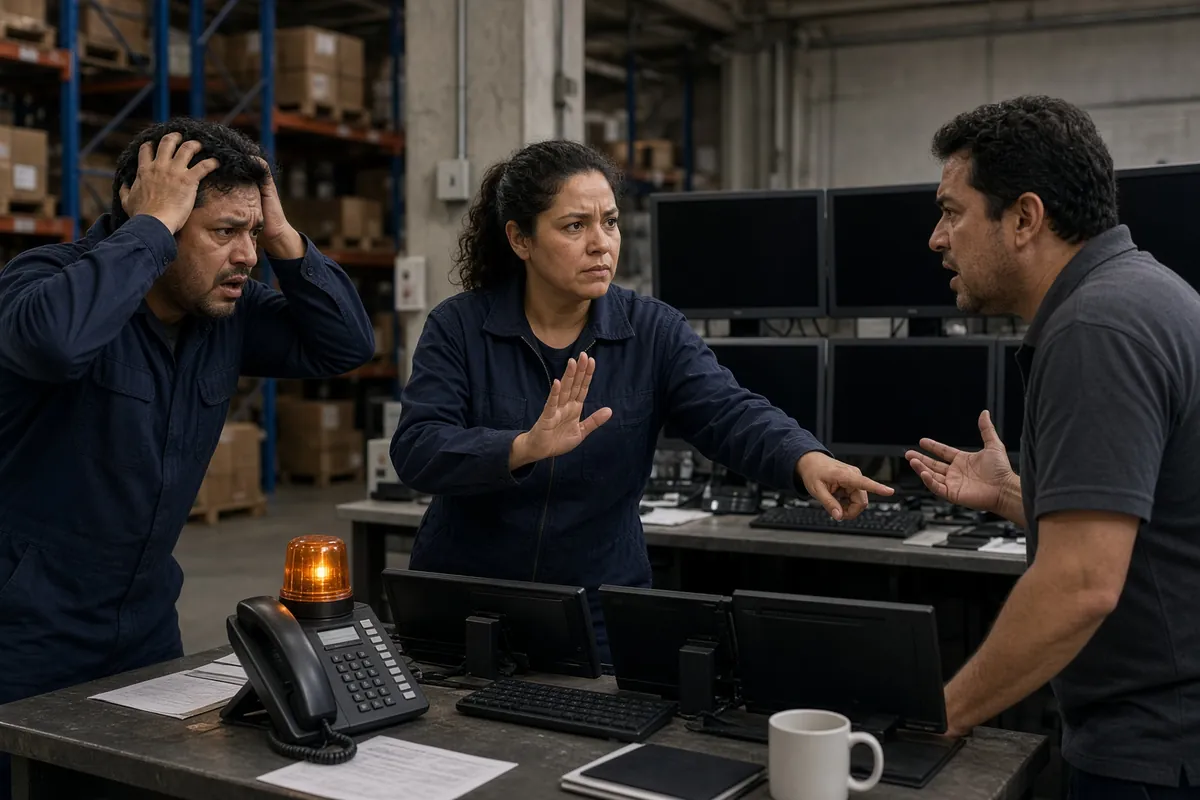
Every company has plans. What sets a great team apart is what it does when the plan breaks: the system that goes down at peak hour, the customer who escalates a complaint in front of everyone, the supplier who fails on delivery day, or the mistake nobody saw coming.
In those minutes, pressure reduces the ability to think clearly. People react on autopilot: they freeze, look for someone to blame, all talk at once, or improvise without direction. Crezendo's Crisis and Unexpected Events Management workshop trains exactly those minutes.
Does your team need to respond better when something goes wrong?
Tell us which unexpected situations you face most often and who would take part. Crezendo prepares a proposal around those cases.
Request the Crisis and Unexpected Events Management workshop
Designing with time is not the same as deciding without it
Methods such as Design Thinking help solve problems when there is time to research, prototype, and test. A crisis does not offer that margin: you have to stabilize first, decide with incomplete information, and communicate while the situation is still changing.
That is why managing the unexpected is a different skill. It does not depend on someone being "naturally good under pressure": it can be trained, just as an evacuation drill prepares people to act without working out every step from scratch.
Is this workshop right for your company?
It can be especially useful if:
- An operational incident turns into chaos because nobody knows who decides.
- Teams freeze or wait for instructions that never arrive.
- The first reaction to a mistake is finding someone to blame instead of containing the problem.
- Customers, managers, and internal teams receive contradictory messages during an incident.
- The same problems repeat because, once the urgency passes, nobody reviews what happened.
- Supervisors and managers need to keep the team calm when it matters most.
Before, during, and after: the three stages of an unexpected event
The workshop covers the whole event, not only the moment of greatest tension.
1. Before: preparing the reflex
Under pressure, people fall back on what they have already rehearsed. That is why the work starts before the crisis: anticipating what could fail, defining "if this happens, we do that" responses, and clarifying roles and decision channels.
2. During: the first minutes
Participants practice managing their own stress response, stabilizing the situation before trying to fully solve it, prioritizing with incomplete information, and communicating clearly: what we know, what we do not know yet, and when the next update will come.
3. After: letting the mistake teach
Once the urgency is over, the team learns to review the incident without blame, document what happened, and turn it into concrete improvements. That review is what keeps the next crisis from being the same one.
How it works: practice under pressure, not a lecture
With Crezendo's method, participants face timed crisis simulations in scenarios adapted to their industry: a system outage, a furious customer, a shipping error, or an incident that requires coordinating several departments at once. Every decision changes what happens next.
Practice is repeated until the right response becomes a reflex. The goal is not to memorize crisis theory, but for the team to know what to do when the plan breaks.
What context helps define the workshop
To prepare a useful proposal, it helps to share:
- The most frequent or most costly unexpected events or incidents for the organization.
- The roles that would take part and who makes decisions during an emergency.
- Existing protocols, if any, and where they tend to fail.
- The channels used to communicate with customers and internal teams during an incident.
- Cases that can be used anonymously to build the simulations.
With that information, scenarios, duration, and depth are adjusted. Delivery conditions are stated explicitly in the proposal.
How to measure the result
Measurement is agreed according to the objective. A practical approach is to run the same simulation at the beginning and at the end of the workshop and compare:
| Aspect | Possible evidence |
|---|---|
| Response speed | Time to the first containment action |
| Role clarity | Who decides and who executes, without overlap |
| Decision quality | Correct priorities with incomplete information |
| Communication | Clear, consistent messages with a next update |
| Learning | Improvements documented after the incident |
That way the organization can see the change, not just hear about it.
Crisis management, stress, and culture
Responding well to the unexpected also depends on team climate. If people are afraid to report a mistake, the problem grows in silence. That is why this workshop can be combined with workplace stress management, assertive communication, business leadership, and organizational culture.
What happens after you contact Crezendo?
- You share the challenge: what kind of unexpected events you face, who would take part, and what result you expect.
- Crezendo reviews the fit: it identifies the scenarios to simulate and the information still missing.
- You receive a scope: the proposal states content, practice, duration, and conditions.
- Your company evaluates it: you review the scope and request adjustments before scheduling delivery.
You can also review all of Crezendo's corporate training workshops in Panama.
Frequently asked questions
Is it only for managers?
No. It can be designed for operational teams, supervisors, or management, or combine levels when the goal is better coordination between them.
Can it be adapted to our industry?
Yes. Scenarios are built around the organization's type of operation, customers, and risks.
Can it be delivered virtually?
It can be delivered in person or virtually depending on the country and the need. Both formats are available in Panama.
How long does it last?
It depends on the objective, the number of participants, and the depth of the simulations. The duration is defined in the proposal.
How do I request a quote?
Complete the workshop request form with your team size, the kind of unexpected events you face, and the result you are looking for.
Unexpected events will happen. What you can decide is how your team faces them. Request the Crisis and Unexpected Events Management workshop or contact Crezendo to receive a proposal.